Revelational Apologetics

0001 PresuppVRev3

Both presuppositional and Revelational apologetics use physical observation and experience/experiment. Evidential apologetics seems to focus mainly on physical observation and experience/experiment that is interpreted via assumptions. Presuppositional apologetics generally recognized Divine revelation as one of many sources of truth, but it puts puts special emphasis on presuppositions as the basis for thinking, while revelational apologetics puts special emphasis on Divine revelation through the Holy Spirit, our Teacher and Counselor sent through Christ, as the basis for thinking.

“Evidential apologetics or evidentialism is an approach to Christian apologetics emphasizing the use of evidence to demonstrate that God exists. The evidence is supposed to be evidence both the believer and nonbeliever share, that is to say one need not presuppose God’s existence.” Wikipedia

“Presuppositionalism is a school of Christian apologetics that believes the Christian faith is the only basis for rational thought. It presupposes that the Bible is divine revelation and attempts to expose flaws in other worldviews.” Wikipedia

I’m careful about what Wikipedia says, since they have such an anti-God influence, but I’ve included these definitions from that site.

“Evidential Apologetics is that style of Christian defense that stresses the miracles found in the Bible, particularly Christ’s resurrection as an evidence for the existence of God and the validity of Christ and His words. It also uses historical evidences to support the veracity of the Biblical account(s). In this, it is very similar to Classical Apologetics, which stresses reason in its approach to evidences.”  Matt Slick of CARM, https://carm.org/evidential-apologetics

“This form of Christian apologetics deals with presuppositions.1 A Christian presuppositionalist presupposes God’s existence and argues from that perspective to show the validity of Christian theism.2 This position also presupposes the truth of the Christian Scriptures and relies on the validity and power of the gospel to change lives (Rom. 1:16).” Matt Slick of CARM, https://carm.org/presuppositional-apologetics

Comparing evidential apologetics to revelational apologetics, evidential apologetics exposes the mechanics of the lies. Revelational apologetics exposes the structure of the lies. Evidential apologetics is helpful to expose the lies about what has been observed. Revelational apologetics exposes that fact that nothing can be known without Divine revelation. Without Christ, nothing can be known. In Him is hidden all knowledge. In Him is hidden all knowledge.

You may wonder if revelational apologetics is the answer that will cause all bad doctrine to cease. Eventually, God will reveal the fallacies of all the lies that have been told, but don’t expect someone who dearly wants to believe in evolutionism or Atheism to be rational. There are many ways to get out of being rational. They’re called fallacies, tricks, and games.

Here is some further reading:

Revelational Apologetics Versus Presuppositional Apologetics

Extrabiblical Revelation, Interpreting Scripture Through Assumptions, and Adding to the Canon of Scripture

A Conversation Using Revelational Apologetics with a Theistic Evolutionist

A Conversation with a Presuppositional Apologist

Equivocation of Assumptions at Berkeley

Assumptions

Worldviews

Divine Revelation

Warnings About Divine Revelation

Skeptical Arguments Against Divine Revelation

What Brings Regeneration?

00001 PresuppVRev22


Facebooktwitterredditpinterestlinkedintumblrmail

Ken Ham-Bill Nye Debate

0001 AppealToTradition

When Bill Nye debated Ken Ham about Creation (and, as it worked out, the favored story about no God, big bang, billions of years, no Flood, abiogenesis, amoeba to humans), Bill Nye wasn’t able to make any point to refute God or the Creation or to prove the favored story without relying on fallacy. In fact, every point Bill tried to make was riddled with multiple, nested fallacies.

Ken Ham, on the other hand, was falsely accused, by Evolutionists, of having the same problem. Some Christians came out against Ken Ham, noting how they would have been much more effective than he was. It’s easy to be critical, envious, or knit-picky. Looking at the transcript and analyzing the video for many hours will reveal that Ken’s fallacies weren’t on his main points. All of his main points hold up as rational, since they are based on his testimony of a personal relationship with Christ in which Christ reveals truth to Him, both through the Bible and through personal experience.

Bill Nye finally realized that he was comparing Divine revelation to assumption. Assumptions consist of made-up stuff. That’s their weakness. Made-up stuff is whatever someone makes up. Divine revelation comes from God Who knows all things and cannot lie.

The human mind has no internal method to tell the difference between made-up stuff and reality. This distinction can only be brought by the Almighty and loving God Who reveals it to us. He actually reveals this to every person, and every person receives partial revelation.

No one receives all that God is willing to give. No one rejects everything that God is willing to give. Some people acknowledge God and are thankful to Him. These have some knowledge of Truth and have a growing discernment between what God has revealed and what comes from other sources. With increasing spiritual maturity comes increasing discernment between good (what comes from God) and evil (what comes from human or demonic minds). Others, like Bill Nye, refuse to acknowledge God. They become increasingly unaware of the difference between reality and make-believe. Eventually, many of them become Atheists or functional Atheists. This is the reason for dogmatically held speculative doctrines in the Church and outside the Church.

Bill Nye ended up defending the use of assumptions as the foundation of all knowledge. Ken Ham ended up defending Divine revelation as the Foundation of all knowledge. Jesus Christ is the Foundation. No other Foundation can be laid that that which is laid, which is Jesus Christ. In Him is hidden all knowledge. He is the Truth. He has become our wisdom, that is, righteousness, holiness, and redemption. In Him is hidden all knowledge. Everyone who’s on the side of Truth listens to Him.

The Book, “Reason,” uses this debate as a backdrop to discuss reason. The book isn’t about the debate, but the debate created a sharp distinction between reality and make-believe. “Reason,” hasn’t yet been released.

Facebooktwitterredditpinterestlinkedintumblrmail

Who is Blindly Following What Can’t be Proven?

Interpretation of Scripture32\

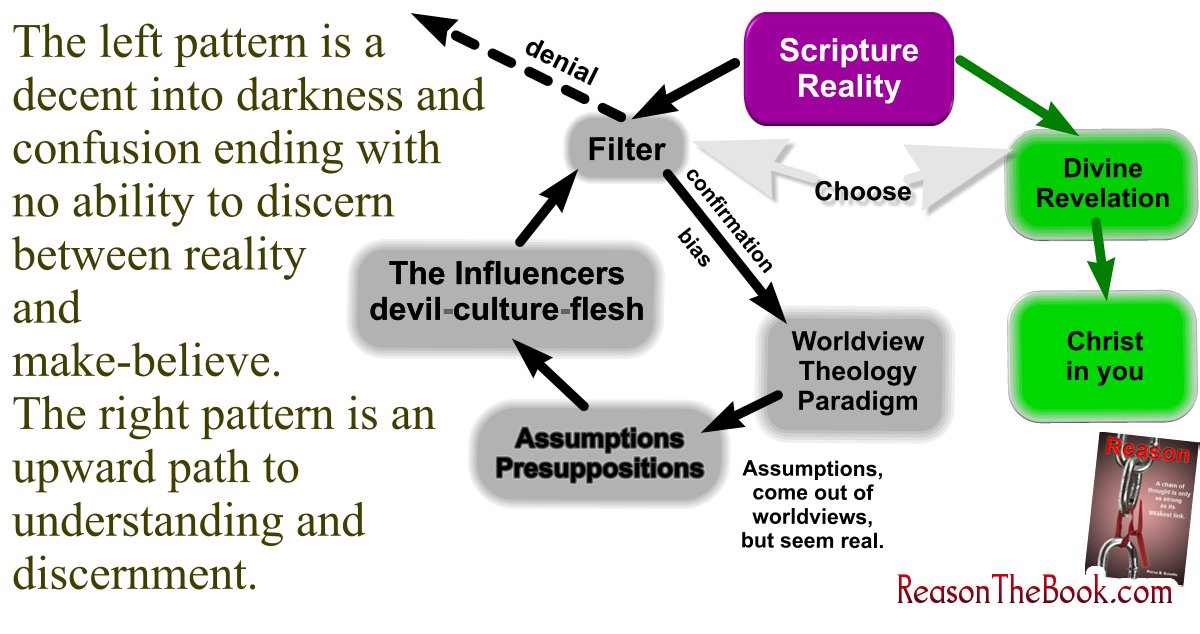
Funny how Evolutionists accuse those who follow Christ of blindly believing what can’t be proven when all they are doing is projecting their own problem onto those who don’t have the problem at all. In reality, the stories of Evolutionism can’t be proven while Creation is obvious. The stories of Evolutionism are all based on assumptions. Assumptions are pulled from worldviews. Worldviews are created by previous interpretations of things taught, things experienced, and things observed. Those interpretations are based on assumptions that are based on worldviews.

The fact of Creation isn’t given this way. It’s given by revelation. God reveals it through Scripture. God reveals it through Creation itself. Everyone, at some point, is confronted by God concerning this fact. Those who refuse to acknowledge Him and thank Him, He turns over to their own reprobate minds so that they do things that they know will result in judgment from God. The unrighteousness they do has an effect. It suppresses God’s truth and those unthankful and willingly ignorant people lose the ability to tell the difference between reality (what God reveals) and make-believe (what comes from human minds or demons).

Some say that Divine revelation requires interpretation by the fallen human mind. This isn’t true. In fact, it’s a tu quoque fallacy on the part of those who lean on their own understandings rather than trusting God. They suddenly realize that they know nothing and then want to accuse you of knowing nothing as well.

If the fallen human mind interprets Divine revelation, it always adds to it or diminishes what God is saying. What God says is enough. Humans have no source to self-generate the knowledge that would be required to interpret any experience, observation, Scripture passage, or revelation. That means that human interpretation is also human speculation. Speculation is just making stuff up.

When we stand in the Presence of God, He reveals Scripture. He reveals the meaning and purpose of life. He reveals right and wrong. What He says is enough.

Faith comes as we hear God. The Greek word, “rhema,” is used in Scripture. “Rhema” means utterance. God speaks. We hear. Faith comes. This faith isn’t conceptual. Theories and theologies are concepts only. Concepts are not reality. Faith is reality from God. It’s substance, that is, reality as opposed to concepts and opinions. It’s the substance of things hoped for. And, it’s also the only evidence that gives absolute proof and certainty. It’s the evidence of things not seen. (Romans 10:17, Hebrews 11:1)

As with all important words, Satan tries to blur the difference between reality and make-believe by redefining the word, “faith.” Some people use the word, “faith,” to mean “making themselves believe in something.” That would be make-believe. Rather than the conviction, certainty, and absolute proof, and reality that comes from God, Satan uses the word, “faith,” to label a human-generated ability to believe in things that aren’t true. Even many Christians are confused by this. Faith comes by hearing God’s Utterance. No one can self-generate God’s Utterance. Demons and flesh both try to imitate this absolute authority, but the Holy Spirit gives discernment.

The more we yield to Him and stand in submission in His Presence, the more we’re able to discern between His Mind and human minds and demonic minds. The more we walk in our own wills, the less we can know. The more spiritual we become, the better we can tell the difference between reality and make-believe. The more fleshly we become and the more we lean on our own understandings, the less we can tell the difference between reality and make-believe.

Facebooktwitterredditpinterestlinkedintumblrmail

The Fruit of the Spirit

TheFruitOfTheSpirit

Why do humans want to try to self-generate those things that are freely given by God through Christ? God says that it’s because they love darkness rather than light. He says that they refuse to thank Him, glorify Him, or even acknowledge Him. Eventually, they become so calloused against Him that they are past any ability to hear His Voice, see His Face, feel His Touch, taste His Sweetness, or smell His Aroma. They have become separated from Him.

The book, “Reason,” while it uses a debate between Ken Ham (Christian) and Bill Nye (Non-Christian) as a backdrop, is really about choosing to accept God’s good gifts. It’s about submission to the Holy Spirit. It’s about allowing God to lead and guide. It’s about receiving His Knowledge, Wisdom, and Understanding. It’s about listening to His Voice so that Faith comes, giving certainty of knowledge rather than guesses and made-up stuff.

It has always been popular to believe that humans could self-generate love, joy, peace, patience, gentleness, goodness, meekness, faith, and self-control. In reality, humans can only generate counterfeits of these. The human mind, and demonic entities, are able to counterfeit any of the good things that only come from God. Consider righteousness. Only God is good. He imparts His gift of righteousness to anyone willing to receive it. Yet, so many people try to generate their own righteousness. They end up being self-righteous and proud. Think about knowledge, wisdom, and understanding. All of these come from God. None of them can be received from God without deep, sincere respect from God. Those who are rebellious toward God persist in trying to self-generate knowledge, wisdom, and understanding. They are able to generate some pretty convincing counterfeits and to deceive many people. However, there isn’t any way for human beings to self-generate knowledge. Even Secularists know that they can never have certainty about anything without Divine revelation. However, they then make the insane, dogmatic assertion, based on made-up stuff, that God doesn’t reveal anything to anyone. Since they don’t have any hope of ever having certainty about anything, why are Secularists so dogmatic about this assertion? Because they have decided not to receive God’s goodness. They have submitted themselves to the spirit of Antichrist.

Some Christians also block the mercy and grace of God by trying to self-generate love, joy, peace, patience, gentleness, goodness, meekness, faith, and self-control. They try to self-generate wisdom, knowledge, and understanding. These wonderful things that come to us as we stand in the Presence of the Holy One are not available to those who try to be double-minded. The self-generated counterfeits can never fulfill or bring satisfaction. Yet, every person who seeks Christ finds Christ. Every person who is willing to abide in Christ, seek Him, spend time in His Presence in submission to Him, is given all these wonderful things. They are imparted by God. These are the things that change the person into the Image of Jesus Christ. It’s not enough to want to be like Jesus. We need to lay down our own efforts and allow Him to think His Thoughts, speak His Words, and do His Acts through us with Power for His Righteousness, which leads to Holiness.

In every situation, you and I are faced with the choice of yielding to self-will or God’s will. Why not let yourself go into the wonderful gifts of God and just allow His love, joy, peace, patience, gentleness, goodness, meekness, faith, self-control, wisdom, knowledge, and understanding to flow through you?

Facebooktwitterredditpinterestlinkedintumblrmail

Certainty

EverHigher71

A common misconception of the definition of “faith” is that it’s blind belief for no reason. Faith isn’t rationalized, but without it, sound reasoning is impossible. That may seem to be a bold statement, but read on to understand.

Rationalization is a mental process by which insane thinking is made to appear sane. It gives the illusion of sound reasoning when the reasoning is irrational. Rationalization works using two methods: axiomatic thinking and smokescreens.

The first method is axiomatic thinking, simply making stuff up. Assumptions are merely fabrications that were made up and then treated as if they were part of reality. Unsupported assertions are concepts that are claimed true when there’s no certainty that they’re true. Axioms are unsupported assertions that are claimed true just because they’re claimed true. Lies are claims that aren’t true. Assumptions are lies in that they pretend the assumption is known when the assumption is, in fact, not known. It’s a lie to imply that an assumption is true. All assumptions are unknown. All of these fallacies fall under the heading of axiomatic thinking fallacies. On one or both sides of every debate, you will find axiomatic thinking.

The second method of rationalization is to try to make the made-up stuff seem to be real. It’s the art of making fake things look real. There are many methods that are used to do this. Some of them are simple and others are very complex. Usually, several methods are nested together, so these methods become very confusing and deceiving. Examples would include statistical tricks, circular reasoning, infinite regression, equivocation, ad hominem thinking, and appeals to human authorities, popularity, fear, emotion, ridicule, or any other thing that gives the illusion that the made-up stuff is true. Hundreds of logical fallacies are used as smokescreens to hide axiomatic thinking fallacies.

Those are the two elements of rationalization: axiomatic thinking and smokescreens. Rationalization is making believe. Whenever we rationalize, and we all do it sometimes, we lose the ability to tell the difference between reality and make-believe for that time and situation. We lose the ability to tell the difference between substance and concept. We lose the ability to tell the difference between what exists and what is theory. Scientific theories are concepts. Some scientists become so irrational that they claim that scientific theories are facts. They do this by rationalization.

When God speaks to us about faith, He isn’t talking about rationalization. Rationalized belief is worthless.

We don’t make ourselves believe in God. That would be make-believe. We don’t believe in spite of the evidence. God has revealed that the faith is the evidence, and the word, “evidence,” in this sense, means absolute certainty and absolute proof.

Now faith is the substance (as opposed to concept) of things hoped for, the evidence (absolutely certain proof) of things not seen. (Hebrews 11:1)

Consider the nature of sound reasoning. Sound logic requires proof. The proof must prove what is claimed. The conclusion is what is claimed. The premise is the proof. The premise must be true.

How do you prove a premise true?

Do you declare it to be an axiom? That’s the axiomatic fallacy. Do you try to prove it with another premise that you can’t prove? That’s the infinite regression fallacy. Do you use circular reasoning? That’s a fallacy, and it proves nothing. There’s only one way to have a true premise.

When God reveals something, then it’s known. It’s true. God reveals things through Scripture, through Creation, and through the moving of the Holy Spirit. God reveals, but we need to acknowledge Him. He does reveal things even to those who refuse to acknowledge Him. Otherwise, all Secularists and Naturalistic Christians would die quite quickly. He supplies what they need to live so that they will have a chance to turn to Him and find Him.

Every person who is actually following Christ is led and taught by the Holy Spirit moment by moment. There are no exceptions to this. They see His Hand working in the Creation. They see His Hand working in others who are following Christ. They hear His Voice in Scripture, in Creation, in their innermost awareness of His Presence, and in any other person who’s speaking by the Holy Spirit. They are learning to hear Him more clearly and to discern between His Voice and every other Voice. As they walk in His Presence and see His glory, they are being changed into the same image from glory to glory by the Spirit of the Lord. They are dying to the flesh and being formed into the new Man. Christ is living in them and becoming stronger and more fully formed. The flesh is losing its hold on them, and the deceptive carnal mind is losing its grip. God has provided an arsenal of weapons for Christ’s followers to make it possible for everyone who is willing to eventually come to the measure of the stature of the fullness of Christ. What a day that will be!

Secularists and Naturalists, on the other hand, have no way to know the difference between what they make up and what God reveals. Within their worldview, they refuse to acknowledge God as He reveals Himself and His truth to them. They take some of the practical knowledge that God gives them, but they claim that it’s conceptual, just like all the things they make up. They reject much of the truth that God gives. Eventually, God turns them over to their own reprobate minds. Their own reprobate minds destroy them. They can’t tell the difference between reality and make-believe. The axiomatic thinking of the Secularist or Naturalist can’t be proven. Axiomatic thinking is the means by which the Secularist or Naturalist interprets his or her observations or experiences (experiments). No Secularist or Naturalist can have certainty that his or her assumptions, unsupported assertions, or axioms are true. However, any Secularist or Naturalist can confirm God. Any one of them can seek God in sincerity and respect and come to know Him through Jesus Christ. All such people need do is confess that they haven’t properly respected God, obeyed Him, or acknowledged Him, and ask Jesus Christ to forgive them and reveal His will and His Person, while willingly submitting themselves to the leadership and rule of Christ. You can see the contrast, can’t you? One can be confirmed. All who seek Him find Him. The other can never be confirmed.

Unfortunately, if we, as Christians lean on our own minds to understand rather than acknowledging the presence and leading of God, we can’t tell the difference between reality and make-believe either. We would no longer be walking by faith but we would be walking by human opinion and interpretation of observation, experience, and philosophy. This happens.

Faith comes by hearing and hearing by the word of God. Some theologians have assumed that “the word of God” is the same as “the Bible.” However, that isn’t what’s written. If we go into the original language, we find no “the.” We find the Greek word, “rhema,” which means “Utterance.” So, this verse literally says that faith comes by hearing and hearing comes by Utterance of God. God speaks through the Bible. Through the Bible, God says that He also speaks many other ways, and all those ways will be consistent with what He is saying through the Bible.

Interpreting Scripture using assumptions is no better than interpreting Creation using assumptions. When scientists lean on human understanding rather than God, they interpret their observations and experiences (experiments) through the filter of their various worldviews. Often, a groupthink worldview is applied among an entire group of scientists. When this happens, the Holy Spirit won’t force Himself on them. They make up all kinds of stories that later must be changed. The same thing happens among theologians. A great leader and popular theologian can cause problems for generations that follow their speculations.

However, in Christ, we have a sure Leader. We have One Whom we can trust. If we all keep seeking Him and His righteousness, we will be found faithful. He will restore the order of the Body of Christ. He will restore the authority and the power. He will restore the Scriptural offices, ministries, and gifts. Despise not the day of small beginnings. God is now working throughout the Earth.

God speaks. He leads. He teaches. We acknowledge and faith comes. We don’t make-believe that God exists. We hear His Voice. We respond with respect and submission. Faith give us access to grace. Grace does God’s Works through us. We can actually become His Hand extended, reaching out to the oppressed.

Facebooktwitterredditpinterestlinkedintumblrmail

Couldn’t You be Deceived?

Intellect Worship

The human mind wants control. It brings arguments against Divine revelation. The argument is that you could be deceived if you look to God for Divine revelation. The reality is that there are only two alternatives to Divine revelation. One alternative is the fallen human mind, one’s own or other’s, that is deceitful and desperately wicked. The other alternative is demonic deception. The two alternatives to Divine revelation assure deception. Yet, the problem of Divine revelation is indeed discerning the difference between Divine revelation and these other sources. Both of these sources try to mimic Divine revelation or else to denigrate it.

Regarding Divine revelation, here are some of the arguments that are used by Secularists:

  • Your own mind could be deceiving you.
  • A demon could be deceiving you.
  • You must process that Divine revelation using your own mind. You don’t get it directly.

As far as demons, they are real and they are deceptive—as is the human mind. For that reason, demons and the failings of human intellect are really the same problem. In fact, if Divine revelation depended on human intellect, we would indeed be lost. There would be no scientific progress, because there could be no knowledge at all. However, discernment is not a matter of intellect. It’s the matter of the sovereign impartation of something that is called “faith” to those who acknowledge God when He’s speaking.

To clarify, God defines “faith” for us. It is not conceptual. It’s part of reality. It’s absolute proof. It’s certainty. It is progressive. It gives access into God’s grace, which is the power of God for righteousness. Grace is the free gift of righteousness.

For these reasons, Neither Münchausen’s trilemma nor Descartes’ demon present a problem for Divine revelation. They do present a problem for theological positions that add anything to what God is saying. It’s very easy to make assumptions. Assumptions are often hidden with various smokescreens. Münchausen’s trilemma and Descartes’ demon do present a problem for all Secularists. In fact, as skeptics argue for disbelieving everything or disbelieving God, the skeptic falls prey to both the trilemma and the demon.

A chain of thought is only as strong as its weakest link. An assumption is an unknown that’s treated as a known. Assumptions have no place in a premise. To put them there is irrational.

Divine revelation is ongoing and progressive. God has revealed that if any person thinks he or she knows anything, that person doesn’t know it as it ought to be known. In other words, there is room for correction by the Holy Spirit. The entire issue of Divine revelation isn’t to prove one person right and another person wrong. Divine revelation has much more to do with having a relationship with God than being the one who is correct. In that relationship and in the humility and openness to correction of the human, the Holy Spirit with teach, correct, and lead.

As far as deception is concerned, we can all be deceived. God has promised that if we ask for bread (a type of Christ), God won’t give us a stone (a type of the human intellect). If we ask for a fish (a type of Christ), He won’t give us a serpent (a type of Satan). Yet, we do get confused. If we continue to seek God, He will lead and correct us. When we think that we’ve arrived or we think that we know certain things, we stop seeking Him. We become stiff necked and dogmatic. The Holy Spirit won’t force Himself on anyone, so we get spiritually stuck. We know many things, but we don’t know any of them as we ought. We need to be open to correction.

Facebooktwitterredditpinterestlinkedintumblrmail

God Speaks Many Ways

GodSpeaks

Rationalism is make-believe. The human mind can’t really self-generate knowledge without the benefit of observation or Divine revelation. There’s a difference between reality and make-believe. Rationalizing blurs the difference.

When looking at things in the present, there are two ways to try to know how they got the way that they are. One is rationalism. The other is Divine revelation. Rationalism can go anywhere. Divine revelation is restricted to what God is saying. Faith (certainty of belief) comes by hearing and hearing by the rhema of God. “Rhema” is a Greek word that means “utterance.” God speaks through Scripture and through every means mentioned in Scripture. Our part is to acknowledge Him. When He speaks, certainty comes regarding whatever He said. As soon as we add anything to what God said or take anything from what God said, we are rationalizing, and our thoughts are based on vapor.

Soon to be released: “Reason,” a book about the basis of thought and how to be rational.

Facebooktwitterredditpinterestlinkedintumblrmail

Righteousness to Holiness

RighteousnessToHoliness

“Just as you used to offer yourselves as slaves to impurity and to ever-increasing wickedness, so now offer yourselves as slaves to righteousness leading to holiness.” Romans 6:19b This is how it works. “whatsoever is not of faith is sin” Romans 14:23b “Dear children, do not let anyone lead you astray. The one who does what is right is righteous” 1 John 3:7a “But by the grace of God I am what I am, and his grace to me was not without effect. No, I worked harder than all of them–yet not I, but the grace of God that was with me.” 1 Corinthians 15;10 “gained access by faith into this grace in which we now stand.” (Romans 5:2 in part) “So then faith cometh by hearing, and hearing by the word (literally, utterance) of God.” Romans 10:17 “My sheep listen to my voice; I know them, and they follow me.” John 10:27

GodSpeaks-Faith-Righteousness-Holiness

Facebooktwitterredditpinterestlinkedintumblrmail

False Objectivity

Christians and unbelievers alike often are deceived into thinking that they can be objective. It’s known as the ontic fallacy. Often, Christians state theological views and declare them to be Scripture. Often, scientists state theological or philosophical views and declare them to be scientific observations or evidence. They are not. They are interpretations. Interpretations add information to what can be known. God speaks through Scripture and through His Creation. Assumptions always add to His Words. Human interpretations always add to His Words.
 
Anyone who’s concerned about reality should realize that nothing can be known if it’s dependent on even a single assumption. In fact, if you allow yourself even one assumption, you can prove anything to yourself.
 
Knowledge of reality requires a true premise. Without Divine revelation, how can you know that a premise is true? With another premise? How can you know that premise is true? It isn’t rational to keep making up premises that need other premises that remain unknown. Yet, that’s what people do. Then, they claim that they’ve proved something or done science.
 
Knowing reality requires a true premise, but you can’t possibly have a true premise without Divine revelation. Now, the skeptic will claim to have infinite knowledge by making the bare assertion that Divine revelation isn’t known either. By doing this, the skeptic is claiming to know the inner spiritual experience of every person who has ever lived. That’s an amazing claim.
 
Every person who follows Christ is led and taught by Christ. While we are still learning to discern His Voice from all the other voices in the world, including the voice of the self, we are making progress in those things where we respond in submission to the Holy Spirit. Without this, there would be no hope of ever knowing the difference between reality and make-believe. A rational person wants to know the difference between reality and make-believe. A rational person realizes that assumptions can never be a basis for knowing.
Facebooktwitterredditpinterestlinkedintumblrmail

Let God Reveal Reality


LetGodBringScriptureToLife470God speaks. He progressively reveals Himself and His will. Let God bring Scripture to life and tear down all theological constructs, replacing them with actual vision of reality.

Facebooktwitterredditpinterestlinkedintumblrmail