Human Pride

(quote from RealReality.org/Real_Faith_and_Reason_Vol_2_-_Scientia.pdf)

Since assumptions go beyond knowledge, we assume what we can’t know. We can make those assumptions anything we want them to be, so they’re a good basis for wishful thinking but not for finding truth. Consequently, if we allow even a single assumption in our thinking, we can “prove” anything to ourselves. So if we want to pretend to know what we don’t know, assumptions supply what we need. Often, our pride directs us to seek our own minds rather than God’s mind. Human pride insists the human mind is trustworthy. However, insisting the human mind is trustworthy denies what God says about the human mind. Perhaps everyone is guilty of putting too much confidence in human ideas and too little confidence in God at times. We must remember what God says. God says the desperately wicked human mind deceives, and we shouldn’t trust it.

(end quote)

Facebooktwitterredditpinterestlinkedintumblrmail

No One Needs Assumptions

(quote from RealReality.org/Real_Faith_and_Reason_Vol_2_-_Scientia.pdf)

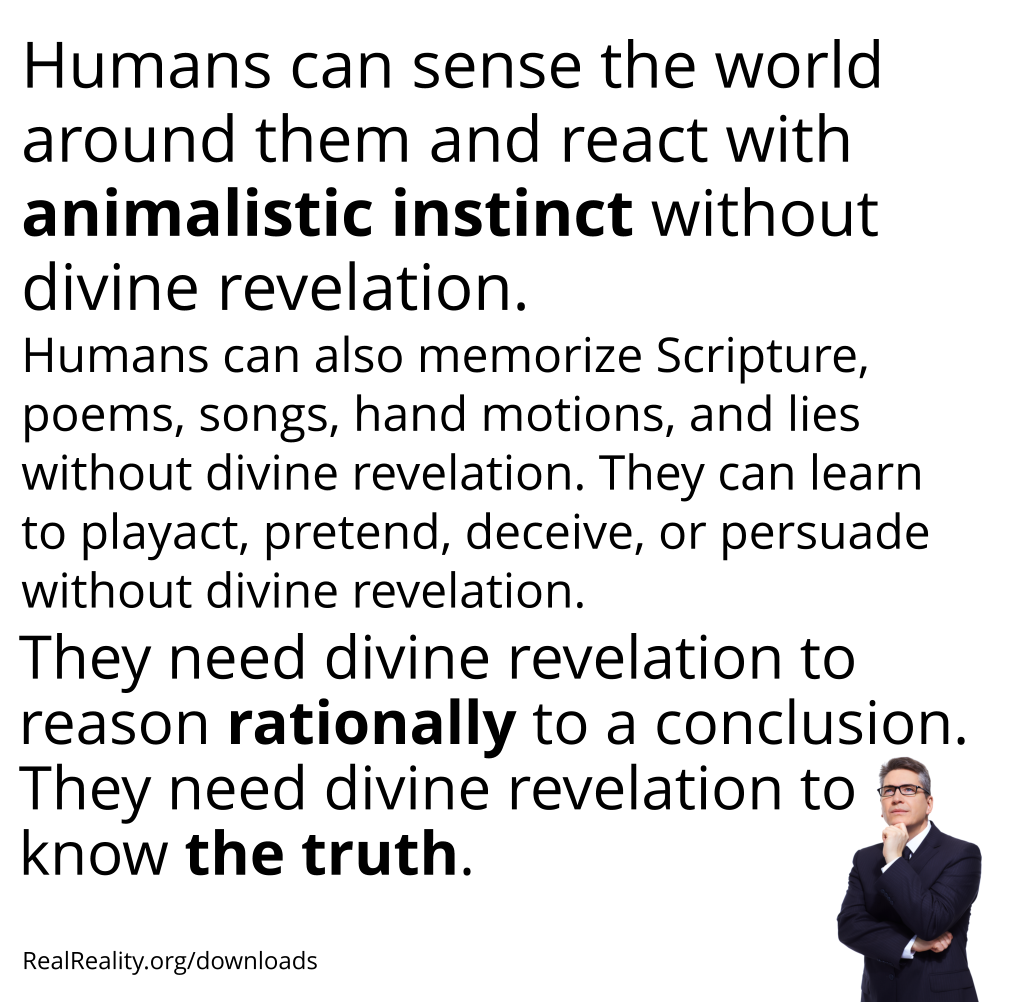
But as we’ve already discovered, no one needs assumptions since assumptions imagine beyond what we know. So it becomes clear that if we build reason on assumption, we build on sand. And the house built on sand will fall when the storms come. Rather than assumptions, we can get to know Jesus Christ. We can depend on divine revelation for all the reasoning the intellectuals tell us about. Then we don’t presuppose or assume. We can stop adding to God’s words. We can stop diminishing God’s words. We can stop making up stories to our own liking. Then we can be rational.

(end quote)

Facebooktwitterredditpinterestlinkedintumblrmail

How Can We Know?

(quote from RealReality.org/Real_Faith_and_Reason_Vol_2_-_Scientia.pdf)

Some people truly believe making up stuff is the only way to know truth. How do they prove it to themselves? They use made-up stuff to prove it to themselves. Since they believe making up stuff is proof, they see nothing wrong with using made-up stuff as proof that made-up stuff can be proof. In other words, they tell a story. In their story, they say we must base all knowledge on made-up stuff. Then, they use their story to prove their story is true, which is a circular-reasoning fallacy.

(end quote)

Facebooktwitterredditpinterestlinkedintumblrmail

Why Do Christians Build on Made-Up Stuff?

(quote from RealReality.org/Real_Faith_and_Reason_Vol_2_-_Scientia.pdf)

We’ve looked at two secular quotes where we would expect to see them eliminating God and suggesting godless reasoning. Now let’s look at some quotes from the Christian community:

“But if the apologist presents an argument that does not presuppose the truths of scripture, how can he be faithful to his Lord? And how can he produce an intelligible argument unless he presupposes those conditions that are necessary for intelligibility?” ~ John Frame

“Second, no system can escape circularity because all systems – non-Christian as well as Christian are based on presuppositions that control their epistemologies, argumentation and use of evidence.” ~ John Frame

“Being a science, theology has one more characteristic in common with the other sciences: it is based on presuppositions that it itself cannot prove.” ~ Tom Greggs, Rachel Muers, Simeon Zahl, Theology as a Vocation

“Christian handling of evidence must always start from Christian presuppositions about the framework of interpretation for that evidence.” ~ David Gibson

“Defending the biblical worldview means pointing out that all of us argue from a non-neutral starting point. None of us is objective. The facts are interpreted in terms of our belief patterns, our presuppositions. The Christian is not given an option of arguing from a supposed neutral starting point. If he begins with the assumption that God’s Word is not true, then he adopts the worldview assumptions of unbelievers and is a fool, biblically speaking. And that’s the worst kind.” ~ American Vision

“When we Christians make arguments for God, we presuppose that he exists. We also presuppose that the Bible is truly the word of God. The existence of God and the inerrancy and infallibility of the Bible are touchstone truths for the Christian. They are foundational truths from which we can argue, though we can’t prove them beyond the shadow of a doubt.” ~ Brian Watson

Did you notice Who is missing from all these quotes by Christian intellectuals? God is missing. The Father is missing. Jesus Christ is missing. The Holy Spirit is missing. Without God, we would all be stuck. We would base all our thinking on made-up stuff. We can presuppose our made-up stuff, suppose our made-up stuff, assume our made-up stuff, or do whatever we like with our made-up stuff, but it’s still made-up stuff. God hid all Truth in Christ Jesus. God hid all knowledge in Him.

As we’ve seen, many secular intellectuals believe making up stuff is the only way to know anything. They find convincing ways to say it. They don’t use the term “made-up stuff.” However, we’re using this term so we don’t deceive ourselves. However, many Christians also believe in the power of made-up stuff, and it’s a dogmatic belief. Both secularists and Christians believe it.

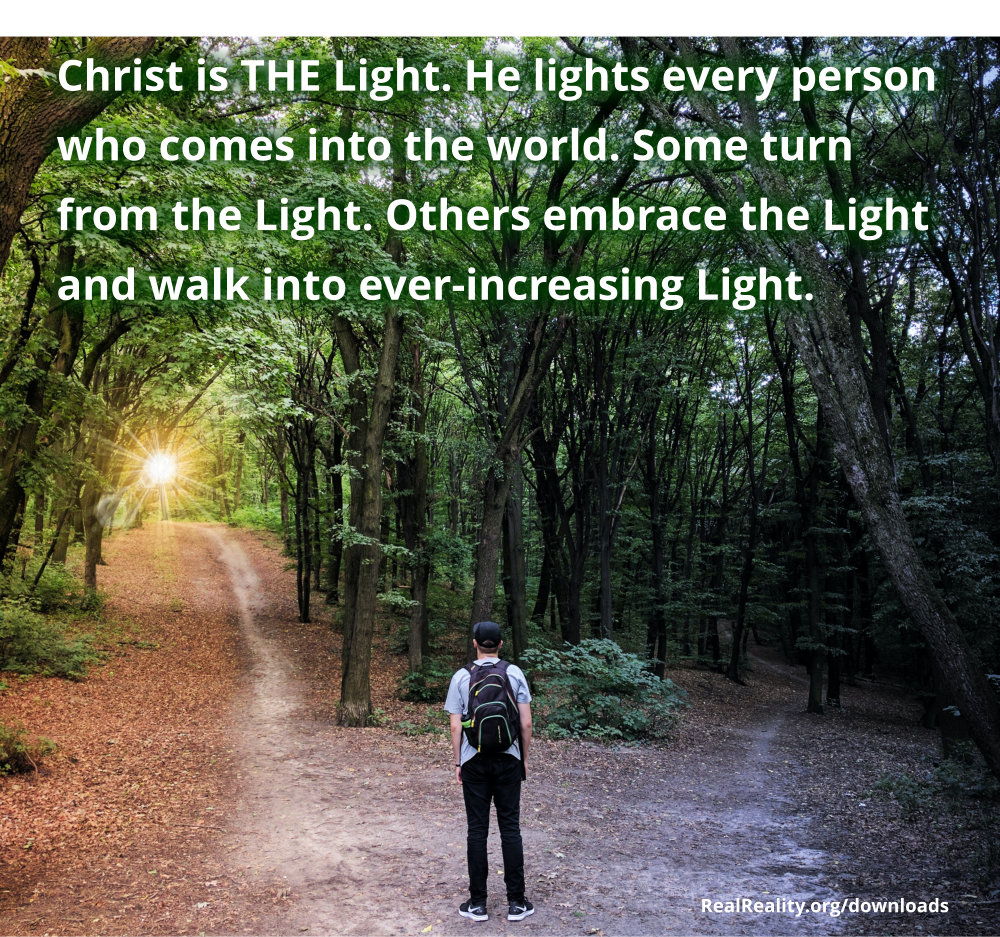
The naturalistic world brainwashes Christians into becoming functional atheists. However, it’s possible the intellectuals we quoted don’t really believe they have to base every thought on presupposition. We pray they all know Jesus Christ in a real way. We pray they’re aware and thankful they enjoy the Light of the world Who Lights every person who comes into the world.

(end quote)

Facebooktwitterredditpinterestlinkedintumblrmail

THE BIG LIE

(quote from RealReality.org/Real_Faith_and_Reason_Vol_2_-_Scientia.pdf)

“Science, like art, religion, commerce, warfare, and even sleep, is based on presuppositions.” ~ Gregory Bateson

Gregory is making a claim. He claims everything is based on presuppositions. He offers no proof. His claim is a bare claim based on a presupposition. It’s an axiomatic-thinking fallacy. He gives no other alternative. Why? What about divine revelation? Divine revelation is excluded. Why? Divine revelation is presupposed out of existence.

(end quote)

Facebooktwitterredditpinterestlinkedintumblrmail

How Can We Know?

(quote from RealReality.org/Real_Faith_and_Reason_Vol_2_-_Scientia.pdf)

“It was already clear to Aristotle that all our reasoning must be based on assumptions, and that therefore we have to start with some assumption(s) that cannot themselves (at that point) be explained or entailed by yet other assumptions.

To call these assumptions that are necessary to base any conclusion upon ‘intuitive knowledge’ seems to involve a rather self-congratulatory account of human capacities. That is: Why style it ‘knowledge’ if it is clear that often it is at best some guess based on some particular evidence?

And in any case, a philosopher should be aware that most assumptions men have framed to account for their commonsense experiences have been refuted in the course of time, for which reasons it seems better to avoid the term ‘knowledge’ in the present context, and to stick to ‘belief’ or ‘guess’.” ~ Maarten Maartensz


It seems Maartensz is questioning the validity of thought based on assumptions, yet he offers no alternative. Perhaps he didn’t know Jesus Christ. Many people don’t follow Jesus. They don’t even know He’s willing and able to lead them and teach them. They walk in a dense fog. They follow a mirage. Atheists don’t know, but many Christians also don’t know.

(end quote)

Facebooktwitterredditpinterestlinkedintumblrmail

Can We Think Rational Thoughts?

(quote from RealReality.org/Real_Faith_and_Reason_Vol_2_-_Scientia.pdf)

We walk by the faith that comes when we hear the rhema (utterance) of God, but some people feel certain they must base all thinking on made-up stuff. Here’s a typical example of a statement from someone who’s convinced all reason must begin with assumptions.

“All reasoning is based on assumptions. All reasoning is done from some point of view. All reasoning is based on data, information, and evidence.” ~ Richard Paul and Linda Elder, The Analysis and Assessment of Thinking

We immediately notice this quote mentions three items.

  • assumption
  • point of view
  • data, information, and evidence

Is all reasoning based on assumptions? Must we always reason from some point of view? Must we always base our reason on our worldviews? If the answer to either of those two questions is “yes,” then no reasoning is based on truth, no reasoning is sound, and knowledge is impossible. Only opinions and manipulation exist if we must base all reasoning on assumptions or some point of view.

What makes the authors of The Analysis and Assessment of Thinking believe “all reasoning is based on assumptions?” What makes them think “all reasoning is done from some point of view?” They base both claims on assumptions. They assume all reasoning is based on assumption. They assume no reasoning is based on divine revelation.

We also notice the quote doesn’t define the terms, “data,” “information,” and “evidence.” Nor does this quote suggest where the data and information come from or how we know it’s accurate. The words “data,” “information,” and “evidence” often mean interpretations riddled with opinion and bias.

(end quote)

Facebooktwitterredditpinterestlinkedintumblrmail

We Experience God’s Leading

(quote from RealReality.org/Real_Faith_and_Reason_Vol_2_-_Scientia.pdf)

False Claim: All Reason Must begin with Assumptions

We’ve answered this claim, but we bring it up again because many persuaders say we must base all reasoning on assumptions. As we consider this claim, we understand axioms and presuppositions are types of assumptions, but we don’t believe all reasoning must begin with assumptions. Instead, we believe God is real rather than merely conceptual. We believe God is real because we know Him through Christ. We constantly experience the Holy Spirit leading, teaching, and correcting us moment by moment. As far as alternatives, we don’t know of any way other than either divine revelation or made-up stuff on which to base our reasoning. We base all reasoning on either assumptions or divine revelation.

(end quote)

Facebooktwitterredditpinterestlinkedintumblrmail

Nesting Presuppositions

(quote from RealReality.org/Real_Faith_and_Reason_Vol_2_-_Scientia.pdf)

Not surprisingly, it’s common for irrational people to use presuppositions for persuasion. They can often deceive us this way. Consider the following from a discussion group:

“I don’t know why young-earth creationists refuse to see the obvious evidence that God created the world using billions of years and evolution.”

This persuader nested six presuppositions in one sentence. The persuader used the words “know,” “why,” “refuse,” “see,” and “obvious.” What’s the claim the persuader is presupposing? The persuader is presupposing God created the world using billions of years and evolution. The so-called evidence is phantom evidence, and the persuader used the word “evidence” to presuppose billions of years and molecules-to-humanity evolution. If we answer this persuader completely, we have to refute six presuppositions before we deal with the claim.

(end quote)

Facebooktwitterredditpinterestlinkedintumblrmail