I’m posting this conversation because it’s an excellent example of the convoluted and deceptive reasoning that comes from the fallen human mind. Those who are familiar with my blog are aware that the human mind has no way to self-generate truth. It can’t conjure up truth without a source for truth. It can react to its environment in the same way that an earthworm can react to its environment or a raccoon can react to its environment. It can’t find a way to reason to a conclusion beyond that environment. For instance, it can do science, which is always pragmatic and practical. It can’t reason rationally about right, wrong, the nature of knowledge, spiritual matters, or the nature of reality. It can’t even prove the existence of a real world. God, on the other hand, reveals right, wrong, the nature of knowledge, spiritual matters, the nature of reality, and the fact that the world around us is real.
The most irrational arguments are the hardest to refute. The refutation tends to become long and hard to follow because of the irrationality of the original argument. Here’s the conversation, but we’ll stop once in a while for critical thinking:
Rockbuilder: Ungodly thinking can’t possibly produce a rational thought that leads to a true conclusion. The problem of infinite regression prevents ungodly thinking from having a true premise. Without a true premise, rational thought is impossible. Only divine revelation can provide a true premise.
Sandbuilder: You don’t need God to have rational thought. Even if a supreme being were necessary, Brahman could easily be the ground for it instead of God. So your last statement is a bare assertion unless you’re using “divine” loosely to allow for any supreme being.
CRITICAL THINKING ****************
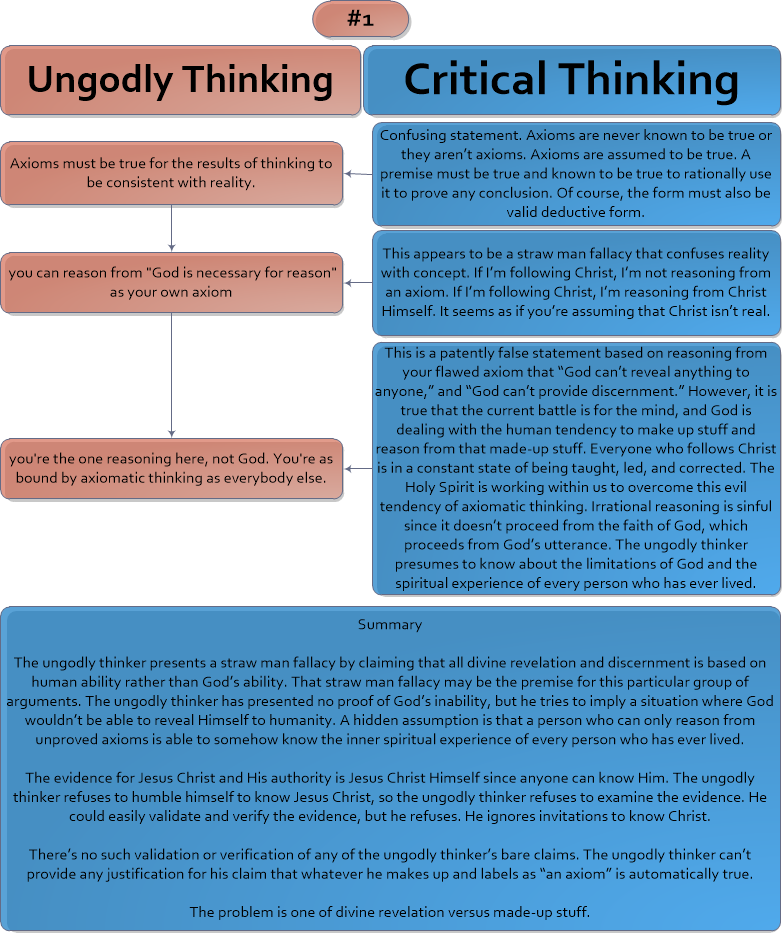
Sandbuilder said, “Brahman could easily be the ground for it instead of God.” Sandbuilder just claimed that a demon is just as credible as God. This statement is patently false. Demons lie, but God can’t lie. The most important thing to know is the source of Sandbuilder’s claim. He made it up. It’s an axiomatic thinking fallacy. As we’ll see, Sandbuilder thinks it makes sense to use axiomatic thinking fallacies as the basis of reasoning. The reason that axiomatic thinking is a fallacy is that axiomatic thinking in making up stuff and then calling the made-up stuff “true.” That’s the definition of insanity.
*********************************
Sandbuilder: Divine revelation is a red herring. Even if we grant that a divine revelation could provide a true premise, which already is a shaky precept, it is impossible for a fallible human to know that any given experience of divine revelation is not a case of self-deception. If you cannot tell a genuine divine revelation from a fake, you have no argument.
CRITICAL THINKING ****************
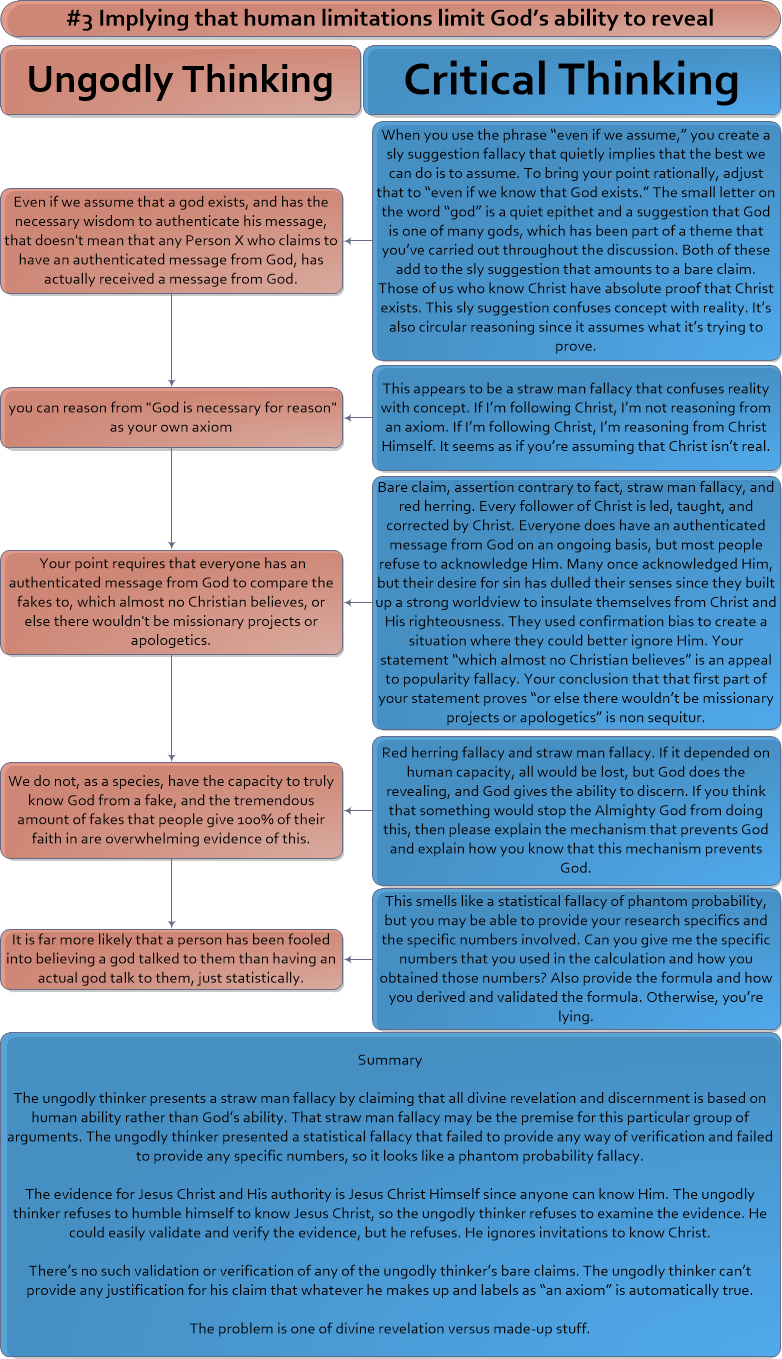
Sandbuilder said that it’s a shaky precept to say that divine revelation could provide a true premise. This is another axiomatic thinking fallacy that claims god-like omniscience. Sandbuilder is claiming that God can’t reveal knowledge. What would prevent God from doing so?
Sandbuilder said, “It is impossible for a fallible human to know that any given experience of divine revelation is not a case of self-deception.” Here is Sandbuilder, who has no way to self-generate a true premise to prove any conclusion, but now he claims to know that God can’t reveal in a way that those who follow Him know that God is God and know the difference between God’s voice and their own human minds. Satan says that you can’t know. Satan says, “Hath God said?” He said that to Eve in the Garden of Eden.
*********************************
Rockbuilder: Making unsupported assertions like you just did is irrational.
Sandbuilder: Can someone receive divine revelation, but in reality be deceived?
If your answer is yes, then my point is valid.
If your answer is no, then that means all claims of revelation are true, even those from different and mutually exclusive gods.
If your answer is “For everyone except me and my god” you need to demonstrate this before you can use it as a foundation.
So you’re in the same boat as the atheists, you’re just lying to yourself about it.
CRITICAL THINKING ****************
We’ll start with Sandbuilder’s conclusion since it’s the crux of his problem. “So you’re in the same boat as the atheists.” Sandbuilder is committing a classic tu quoque fallacy stated very plainly. Tu quoque means “You too.” The reason that a tu quoque fallacy is a fallacy is that it doesn’t solve the original problem, but it’s an admission that the original problem is real. The original problem is that there is no way rationally to come to any conclusion without divine revelation. Sandbuilder just admitted that, but he said, “You too have the same problem since no one anywhere can rationally come to any conclusion.”
Why is that a problem? Sandbuilder didn’t solve his first problem, which is that he can’t come to a rational conclusion about anything because he can’t have a true premise. He believes that an axiom is enough, but axioms consist of made-up stuff. But it’s irrational to say, “I made us X, and that proves Y.” Made-up stuff can’t prove anything. Sandbuilder still has this problem. He admits it. He says, “You too have the same problem because I conclude that the Almighty God is incapable of communication in a meaningful way.”
Therefore, Sandbuilder is admitting that any conclusion is irrational, but yet he thinks that his conclusion about the limitation of Jesus Christ is rational. His conclusion that says, “Almighty God is incapable of communicating in a meaningful way,” is a claim of amazing knowledge of the spiritual realm and the nature of God. For an atheist, that’s an irrational claim. And yet, claiming to have this amazing knowledge, Sandbuilder can’t muster up a true premise for even the most simple conclusion. Of course, looking at the rest of what Sandbuilder wrote bears out his problem with reasoning.
Now, let’s examine Sandbuilder’s conclusion that takes the form of a three-pronged trilemma. We’ll look at each one and show the irrationality of all of them.
Prong #1: Can someone receive divine revelation, but in reality be deceived? If your answer is yes, then my point is valid.
No one can receive divine revelation but in reality, be deceived. He’s presupposing no God. Presupposing is a form of the axiomatic thinking fallacy. Someone can think that he or she is receiving divine revelation and be deceived, but this only happens when the person is deceived by his or her fleshly desires. And we all deceive ourselves at times. However, if we truly desire to do God’s will, He’ll correct us, we’ll receive or correction, and He’ll set us back on the right path. Every person who follows Christ has this experience of divine correction. So, the answer is No, but Sandbuilder is misstating the problem. He’s misstating the problem because he’s imagining the problem using his fallen mind that’s incapable of rational thought. In any case, Sandbuilder’s point isn’t valid.
Prong #2: Can someone receive divine revelation, but in reality be deceived? If your answer is no, then that means all claims of revelation are true, even those from different and mutually exclusive gods. That way absurdity lies.
We’ve touched on this already, but the answer is No. No one can receive divine revelation and be deceived by divine revelation. God deceives no one.
Sandbuilder’s conclusion is totally irrational, although his grammar makes his thought unclear. It is clear that he’s equating everything that humans call “a god” with the Almighty God Who created all things. That’s the type of nonsense that happens when a human being based reason on made-up stuff. Now, idols made of stone, wood, or gold cannot speak. They’re incapable of articulate speech. However, demons are created beings who have also fallen away from God just as mankind has fallen away from God. Demons speak, but they lie. God speaks, but He can’t lie.
Prong #3: Can someone receive divine revelation, but in reality be deceived? If your answer is “For everyone except me and my god” you need to demonstrate this before you can use it as a foundation.
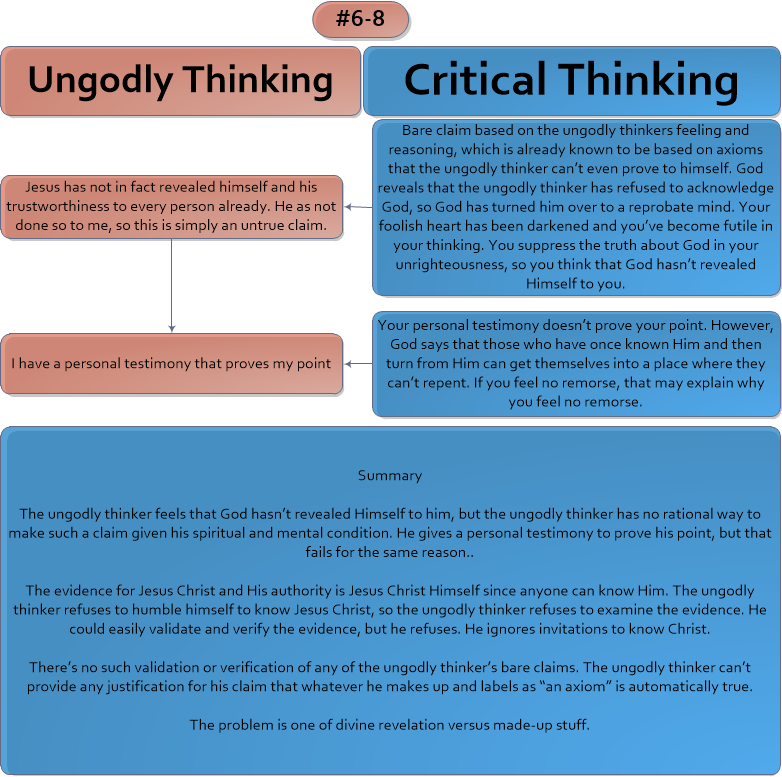
Sandbuilder, like all people, know that Jesus Christ exists, and he knows a lot about Him. Sandbuilder knows this so well that God says that Sandbuilder is without excuse. He knows. He refuses to acknowledge Jesus Christ, the Creator God because Sandbuilder’s deeds are evil. God reveals these facts, and God doesn’t require that we “demonstrate this” to Sandbuilder since Sandbuilder already knows.
That being said, God demonstrates the fact that He can communicate and impart discernment to Rockbuilder, Sandbuilder, and every other person. That’s why Sandbuilder is without excuse. Therefore, Sandbuilder’s proposal is in error, which would be expected since he’s making the whole thing up. He was bound to get it wrong.
Notice that all three of these prongs are misstatements. They are straw man arguments that seek to frame the entire discussion inside of a lie. Someone who knows Christ can be deceived, but not by Christ. Christ is in charge of both divine revelation and discernment, so these aren’t dependent on human ability. If Satan deceives a person who knows Christ, God knows all about that and will lead that person back to Himself providing the Christ-follower sincerely wants to follow Christ. God is not equal to the lesser creatures that He created, and He’s not equal to the imagination of the human mind, but Sandbuilder presupposed that.
Rockbuilder didn’t cast these pearls before Sandbuilder, knowing that Sandbuilder wouldn’t be able to receive them. Instead, Rockbuilder just pointed out that Sandbuilder couldn’t reason to his tu quoque fallacy without first having a true premise.
*********************************
Rockbuilder: You’re trying to reason beyond your immediate senses. You have no true premise for any claim, and it’s your own fault since Christ reveals Himself to every person and gives discernment between Himself and all creatures that He created. You can only know what God reveals. If you’re deceived, it’s your own fault since you want to be deceived to satisfy your flesh. But all who sincerely desire Christ receive Christ. All who ask for the Holy Spirit receive the Holy Spirit. Once they’re born again, they can be tempted, but God doesn’t tempt them. Their own flesh tempts them.
Sandbuilder: From your response, you fall on the third prong of my question, and so you need to demonstrate all of your claims before they can be seriously considered. I understand you don’t intend to, as this is what attracts people to presuppositional apologetics, thinking they can avoid this responsibility.
CRITICAL THINKING ****************
Sandbuilder just told a lie. Rockbuilder doesn’t need to demonstrate anything to Sandbuilder. God has already demonstrated this to Sandbuilder and to Rockbuilder. Not only that, but every person who seeks Christ finds Christ. Sandbuilder wouldn’t look at the evidence because he wouldn’t be able to continue in the sin that he loves. However, if Sandbuilder were to turn his life over to Jesus Christ and live in submission to Christ, Jesus Christ would demonstrate this and much more to Sandbuilder.
*********************************
Rockbuilder: Nonsense. You’re way over your head. Your tu quoque doesn’t work since it’s based on made-up stuff and your desperation is trying shoehorning your faulty logic onto something that can confuse unintelligent people. Tell me something that’s not dependent on made-up stuff.
Sandbuilder: Already did, I don’t need to repeat myself. Engage with what I’m saying, rather than using your flimsy excuses not to. They are transparent.
CRITICAL THINKING ****************
Here Sandbuilder now claims to have presented a true premise. Notice the reversal since he admitted that atheists have no way to have a true premise. This is inconsistency and is irrational. He has so deceived his own mind that he thinks his bare claims are real. He’s committing the projection fallacy since he’s the one making flimsy excuses and refusing to engage with Jesus Christ, the Source of all truth.
*********************************
Rockbuilder: Sorry. I don’t accept made-up stuff as the basis for reason, so I don’t accept your irrational tu quoque fallacy. In addition, God didn’t give me the responsibility to prove anything to you since you already know as I previously explained. You know. God holds you responsible.
Sandbuilder: “Sorry. I don’t accept made-up stuff as the basis for reason”
You know that’s a lie Bob, or else you wouldn’t have embraced such an evasive tactic as your primary apologetic. You cannot defend your claim, but you think you can avoid having to if you repeat it long enough.
CRITICAL THINKING ****************
Again, Sandbuilder resorts to pure made-up stuff, projection, and false bravado.
*********************************
Rockbuilder: Show me a true premise, or don’t bother bringing yet another axiomatic thinking fallacy.
Sandbuilder: Already did. And btw, using axioms isn’t a fallacy.
CRITICAL THINKING ****************
Again, Sandbuilder lied about having a true premise. Then, he drops the bombshell. The reason he claims to have shown a true premise is that he thinks that making up stuff and calling the made-up stuff “true” is rational. That’s the insanity that’s common to ungodly thinking.
*********************************
Rockbuilder: You have no way to prove any premise true, not even to yourself. That’s the ungodly thinking problem. It applies to every thought that’s not originated from God—including my own thoughts when I fail to yield to the Holy Spirit. So, you’re stuck without a true premise, and your smokescreen fallacies can’t help you.
Sandbuilder: You have the same problem as atheists. You cannot know that when you claim you “submit to the Holy Spirit,” you are not deceiving yourself. Indeed, if you think that you are, you ARE deceiving yourself, and you cannot avoid this. Even if your presuppositional argument had merit, you couldn’t lay claim to knowledge as you can always be fooled.
CRITICAL THINKING ****************
Now that we understand Sandbuilder’s reasoning, we see how he could say anything as foolish as what he just said. He just claimed to know about all of Rockbuilder’s inner spiritual experiences with Christ. In addition, he claimed to know that Christ is limited and unable to provide discernment and make His messages clear. Sandbuilder is suffering from a god complex. And Sandbuilder believes that whatever he makes up is truth.
*********************************

Summary of the faulty atheist mindset:
- believes that whatever he makes up is truth.
- begins thinking with a presupposition of no Almighty Creator God or, at least, no way to know God.
- presupposes that God has no power to communicate and impart discernment.
- tries to project the atheistic problem onto those who follow Christ.
- asserts that he knows all about the inner spiritual experiences of every person who follows Christ.
- knows that he can’t self-generate a true premise but believes that he can self-generate a true premise.
- doesn’t admit that God has already revealed Himself to him.
The ungodly thinker returned. You won’t believe how “The Athiest God Complex Part 2” went. https://realreality.org/atheist-god-complex-2/