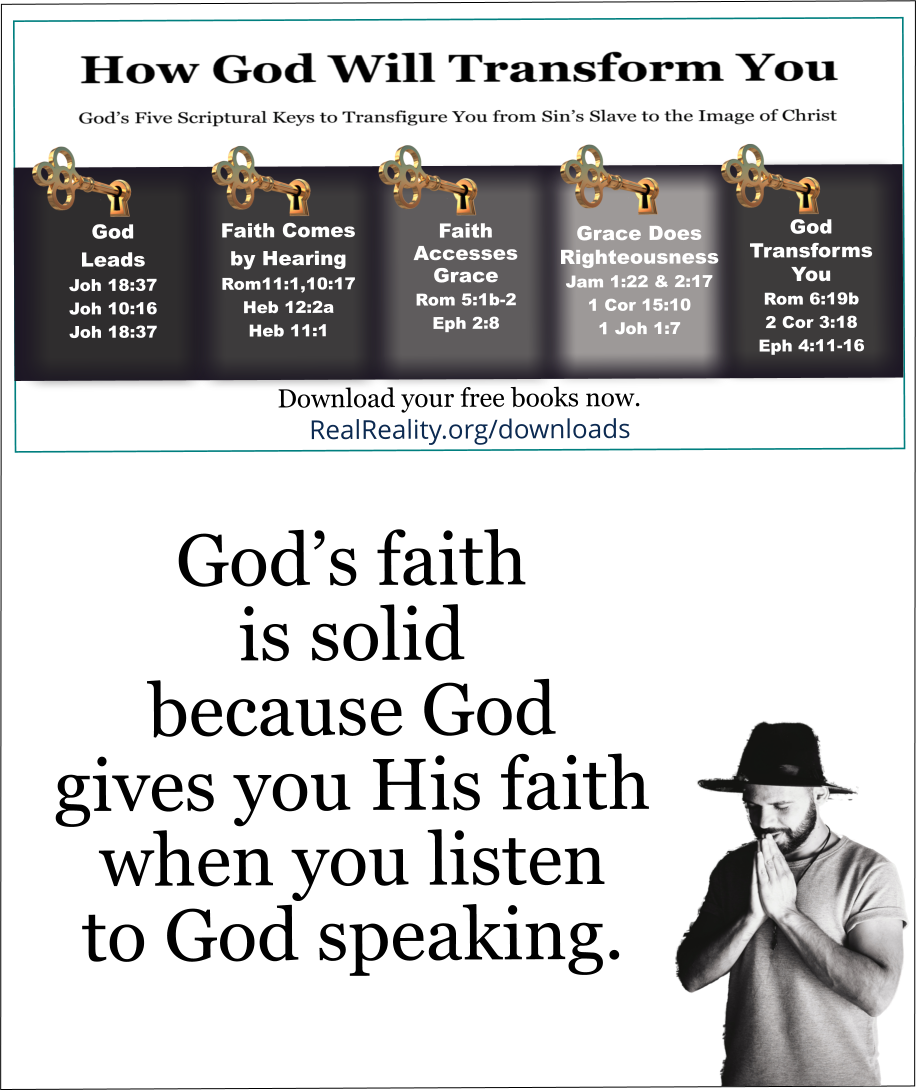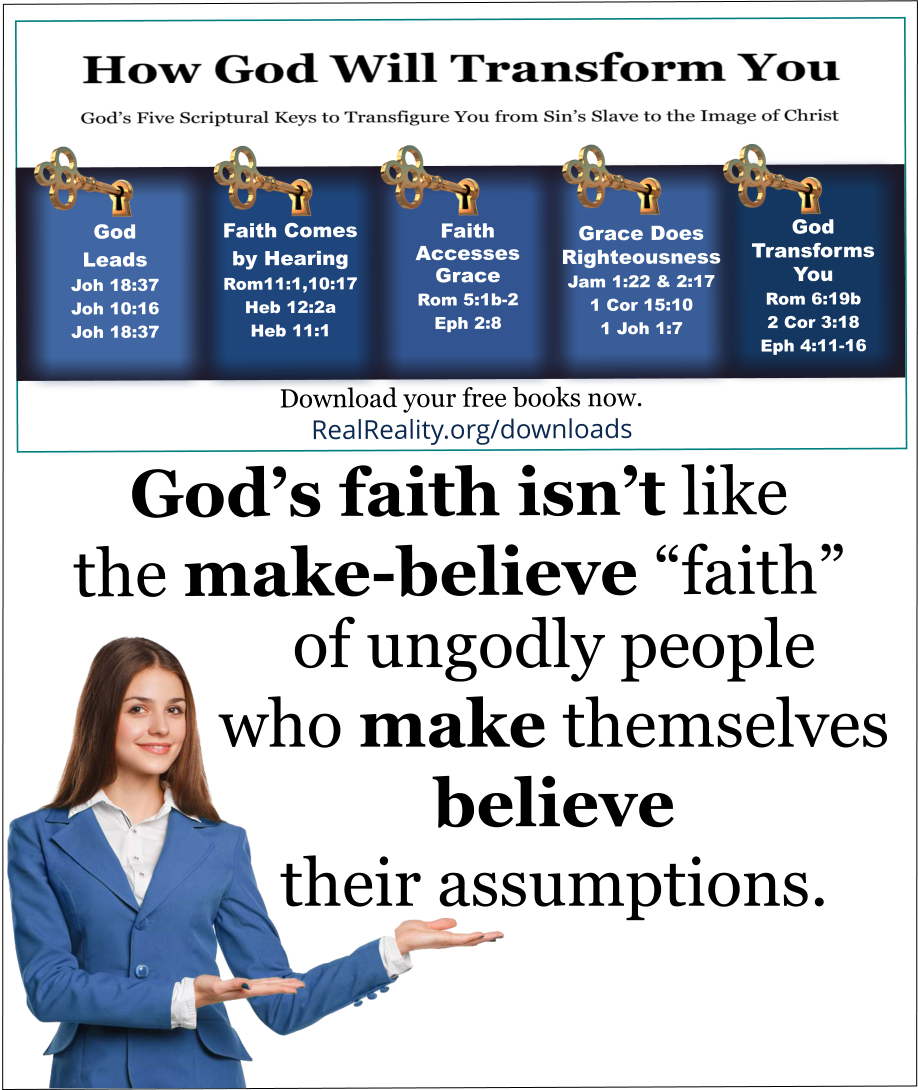
[God’s] faith isn’t like the make-believe “faith” of ungodly people who make themselves believe their assumptions.
(Quote from https://realreality.org/downloads/how-god-will-transform-you/)
CONTEXT:
This faith isn’t like the make-believe “faith” of ungodly people who make themselves believe their assumptions.
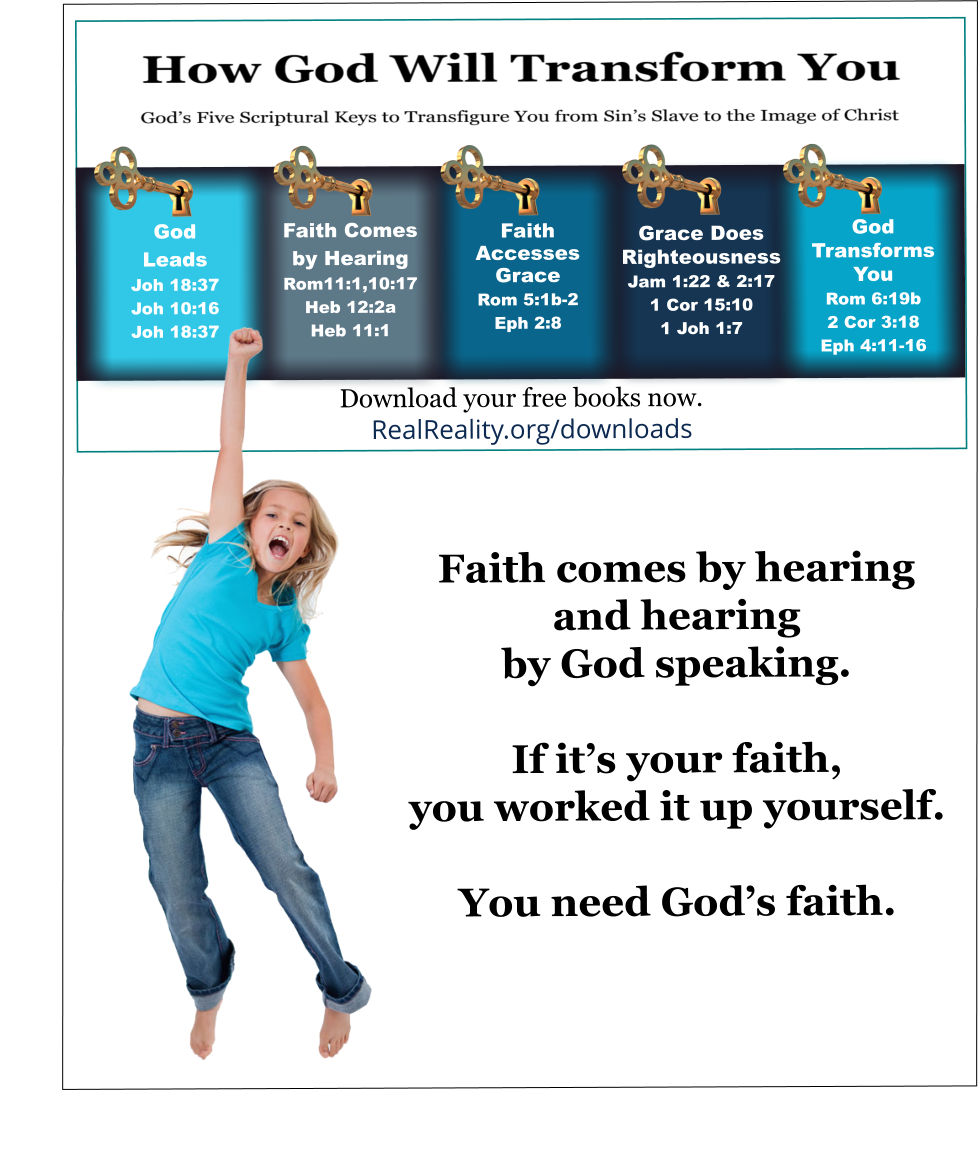
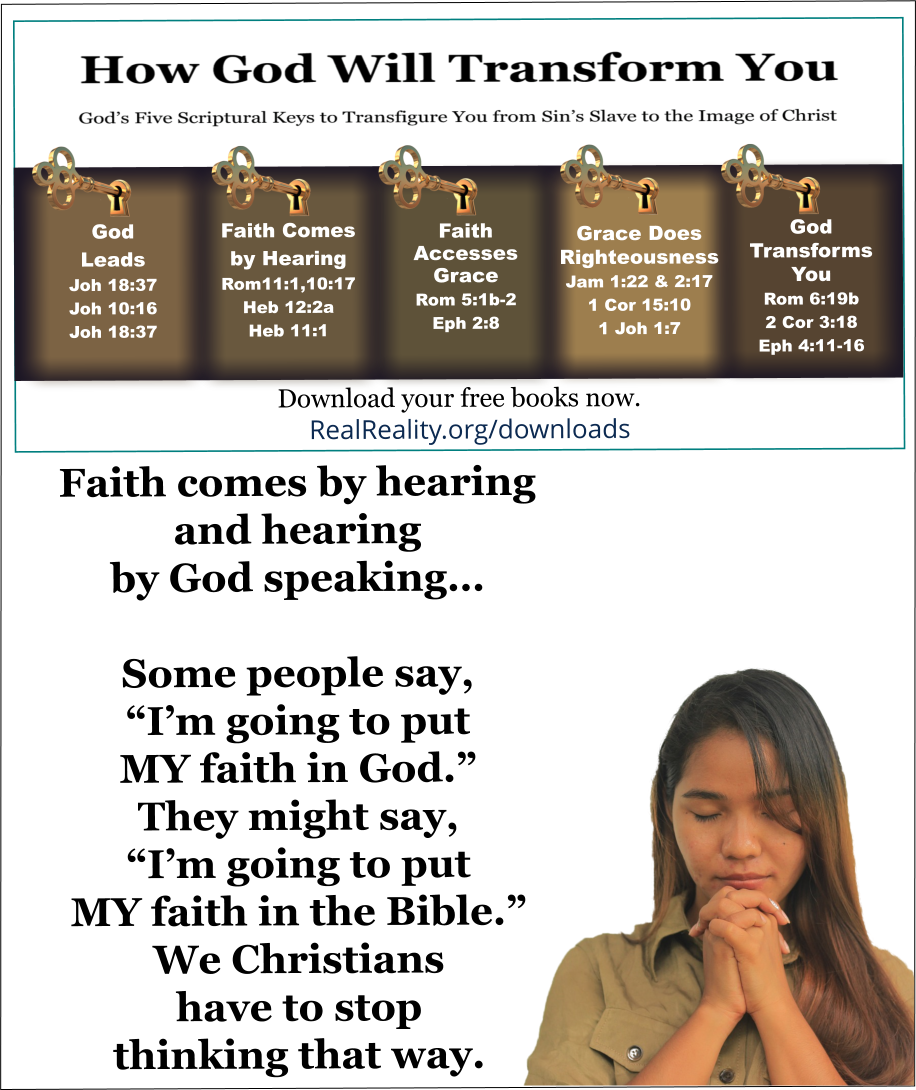
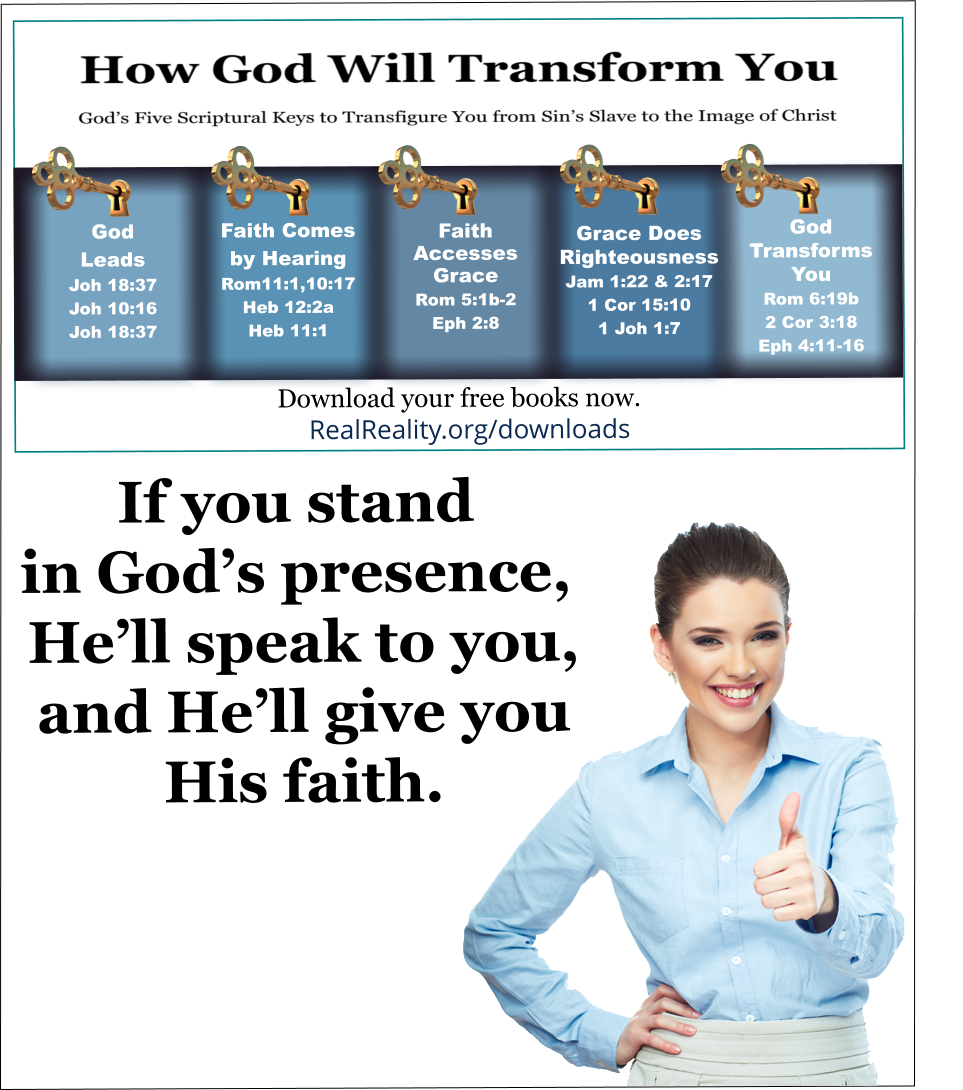
If you stand in God’s presence, He’ll speak to you, and He’ll give you His faith. Some people have tried to work up faith through human effort. You can’t self-generate faith. Some people say, “I’m going to put MY faith in God.” They might say, “I’m going to put MY faith in the Bible.” We Christians have to stop thinking that way. If it’s your faith, you worked it up yourself. You need God’s faith.
If you think you can have the faith of God by human willpower, you are mistaken. You must seek God and stay in His presence. Shouting affirmations won’t bring you the faith of God. Intellectual gymnastics will bring you into error and self-righteousness, but it won’t give you the faith of God. Human emotion will bring you into illusion and confusion but won’t bring you the faith of God. Physical evidence and logical arguments won’t create the faith of God in you. A rationalized, make-believe “faith” has no power, but the faith of God has power and authority. No amount of human effort will bring you the faith of God.
You must stand in the presence of God if you want the faith of God. By intuition, you know how to turn your will and mind toward God. If you call to Him, He’ll answer you. If you yield yourself to His will, you’ll find He’s been there all along. As you do this, you exercise your spiritual senses. As you exercise your spiritual senses, they grow more sensitive. Your spiritual senses grow to know God’s voice better as you continue to spend time with God. Jesus Authors Faith
Let us fix our eyes on Jesus, the author and perfecter of our faith ~ Hebrews 12:2a Berean Study Bible
Fix your spiritual eyes on Jesus. Direct your will to follow His will.
In the parable of the sower, God sows the Seed. The Seed is the Word, which is God’s spoken Word. Jesus is the Logos, the spoken Word of God by Whom God created the universe. Jesus authors your faith. That’s why faith has such authority. Faith is Substance and Evidence
Now faith is the substance of things hoped for, the evidence of things not seen. ~ Hebrews 11:1 King James Version
Faith is a substance. And yet, it’s not a material substance. The substance of faith is real. It’s much more real than the material world of creation. Faith is a spiritual substance that will never be destroyed. Any material substance will pass away. Faith is reality as opposed to an idea or concept. God is working to put this spiritual substance into you permanently. You can’t separate the substance of faith from Christ Himself.
Faith is the reality of things hoped for. This hope isn’t “I-hope-so” hope. God’s hope is eternal. God’s hope is solid. God’s hope is a vision from God of what He’s going to do. It shows you who you are in Christ. This vision from God shows how you fit into the body of Christ. It shows you what is and isn’t part of the body of Christ. It shows you what God is calling you to do right now.
You have to know what God is telling you to do so you can do His will. You need to know how you fit into the body of Christ. You need to know what is and is not part of the body of Christ. God is building His house according to His pattern, and He’s revealing His pattern to you.
And faith is the evidence of things you have never seen. Faith doesn’t need circumstantial evidence to prove it. Circumstantial evidence never proves anything. It can’t. God can speak to you through circumstantial evidence, but circumstantial evidence isn’t sure without God revealing the meaning of the circumstantial evidence. People often use circumstantial evidence to tell lies.
Faith is proof because God gives you supernatural faith when He speaks to you. What God says to you is true. All physical and natural evidence is circumstantial, so it can’t show you the truth. Circumstantial evidence uses rationalizations. Rationalizations use assumptions. Assumptions are beliefs based on nothing but inner concepts and worldviews. You created your inner concepts and worldviews with circular reasoning and confirmation bias. You can’t trust them. That means you can’t trust circumstantial evidence.
You can trust God. God is absolute.
Faith Can Be a Fruit
But the fruit of the Spirit is love, joy, peace, longsuffering, gentleness, goodness, faith ~ Galatians 5:22 King James Version
Faith is also a fruit of the Spirit. That fruit sprouted up in you by grace, which was through faith, which came when God spoke to you. And yet, the fruit that springs up in you includes faith. God is giving you a second round of faith when the fruit of faith comes by grace through faith. You might have to ask the Holy Spirit to show you how that works before you can understand it.
Faith Can Be a Gift
Now there are different gifts, but the same Spirit. There are different ministries, but the same Lord. And there are different activities, but the same God works all of them in each person. A manifestation of the Spirit is given to each person for the common good: to one is given a message of wisdom through the Spirit, to another, a message of knowledge by the same Spirit, to another, faith by the same Spirit, to another, gifts of healing by the one Spirit, to another, the performing of miracles, to another, prophecy, to another, distinguishing between spirits, to another, different kinds of tongues, to another, interpretation of tongues. One and the same Spirit is active in all these, distributing to each person as he wills. ~ 1 Corinthians 12:4-11 Christian Standard Bible
God also gives a special gift of faith to some. This gift of faith operates in them only at the command of God. These people with the gift of faith aren’t free to direct this faith as they want. God always moves first for any faith, including the gift of faith. Never forget. God speaks. You hear. Faith comes. That’s why faith has power.
Faith by Hearing
If faith comes as a fruit of the Spirit, it comes by hearing. If faith comes as a gift of the Spirit, it comes by hearing. The faith to be born again comes by hearing. Any faith you have comes by hearing God leading, teaching, or correcting you. God can speak to you through the Bible. As God speaks through the Bible, He tells you about many of the other ways He speaks to you. No matter how God speaks to you, God’s faith will come if you listen.
Satan’s Tricks
Satan will try to convince you that faith is something faith is not. Satan will say faith is belief WITHOUT evidence when faith IS the evidence. Satan will say faith is belief BASED ON evidence when faith IS the evidence.
Satan will try to convince you that you can get faith some other way. Satan doesn’t want you listening to God’s voice in willing submission and deep respect. Satan will say you have to do works of piety to get faith. Satan will try to get you to use your intellect, emotion, knowledge, observation, common sense, or something else to get faith. None of that works.
Satan will say faith is belief, but you have to presuppose God exists, and you have to presuppose the Bible is God’s word without error. You don’t have to presuppose anything. God reveals He exists. He makes it so plain to you that you know by divine revelation. The same for the Bible. God shows you the Bible is His word without error. You don’t have to presuppose God’s revelation or figure it out.
Don’t fall for Satan’s tricks. Don’t be deceived.
Pressing Toward God’s Goal
God intends to transform you and make you like Jesus. You can’t even imagine what that is right now, but your transfiguration will make human ideas about power and authority look foolish. It will make human ideas about love, justice, and peace look pathetic. This is transformation beyond your wildest hopes. You’ve always sensed an inner longing for something more. God put that longing in your heart, and He intends to fulfill it in you. You now know how to seek God and find Him. You know how to let the Holy Spirit lead you. You know how to receive the powerful and effective faith of God. Those are the first two keys you need to open God’s mysterious and ingenious lock. Those two keys alone won’t open the door to your total transfiguration into the image and likeness of Christ. Three more keys remain. I’ve hinted at them, but you need the detail to see how they work. And you have much to learn about the pitfalls and traps Satan has set for you. You need to know how to avoid all those pitfalls and traps. You need to know how to apply the remaining three keys in God’s way and order.
Key #3: Faith Gives Access to Grace
How do you get God’s grace? What are the means of grace?
Therefore, since we have been justified through faith, we have peace with God through our Lord Jesus Christ, through whom we have gained access by faith into this grace in which we stand. ~ Romans 5:1b-2 Berean Study Bible
What does Romans 5:1b-2 tell you? It says you gained access into this grace. And you gained access into this grace by faith. Faith gave you that access. Faith allowed grace to take hold of you. Faith is the key that opened your door to grace. You stand in this grace. You couldn’t stand without this grace. Grace causes you to stand in Christ and to walk in His righteousness. Only by grace are you able to stand. Only by grace are you able to walk in God’s will.
You need God’s grace, but you can only receive God’s grace one way. Through Jesus Christ, you have gained access, by faith, into this grace. (Romans 5:2) Once you receive God’s faith by hearing His Word (The Father’s Utterance is Jesus Christ), God gives you His grace through faith. (Ephesians 2:8) Then, you advance to the works grace does since “faith without works is dead.” (James 2:17) God’s grace says God’s words and does God’s acts through you. (1 Corinthians 15:10) That means Christ, by grace, saves you from sin. (1 John 1:7) Now, you can have the real Sabbath Day rest as you stop doing your own works. (Hebrews 3:7-4:8) When Jesus does His works through you, that’s what righteousness is. Jesus authors your faith, and then He finishes your faith by doing His works through you. (Hebrews 12:2) You have a part in this. You surrender your entire being to God’s gift of righteousness. (Romans 6:13)
God leads you. He can speak to you through His creation. He leads you through the Bible. He leads you through a Christian brother or sister who speaks by the Holy Spirit. He may speak through a dream, vision, or intuition. Faith comes when He leads and you hear. Faith allows you to move in the power of God’s grace. It allows God to move through you by His grace.
For it is by grace you have been saved through faith, and this not from yourselves; it is the gift of God ~ Ephesians 2:8 Berean Study Bible
You are saved from sin and to righteousness. Ephesians 2:8 says you’re saved by grace and grace is through faith. You know where faith comes from. I’ll repeat it since so many have come up with a different definition of faith. Your faith comes when you hear God leading, teaching, and correcting you. It’s not really your faith then. It’s God’s faith in you. That’s why it can do God’s work through you.