Long Dialog with a Skeptic
Most of the recent posts have been short quotes from the book “Real Faith & Reason Volume One.” This is a longer quote. It’s longer because it’s a dialog that explains real faith and real reason as opposed to a fake, make-believe dogmatism and fake, irrational reason. Please read the entire dialog. You’ll be glad you did.
<quote from Real Faith & Reason>
Skeptic: I’m no longer a Christian.
Christ-follower: “Did you turn from following Christ or didn’t you ever experience His moment by moment leading and correction?”
Skeptic: “I never imagined I’d find anything more wonderful than my daily walk with Jesus and the joy of the Lord, and yet I did.”
As we can see, the skeptic is claiming certainty, and he’s certain of his “joy.” But what makes him certain that his so-called “joy” is real? Although not included here, the skeptic went on about his experience with Christ before abandoning Christ, which led to the following exchange:
Christ-follower: “From that, it sounds like you did know Him, and you heard His voice, but it sounds like you just walked away from Him and chose something else. Some people don’t think that’s possible, but I’ve seen that it’s possible in my own life as I started to walk toward my own will and desires. When I tried to depend on my own understanding, His voice became dull. Then I started having trouble knowing the difference between my mind and the voice of the Holy Spirit.”
Skeptic: “Right. When I was a young child of seven, after begging Jesus to save me but doubting my salvation, I had many Christians assuring me that I was a Christian. Do you think they were lying? I know the joy of the Lord, and I know how it feels to have a personal relationship with Jesus. The human mind can do incredible things. But after reading the Greek New Testament through 11 times in Greek, I could no longer believe due to the absurdities. I was a licensed pastor, but I had to give that up for the sake of epistemic integrity.”
We can’t know all about the skeptic’s experience, but we may have a clue in his words. He seems to equate a relationship with Jesus to a feeling. Feelings are fickle and can come from a variety of sources. This statement conflicted with his former statement about following Christ and listening to His voice. From this statement, it sounds like the skeptic was conforming to peer pressure from his local church rather than finding Christ, but we don’t know that.
The skeptic is certain that the human mind is capable of deception. We know, by revelation, that the human mind is indeed capable of deception. The human senses can fool us too. The skeptic admits this weakness, and then the skeptic ignores the deceptiveness of the human mind as he asserts his certainty of supposed absurdities in the New Testament. Skeptics live with continuously conflicted thoughts. He’s certain that his logic is perfect when he claims to have found absurdities in the New Testament, but, at the same time, he can’t be certain about anything.
He’s concerned with what he calls “epistemic integrity.” The term “epistemic” means relating to knowledge. This man is a skeptic who claims that knowledge is impossible, yet he’s concerned about having integrity regarding the knowledge that he claims can’t exist.
The skeptic presupposes the absurdities rather than stating them. These are phantom absurdities, and we’ll explain how we know as we continue our pilgrimage. However, this skeptic is certain about what he calls “absurdities in the New Testament.” He’s certain enough of his rationalizations about the New Testament that he’s willing to deny his actual experiences with the living Christ if he had any. Finally, he’s concerned about integrity, which exposes his inner conflict since integrity is an idea he can’t verify in his worldview.
Skeptic: “I might ask you some questions about the coherency of your belief system later if you don’t mind.”
When discussing ideas, it’s common for skeptics to want to ask questions, but they rarely like to answer questions. All too often, they obnoxiously turn the discussion into a game of “Now I’ve got you.” This game works against a person with no rational basis for thought because it works to expose the foolishness of ungodly thinking in anyone, including Christians. So it’s not a bad thing to ask questions since asking questions can expose vacuous thinking. However, it’s rude to turn a conversation into a nasty game, and it’s irrational to demand an unequal burden of proof.
Christ-follower: “That’s fine. I’m not a theologian, but I’m learning to perceive God’s voice and to respond in submission to Him. In other words, I don’t follow a belief system. I’ve come to know Christ, and all my arguments shatter in His presence, so I listen to His voice of truth and follow Him.”
Skeptic: “I will also have questions about your epistemology. The process you used to determine whether it’s God or something else less honest talking to you.”
Christ-follower: “It’s a walk from glory to glory of learning to perceive. It started about 65 years ago when I was young, but about 50 years ago, God showed me the weakness of human thought. He explained, in various ways, that human thought can’t be rational without divine revelation. I now understand this truth from the rules of logic and the Münchausen trilemma. I would like to ask you how you, without divine revelation, justify any reasoning at all without knowing that your premise is true.”
Skeptic: “I believe I cannot be absolutely certain about anything apart from my immediate sensations.”
Once again, the skeptic claims certain belief. He believes he can’t be certain, and he believes he can reason to this belief and be certain of it. He also believes that he can be certain about his immediate sensations, his five senses and his emotions. The skeptic is certain about the reality of logic and reason, and yet he said he could only be certain about immediate sensations. However, neither logic nor reason is an immediate sensation. We see the conflict plainly, but the skeptic has blinded his own eyes to it.
Going back to a previous claim, “. . . after reading the Greek New Testament through 11 times in Greek, I could no longer believe due to the absurdities.” Since he can only be certain of his immediate sensations, how could he be certain of his analysis of the New Testament? He couldn’t, and we would find, if we took the time and he allowed it, every so-called “absurdity” depends on assumptions. Every so-called “absurdity” depends on made-up stuff. An ungodly thinker can only base thought on made-up stuff as we’ll more fully explore on this trip when we get to the ungodly thinking problem. Ungodly thinkers have no other choice for thinking, so we know that ungodly thinkers base their arguments against Scripture on made-up stuff.
Also, why should he be certain about his immediate sensations? We know by divine revelation that his five senses are somewhat reliable, but he rejects divine revelation. And he includes emotions like a feeling that he calls “joy” in his sensations. Emotional sensations are unreliable. As already mentioned, his belief in skepticism isn’t an immediate sensation. Instead, it’s a rationalized belief system that he hasn’t reasoned rationally. Irrationally, he firmly believes in his ability to reason from made-up stuff to a complex and selective mix of dogmatism and skepticism.
Christ-follower: “Why do you believe that you can’t be certain of anything except your immediate sensations when you have no proof? Why do you believe your immediate sensations?”
Skeptic: “I can’t be wrong to believe I am feeling joy when I feel joy since there is no necessary intermediate mechanism. But how are you absolutely certain it is God speaking to you when you feel He is?”
Again, the skeptic claims he can’t be wrong, this time about something he calls “joy.” One can only wonder what mechanism allows him to “know” that his so-called “joy” is real joy and not some counterfeit. Notice that he also used the word “feel” to define the Christ-follower’s certainty in Christ. That’s a subtle suggestion to imply that Christ is an emotional rationalization rather than a real person.
What unfolds next is an amazing case of a double standard and inner conflict. The skeptic insists that he knows nothing and, at the same time, insists that his joy is real. He’s sure that God can’t possibly reveal the difference between Jesus Christ and some other entity. This poor skeptic claims to know nothing. And yet his claims imply that he knows all about the spiritual realm, God, and the way God can work with human minds.
Christ-follower: “God imparts certainty of reality called ‘faith’ when He speaks. He makes me certain. What makes you think God can’t impart certainty and give discernment? Also, how do you know you’re feeling joy when you think you’re feeling joy? That would involve sound reason, and sound reason requires a true premise.”
Skeptic: “Through what mechanism did you determine it was actually God?” [The skeptic is ignoring both questions and repeating a question that the Christ-follower already answered.]
Christ-follower: “Through the mechanism of divine revelation. Divine revelation is the only way to know anything. Divine revelation is also how I know that it makes sense to reason based on true premises. But again, I don’t see a reason for you to know that you’re feeling joy when you think you’re feeling joy since you would need sound reason, and sound reason must have a true premise.”
Skeptic: “Through what mechanism did you determine divine revelation was actually God?” [The skeptic again refused to address his own issue and repeated a question the Christ-follower already answered twice.]
Christ-follower: “God revealed Himself to me when I was about five years old. Since then, I’ve been coming to know Him better. I still make mistakes. But He assures me that, as the Holy Spirit forms Christ in me and my carnal mind atrophies, the transformation will change me. I’ll eventually be free to be fully rational. Many have died without receiving this promise. My way is secure even if I don’t realize the fullness in my lifetime on earth.”
Skeptic: “Through what mechanism did you determine divine revelation was not actually Satan?”
Christ-follower: “I’ve dealt personally with both Satan and God, and the difference is stark, but you asked about the mechanism. God is the mechanism. He reveals the difference between Satan and Himself. Jesus Christ is the Author of faith and faith comes by hearing God’s voice. God is almighty, and He won’t deceive a sincere heart who seeks Him. All who seek Him find Him. And, by the way, it’s the only way we can know anything about anything. For instance, it’s the only way to know whether joy is merely chemical, fake joy induced by an evil spirit or true joy that’s a fruit of the Holy Spirit.”
Skeptic: “I know what you believe. I want to know the mechanism that determined the divine revelation was actually from God.”
Asking the same question repeatedly after we’ve answered the question is a trick that can work sometimes, but it’s not rational. In this case, the trick became too obvious to fool even a dedicated ungodly mind. We also note the trick of turning a conversation into a one-sided interrogation, which is a common way for ungodly thinkers to debate. They refuse to answer any questions while using questions as weapons for ungodly evangelism. Not only atheists and skeptics use these tactics, but Christians who are reasoning in an ungodly way also use these tactics.
We can sense the skeptic’s frustration in dealing with a Christ-follower with real faith rather than rationalized faith. The skeptic has no power to introduce doubt when the Christ-follower can turn to the Holy Spirit in real time. The Holy Spirit assures the Christ-follower that the skeptic’s statements aren’t rational.
Christ-follower: “The mechanism is divine revelation, as I said. In other words, the mechanism is God speaking and imparting faith. What is the mechanism by which you think it makes sense to reason about these things?”
Skeptic: “You had to make sure the “divine revelation” was not Satan, right? How?” [The skeptic again ignored the question, but he doesn’t understand God’s power.]
Christ-follower: “God reveals, but you seem to be implying that God is incapable of revealing and giving discernment. What mechanism do you imagine would prevent God from revealing and giving perception? It seems that you only want to ask questions rather than having a real conversation. Could you answer the question I asked? How do you justify reason?”
Skeptic: “How do you know it is God rather than Satan?” [Again, the skeptic repeated a question the Christ-follower already answered, and he refused to answer questions even after the Christ-follower brought attention to the skeptic’s rudeness.]
Christ-follower: “Because God reveals it. When I focus my will on acknowledging Him, He takes care of the rest. How do you justify reason? How do you know your joy isn’t hatred?”
Skeptic: “How do you know God revealed it rather than Satan?”
Christ-follower: “I’ve answered this question enough times, but you refuse to answer any questions. No one can know anything without Christ. God reveals this fact. What makes you think God can’t reveal and impart perception? What makes you think your joy isn’t fake joy induced by a demon who intends to kill you?”
Skeptic: “There is no intermediary between my joy and myself. There is a huge gap between you and any proposed revelation. But, let me confirm. You actually believe you can’t be wrong, right?”
To analyze this claim, we might ask, “What is the mechanism by which the skeptic thinks he knows that no intermediary exists between his joy and himself?” He’s asserting a universal negative and denying that his worldview filters every experience he has, including his supposed joy. It seems that he forgot what he said about his body and mind working together to produce several immediate sensations. However, he admitted having this problem earlier, but he only applied it to his experience with Christ. His thinking conflicts with itself. He only applies his skepticism to Jesus Christ and the Bible. Without divine revelation, he has no mechanism to know anything.
Also, the skeptic makes the dogmatic claim of a huge gap between the Christ-follower and God’s revelation. What makes him think a gap exists since Christ abides within the Christ-follower? Is this claim part of his immediate sensations? He claims he “knows” what comes from his immediate sensations and knows nothing else. So, where does he get this supposed gap? He would have to either observe it using his five senses or else feel it in his emotions. And he’s certain that his emotions prove things to himself, so that must be where he gets his gap. But what could prevent Almighty God from giving certainty, discernment, and perception to His people? Nothing could.
The skeptic is committing an argument against self-confidence fallacy. He craftily substitutes confidence in God’s ability with confidence in human ability to discern. If God made us responsible for managing discernment, then we would indeed be in trouble. Since Christ within us is in charge of discernment, nothing can stand in His way. We must admit that we sometimes allow others to deceive us by directing our wills toward authorities other than Christ. But Christ promises that He’ll give us the Holy Spirit if we ask Him, and He promises that we’ll find Christ if we seek Him.
We notice that it’s common for ungodly dogmatic persuaders to resort to attempts to destroy faith by questioning God’s voice while trying to give the illusion made-up stuff has substance. Faith is substance, but made-up stuff is vapor. Since faith comes by hearing God’s utterance, the sarx mind tries to undermine this faith by asking us to listen to utterances other than God’s utterance. This undermining takes the form of Satan’s question to Eve, “Hath God said?” “How do you know that God revealed it rather than Satan?” However, God assures us that Christ is our highway called “the Holy Way,” and, though we may not understand, He’ll be the One Who makes sure we don’t get lost. God can restore those parts of our lives where we’re convinced of false doctrines, as we follow Christ. He’ll demolish all those strongholds in our minds if we yield to Him.
“A highway will be there—yes, there— and people will call it ‘The Holy Way’. As for unclean people, they will not journey on it, but it will be for whomever is traveling on that Way—not even fools will get lost.” (Isaiah 35:8 International Standard Version)
“And an highway shall be there, and a way, and it shall be called The way of holiness; the unclean shall not pass over it; but it shall be for those: the wayfaring men, though fools, shall not err therein.” (Isaiah 35:8 King James Bible)
God gives us great confidence through this Scripture about this Highway, a Way. We know this Way. His name is Jesus. If we can get on this Way, He’ll make sure we don’t err. The original language implies we won’t wander about in sin and confusion. What do we need? How do we qualify? First, we must be clean. This Way isn’t for the unclean. “As for unclean people, they will not journey on it.” Jesus washed us. Second, we must be wayfaring. We must be moving. We can’t think we’ve arrived. It’s for those who move. It’s not for those who don’t want to move. If we’re willing to move at the command of God, we won’t wander around in a confused, drunken stupor, and sin won’t bind us. He’ll even make sure that a fool doesn’t err. It doesn’t depend on us except to be willing to seek His mind and submit ourselves to it.
The practiced skeptic who came with fake politeness suddenly became rude, refusing to answer any questions and repeatedly asking the same two questions. He didn’t want to move. He wanted to stay as He was. He was a dogmatic skeptic.
He showed his frustration as he said, “You actually believe you can’t be wrong, right?” Of course, the Christ-follower didn’t claim or imply any such thing. However, this skeptic had already claimed that he couldn’t be wrong, so we’re looking at a projection fallacy as he projects his own fault onto the Christ-follower. Since the Holy Spirit leads, teaches, corrects, and purifies everyone who follows Him moment by moment, this disbeliever is inconsistent when he says the Christ-follower is claiming that he can’t be wrong. If the follower of Christ couldn’t be wrong, Christ wouldn’t need to lead, teach, correct, and purify us moment by moment every day. As the Holy Spirit forms Christ in us and we die to the fleshly nature, our understanding of Christ and His leading becomes more accurate and precise. Now, we know in part, but we will know in the fullness. We may even make mistakes, but, since discernment doesn’t depend on us, Christ will correct our errors in thinking and perception as we yield ourselves to Him.
Christ-follower: “People can have false joy. How can you assert such definite statements regarding your own supposed joy and the lack of an intermediary? And how can you assert such definite statements regarding an imagined gap between myself and God’s ability to reveal and impart His faith? In fact, you imagine a gap between Christ and me. Christ is in me and joined to me, and yet you dogmatically assert this gap that you conjured up from your imagination. But you’re claiming to have amazing familiarity with my inner spiritual experiences. You’re dogmatic, but you claim not to have any knowledge of reality other than your immediate sensations. How do you sense my inner spiritual experience with Christ? To your last question, I’ve already answered it by saying I’m learning and God is constantly correcting me. That means I’m wrong a lot. If I depended on myself, all would be hopeless, but I know Christ.”
Skeptic: “You believe I could have a false joy, but you could not have a false Christ, right?”
The skeptic is implying that we could be sincerely seeking Christ and yet be deceived by our own fallen minds or by evil spirits. Satan uses this lie against Christians. And yet, Christ has promised us that He is faithful. He promises us that He won’t give us a serpent if we ask for a fish. The serpent is a type of Satan, and the fish is a type of Christ. He promises that He won’t give us a stone if we ask for bread. The stone is a type of the hardened human heart or mind, and the bread is a type of Christ’s body.
But some people do follow false Christs. They follow demons, false prophets, false teachers, or their own minds and think that they’re receiving revelation from Christ. So, how does that happen? It happens when they’re deceived because they are drawn off the path by their own desires. Those who truly want to do God’s will have zero percent chance of going astray because of the power and goodness of God, not because of a theological formula. In our immature state, the fleshly nature is deceitful and desperately wicked. The fleshly nature is opposed to God. So, Christians may slip or step off the Way (Christ) from time to time, but, because their hearts are sincere to desire righteousness, Christ will bring them back in line. On the other hand, if they truly want to go their own ways, God won’t force them.
Satan often works by introducing confusion. In this case, the skeptic is working to suggest that there’s no difference between the skeptic’s ability to absolutely know that the joy he’s feeling is real and the Christ-follower’s ability to absolutely know that Christ is leading. In fact, the skeptic claims that he has a superior ability to know about his supposed joy absolutely, but the Christ-follower just can’t know.
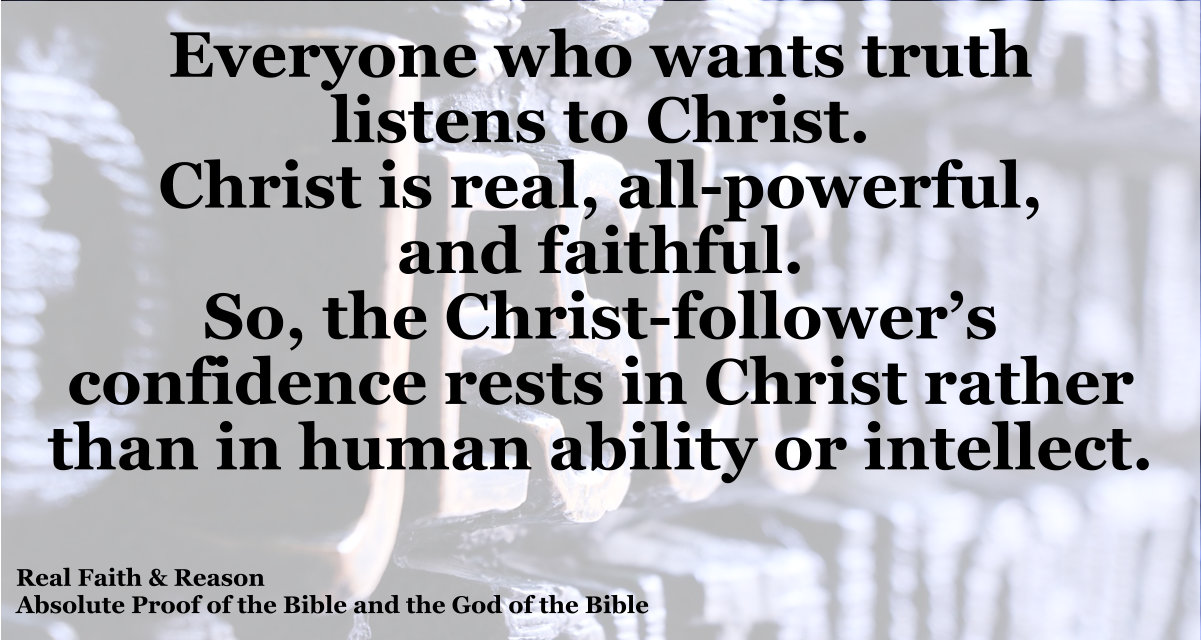
Let’s look at the basis for the two claims. The skeptic’s basis for his claim is a rationalization. He rationalizes a story, and, in his story, he tells himself that there is no intermediary between him and the joy he feels. So, the skeptic’s confidence rests in himself and his own mind. The Christ-follower’s basis for knowing that Christ is leading rests in Christ and the faith that Christ imparts when Christ speaks to him. Everyone who wants truth listens to Christ. Christ is real, all-powerful, and faithful. So, the Christ-follower’s confidence rests in Christ rather than in his own ability or intellect.
Christ-follower: “I know you haven’t mentioned a true premise on which you build your belief that your joy is real. I know Jesus Christ gives every person a true premise to believe Him. You seem to think God isn’t capable of imparting divine revelation. However, you haven’t mentioned any proof of His inability.”
Skeptic: “Yeah, I think this conversation is over. You need to learn some honesty.”
The skeptic became upset at that point and shut down discussion with the epithet “You need to learn some honesty.” His remark brings up a question. From a skeptic’s position, how could the word “honesty” mean anything? He says he only “knows” immediate sensations. Is he saying honesty is an immediate sensation? As a skeptic, he doesn’t even have proof that any form of reasoning is worth the mental effort. He didn’t have a true premise for believing his immediate sensations.
We must revisit this issue of not knowing whether Christ or Satan is leading us since it’s an issue evil spirits love to bring up. Christ speaks to us and says all who seek Him find Him. He also says every person already knows. We can already perceive and judge between Christ and other voices, but other voices can fool us when we want our own wills or follow our own minds. We can be wrong, so we ought to bring our doctrines before Him continually and allow Him to point out those untrue doctrines. We must admit that we often make job decisions, communication decisions, or financial decisions where we don’t understand God’s will. Some of us have even fallen into gross immorality, but we found that Christ pulled us out of it.
However, we do know the difference. And this skeptic knows the difference but wants to do his own thing so he’s willingly ignorant. He denies the knowledge and hides it from himself, so, in a sense, he knows nothing even though he does know. We humans mix up our minds when we want to do our wills rather than God’s will. It’s in those places where we want our desires and our ways rather than God’s way. When we were first born again, the Holy Spirit started a project within us. We sincerely confessed Jesus is Lord, which no one can confess except by God’s Spirit. From that day forward, even if the deceivers deceive us, God is watching over the entire process and will be faithful to complete the work in us. God gave us the responsibility to sincerely seek Him and yield to His Spirit despite the voices of many liars. If any of this revelation and discernment depended on our strength, intelligence, wisdom, understanding, or judgment, we would lose our way. But it depends on the Creator God Who’s well able to complete the work.
“being persuaded of this very thing, that the One having begun a good work in you will complete it until the day of Christ Jesus.” (Philippians 1:6 Berean Literal Bible)
Revealing the twisted nature of skeptical thinking, the skeptic’s entire line of thinking has self-righteousness and virtue signalling oozing out of it. It shows that skeptical reasoning is absolutely vacuous. Because of his mindless thought process, the skeptic couldn’t answer the following questions:
Without divine revelation, how does the skeptic justify any reasoning at all without a true premise?
Why does the skeptic think he can’t be certain about anything apart from his immediate sensations when he has no proof?
How does the skeptic know that he’s feeling joy when he thinks he’s feeling joy since such knowledge would involve reason, and sound reason requires a true premise?
Why does the skeptic think that it makes sense to reason about anything?
How does he justify reason?
How does he know his joy isn’t hatred?
How does he know his joy isn’t sorrow?
What makes him think that what he calls “joy” isn’t fake joy induced by a demon who intends to kill him?
How can he assert that there’s no intermediary between him and his joy?
How can he be so sure about an imagined gap between a Christ-follower and Christ Who lives in the Christ-follower?
What makes him think that God can’t impart divine revelation?
What makes him think that God can’t reveal and impart perception?
What mechanism does he imagine that would limit God’s ability to reveal and impart His faith?
What mechanism does he imagine would prevent God from revealing and giving discernment?
The skeptic and the Christ-follower didn’t discuss the Bible and the history in the Bible, but God reveals the accuracy of the Bible just as He reveals Himself. Of course, He doesn’t reveal everything, and we don’t know much, but we do know whatever He reveals to us.
</end quote>
#RealFaith&Reason
Have you read this book yet?
You can BUY it on Amazon, but you can your FREE copy of Real Faith & Reason, which shows the intersection of faith, reason, truth, and sanity.
http://RealReality.org/Real_Faith_and_Reason_Vol_1_-_Scientia.pdf