Revelational Apologetics

0001 PresuppVRev3

Both presuppositional and Revelational apologetics use physical observation and experience/experiment. Evidential apologetics seems to focus mainly on physical observation and experience/experiment that is interpreted via assumptions. Presuppositional apologetics generally recognized Divine revelation as one of many sources of truth, but it puts puts special emphasis on presuppositions as the basis for thinking, while revelational apologetics puts special emphasis on Divine revelation through the Holy Spirit, our Teacher and Counselor sent through Christ, as the basis for thinking.

“Evidential apologetics or evidentialism is an approach to Christian apologetics emphasizing the use of evidence to demonstrate that God exists. The evidence is supposed to be evidence both the believer and nonbeliever share, that is to say one need not presuppose God’s existence.” Wikipedia

“Presuppositionalism is a school of Christian apologetics that believes the Christian faith is the only basis for rational thought. It presupposes that the Bible is divine revelation and attempts to expose flaws in other worldviews.” Wikipedia

I’m careful about what Wikipedia says, since they have such an anti-God influence, but I’ve included these definitions from that site.

“Evidential Apologetics is that style of Christian defense that stresses the miracles found in the Bible, particularly Christ’s resurrection as an evidence for the existence of God and the validity of Christ and His words. It also uses historical evidences to support the veracity of the Biblical account(s). In this, it is very similar to Classical Apologetics, which stresses reason in its approach to evidences.”  Matt Slick of CARM, https://carm.org/evidential-apologetics

“This form of Christian apologetics deals with presuppositions.1 A Christian presuppositionalist presupposes God’s existence and argues from that perspective to show the validity of Christian theism.2 This position also presupposes the truth of the Christian Scriptures and relies on the validity and power of the gospel to change lives (Rom. 1:16).” Matt Slick of CARM, https://carm.org/presuppositional-apologetics

Comparing evidential apologetics to revelational apologetics, evidential apologetics exposes the mechanics of the lies. Revelational apologetics exposes the structure of the lies. Evidential apologetics is helpful to expose the lies about what has been observed. Revelational apologetics exposes that fact that nothing can be known without Divine revelation. Without Christ, nothing can be known. In Him is hidden all knowledge. In Him is hidden all knowledge.

You may wonder if revelational apologetics is the answer that will cause all bad doctrine to cease. Eventually, God will reveal the fallacies of all the lies that have been told, but don’t expect someone who dearly wants to believe in evolutionism or Atheism to be rational. There are many ways to get out of being rational. They’re called fallacies, tricks, and games.

Here is some further reading:

Revelational Apologetics Versus Presuppositional Apologetics

Extrabiblical Revelation, Interpreting Scripture Through Assumptions, and Adding to the Canon of Scripture

A Conversation Using Revelational Apologetics with a Theistic Evolutionist

A Conversation with a Presuppositional Apologist

Equivocation of Assumptions at Berkeley

Assumptions

Worldviews

Divine Revelation

Warnings About Divine Revelation

Skeptical Arguments Against Divine Revelation

What Brings Regeneration?

00001 PresuppVRev22


Facebooktwitterredditpinterestlinkedintumblrmail

Can Evidence Based on Assumption be Taken Seriously?

0001AssumptionWeakestLink1

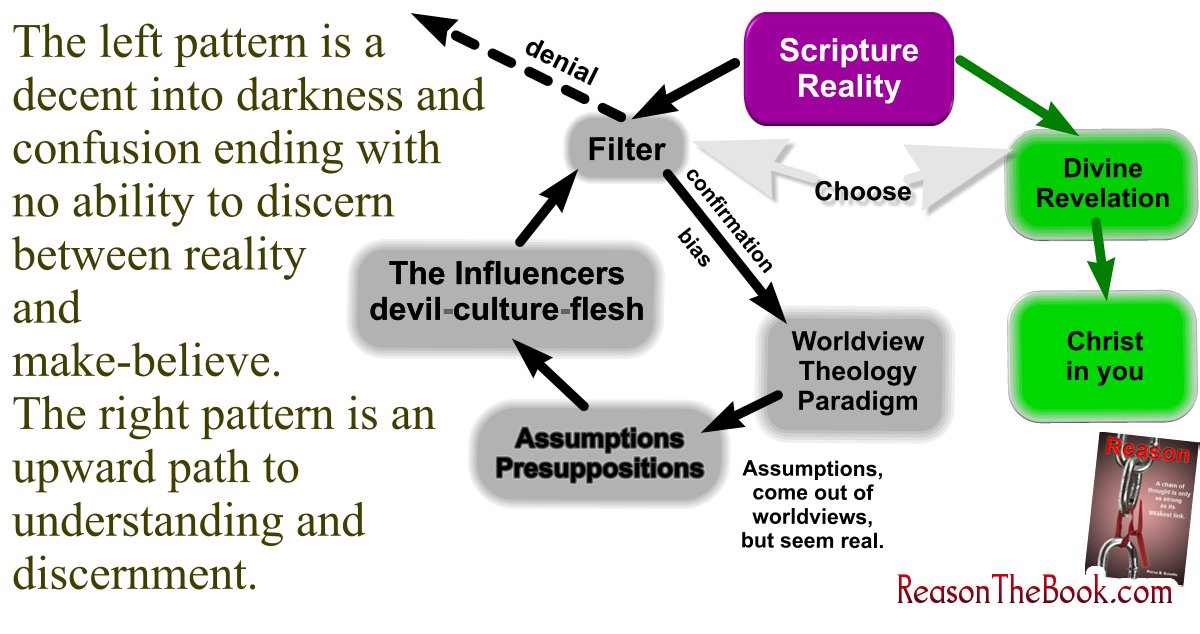
In science, theology, politics, and interpersonal communications, it’s difficult to tell the difference between reality and make-believe. We observe things, but not directly. We filter our observations through our own worldviews. Worldviews are powerful filters that don’t allow us to observe what doesn’t already fit into the worldview. Group-held worldviews are even more powerful, since they provide the group-think confirmation bias that creates an even stronger illusion . . . that our worldviews are reality itself rather than an just inner concept of what we think reality is.

Look at the Theory of Evolution as an example. When you actually look at the so-called “evidence,” every evidence is based on assumptions. Assumptions consist of made-up stuff that generally has been formulated to conform to the existing worldviews. The worldview is merely a fake reality masquerading as real reality. If you allow yourself even a single assumption, you can prove anything to yourself.

Let me give an example. Allow me one assumption. I will assume that you don’t exist. That’s now a given. Since you don’t exist, you don’t exist. That didn’t take any heavy lifting, did it? I just proved that you don’t exist based on my assumption.

Of course, that wouldn’t fool anyone. You need many more fallacies to cover up the fact that I’m making the whole thing up. So, how do I do that. Add more stories and complexity to the idea using the hundreds of available fallacies, and I could develop a story about your non-existence that’s as funny as the big bang, billions of years, no Flood, life from non-life, amoeba to human, no need for God story.

Here, we have a situation where every person who follows Christ knows Christ and is led and taught by the Holy Spirit moment by moment. As you know that you exist because of your experience of being you, everyone who follows Christ knows God exists because of his or her experience of being led and taught by the Holy Spirit. That’s not to say that we’re always faithful in listening, acknowledging, submitting, or allowing Him to think His thoughts, speak His Words, or do His acts through us. It just means we’re familiar with Him to some extent. To the extent that we have yielded to Him, we have discernment between that which comes from Him and that which comes from other sources. Many times, we do lean on our own understanding rather than acknowledging Him. Hence, you can witness the many doctrinal and denominational divisions in the Church. Yet, Jesus Christ is real, and He is the reality of the ongoing experience of every single person who follows Him.

For a Secularist (skeptic, Atheist, Agnostic, Humanist, etc.) to claim that a follower of Christ isn’t experiencing what he or she is experiencing is as bizarre as me claiming that you don’t exist. The Secularist has only one tool to develop such a thought: making stuff up and then confusing the issue with smokescreen fallacies.

Yet, when confronted with the fact that you know Jesus Christ personally, Secularists commonly will begin to use the fallacy of faulty comparison. There are several types of faulty comparison fallacies. This one is false equivalence of two opposites. It’s very helpful to the Secularist in this situation, since the Secularist is faced with a stark contrast between Divine revelation and making stuff up. The Secularist isn’t comfortable with the fact that every single thing he or she thinks he or she knows is based on made-up stuff. So, in this case, Secularists intuitively reach for a tu quo que (you too) fallacy. They want to say, “You too have the same problem.” Of course, tu quo que doesn’t solve the Secularist’s problem. It merely is a way to project their problem onto you. In effect, they’re saying, you’re situation is just as bad as mine. There are many problems with this kind of thinking. Most importantly, you don’t have the same problem the Secularist has. Yet, if you don’t stay in the Presence of Jesus, if you try to lean on your own mind rather than His Mind, you will become confused by these tactics.

To use tu quo que, the Secularist must use a faulty comparison fallacy first. Therefore, the Secularist will try to lump Divine revelation in as part of the made-up stuff. He or she must claim that Divine revelation is also made-up stuff. This asserts the following universal negative: “God doesn’t reveal anything to anyone.” This, of course, is based on that bare assertion and universal negative, “There is no God.”

When the lumping fallacy fails, the Secularist may turn to other ways to equate Divine revelation with making stuff up. He or she may claim that you can’t know it’s God speaking to you, and, if Divine revelation depended on human ability, that would be true. However, Divine revelation is, as the term implies, dependent on God. He is able. What would possibly prevent the Almighty God from being able to reveal Himself and His Truth to a willing human heart? Another common Secularist tactic is to claim that the human mind must interpret the revelation, and the revelation is, therefore, subject to human interpretation. That’s a statement contrary to fact. God’s revelation is pure. Human interpretation adds to it or diminishes it. That’s why God commands us not to add to His Utterances or diminish them. Divine revelation plus human interpretation equals human ideas. We must leave the things God hasn’t revealed with God and receive the revelation He has given. Then the Secularist is likely to remind you that your own mind can fool you, and this is true. However, that’s not a problem to God as long as we remain humble. It’s a very good reason for us to hold our theology loosely, but it’s not a good reason to stop seeking God or to follow the Secularist’s delusion. The Holy Spirit is constantly leading us. As we yield. our spiritual senses are exercised, which brings maturity and discernment between good (what God is saying) and evil (what comes from human or demonic minds). The Holy Spirit is given to lead us into all Truth. Just keep following Him, and be ready to abandon your own convictions and many things you’ve been taught in favor of Divine revelation.

The big problem that the Secularist has with all his or her claims is that Secularist’s claims are based on made-up stuff. It’s irrational to make stuff up and call it real. Their claims to deny Divine revelation are based on made-up stuff. Your testimony of Divine revelation is based on Divine revelation. It always comes down to Divine revelation versus made-up stuff.

If the Secularist is successful in convincing himself or herself using these arguments, the Secularist loses the ability to know the difference between reality and make-believe in this regard. It’s no longer a game. It’s insanity. Secularists have lost touch with reality.

The big bang, billions of years, no Flood, life from non-life, amoeba to human, no need for God story is a complex story based on fallacies. The hundreds of fallacies can be classified into two groups, and only one of those groups is functional. The functional fallacy is always some form of making stuff up and calling it true. It could be an outright lie. It could be a hidden assumption. It could be an “axiom of science.” There are many ways to make stuff up.

All other fallacies are smokescreens to give the illusion that the made-up stuff isn’t made-up stuff. Those smokescreens include appeal to ridicule, which has become very popular. There are many ways to ridicule. Appeal to offence is becoming very popular: “I’m offended; therefore, you are wrong and I am right.” Appeal to anger works the same way.

Then, there are the many statistical fallacies: “It’s very unlikely that God exists.” Really? What is the number you can put on that probability, and how do you derive it? How do you know that you have taken every factor into account? What are the steps to your scientific experiment you use to determine that every follower of Christ is not experiencing what he or she is experiencing?

Bill Nye debated Ken Ham. He suddenly realized that he had to defend the use of assumption. He claimed that assumptions come out of experience. Another word for experience is experiment. One of the ways we observe in science is through experience/experiment. These experiences are repeatable, so many people can observe the same thing. Assumptions don’t come out of experiments. They’re used to interpret the observations made when performing an experiment. Interpretation always adds to what has been observed or diminishes it. These assumptions are developed to conform to the existing worldview, in most cased, the group-think of the ruling shared worldview of the scientific community.

Of course, the same thing happens in Christian denominations. It happens in politics. Is there any hope for humanity?

Yes. Jesus Christ came to set us free. In fact, He said that the Truth will set us free. He is the Truth. God knows all things. He reveals some things to us. For instance, He reveals Himself through the things He has created to every person. Those who acknowledge Him and thank Him receive further revelation and faith, that is, certainty of reality, comes to them. Those who refuse to acknowledge Him lose the ability to tell the difference between what human minds are making up and what is coming from God.

When we believe what God is telling us about Jesus Christ and how He died to pay the price of our own sins, how He rose again from the dead having overcome sin, and how He now offers us forgiveness and a path to freedom from our fallen state, we are changed. We are born into the family of God, when we had previously been slaves to Satan. At that point, we receive the gift of the Holy Spirit to be our Teacher and Leader. If we seek Him and His Will, then, we continue to learn and be changed. One of the first things that He teaches us is that the Bible is His Word without error, and that He speaks to us through the Bible. He teaches us that there are many gifts that come through the Spirit, that the gifts, ministries, offices, and orders that He reveals through Scripture are important to Him and that He will eventually reveal how all of them work for us and are part of our salvation.

As we walk with the Spirit and keep step with the Spirit, we don’t stay in the same place. What we thought we understood yesterday soon becomes quite shallow compared to the new, unfolding, revelation of today. Tomorrow, there will be more as we progress in the Spirit. God has built many safeguards into the Church to keep this unfolding revelation on track. Every human-developed method that isn’t in Scripture creates a danger of going off course. As we yield to the Spirit, our spiritual senses are exercised by reason of use to discern between good (what comes from God) and evil (what comes from other sources).

We don’t need to boast of our spirituality. In fact, such boasting is a sure sign of spiritual immaturity. God has provided no way by which we can truly measure our maturity in Christ. We can tell a bit about our spiritual immaturity every time we exhibit some form of the fruit of the flesh: thoughts, words, or acts of sexual immorality, impurity and debauchery; idolatry and witchcraft; hatred, discord, jealousy, fits of rage, selfish ambition, dissensions, factions, and envy; drunkenness, orgies, and the like. Every time we find ourselves irritated or striving for something, we realize that we need more of Him.

The way forward is glorious for those who don’t get distracted. There are higher heights and deeper depths in Christ. Keep on keeping on.

Facebooktwitterredditpinterestlinkedintumblrmail

Ken Ham-Bill Nye Debate

0001 AppealToTradition

When Bill Nye debated Ken Ham about Creation (and, as it worked out, the favored story about no God, big bang, billions of years, no Flood, abiogenesis, amoeba to humans), Bill Nye wasn’t able to make any point to refute God or the Creation or to prove the favored story without relying on fallacy. In fact, every point Bill tried to make was riddled with multiple, nested fallacies.

Ken Ham, on the other hand, was falsely accused, by Evolutionists, of having the same problem. Some Christians came out against Ken Ham, noting how they would have been much more effective than he was. It’s easy to be critical, envious, or knit-picky. Looking at the transcript and analyzing the video for many hours will reveal that Ken’s fallacies weren’t on his main points. All of his main points hold up as rational, since they are based on his testimony of a personal relationship with Christ in which Christ reveals truth to Him, both through the Bible and through personal experience.

Bill Nye finally realized that he was comparing Divine revelation to assumption. Assumptions consist of made-up stuff. That’s their weakness. Made-up stuff is whatever someone makes up. Divine revelation comes from God Who knows all things and cannot lie.

The human mind has no internal method to tell the difference between made-up stuff and reality. This distinction can only be brought by the Almighty and loving God Who reveals it to us. He actually reveals this to every person, and every person receives partial revelation.

No one receives all that God is willing to give. No one rejects everything that God is willing to give. Some people acknowledge God and are thankful to Him. These have some knowledge of Truth and have a growing discernment between what God has revealed and what comes from other sources. With increasing spiritual maturity comes increasing discernment between good (what comes from God) and evil (what comes from human or demonic minds). Others, like Bill Nye, refuse to acknowledge God. They become increasingly unaware of the difference between reality and make-believe. Eventually, many of them become Atheists or functional Atheists. This is the reason for dogmatically held speculative doctrines in the Church and outside the Church.

Bill Nye ended up defending the use of assumptions as the foundation of all knowledge. Ken Ham ended up defending Divine revelation as the Foundation of all knowledge. Jesus Christ is the Foundation. No other Foundation can be laid that that which is laid, which is Jesus Christ. In Him is hidden all knowledge. He is the Truth. He has become our wisdom, that is, righteousness, holiness, and redemption. In Him is hidden all knowledge. Everyone who’s on the side of Truth listens to Him.

The Book, “Reason,” uses this debate as a backdrop to discuss reason. The book isn’t about the debate, but the debate created a sharp distinction between reality and make-believe. “Reason,” hasn’t yet been released.

Facebooktwitterredditpinterestlinkedintumblrmail

Who is Blindly Following What Can’t be Proven?

Interpretation of Scripture32\

Funny how Evolutionists accuse those who follow Christ of blindly believing what can’t be proven when all they are doing is projecting their own problem onto those who don’t have the problem at all. In reality, the stories of Evolutionism can’t be proven while Creation is obvious. The stories of Evolutionism are all based on assumptions. Assumptions are pulled from worldviews. Worldviews are created by previous interpretations of things taught, things experienced, and things observed. Those interpretations are based on assumptions that are based on worldviews.

The fact of Creation isn’t given this way. It’s given by revelation. God reveals it through Scripture. God reveals it through Creation itself. Everyone, at some point, is confronted by God concerning this fact. Those who refuse to acknowledge Him and thank Him, He turns over to their own reprobate minds so that they do things that they know will result in judgment from God. The unrighteousness they do has an effect. It suppresses God’s truth and those unthankful and willingly ignorant people lose the ability to tell the difference between reality (what God reveals) and make-believe (what comes from human minds or demons).

Some say that Divine revelation requires interpretation by the fallen human mind. This isn’t true. In fact, it’s a tu quoque fallacy on the part of those who lean on their own understandings rather than trusting God. They suddenly realize that they know nothing and then want to accuse you of knowing nothing as well.

If the fallen human mind interprets Divine revelation, it always adds to it or diminishes what God is saying. What God says is enough. Humans have no source to self-generate the knowledge that would be required to interpret any experience, observation, Scripture passage, or revelation. That means that human interpretation is also human speculation. Speculation is just making stuff up.

When we stand in the Presence of God, He reveals Scripture. He reveals the meaning and purpose of life. He reveals right and wrong. What He says is enough.

Faith comes as we hear God. The Greek word, “rhema,” is used in Scripture. “Rhema” means utterance. God speaks. We hear. Faith comes. This faith isn’t conceptual. Theories and theologies are concepts only. Concepts are not reality. Faith is reality from God. It’s substance, that is, reality as opposed to concepts and opinions. It’s the substance of things hoped for. And, it’s also the only evidence that gives absolute proof and certainty. It’s the evidence of things not seen. (Romans 10:17, Hebrews 11:1)

As with all important words, Satan tries to blur the difference between reality and make-believe by redefining the word, “faith.” Some people use the word, “faith,” to mean “making themselves believe in something.” That would be make-believe. Rather than the conviction, certainty, and absolute proof, and reality that comes from God, Satan uses the word, “faith,” to label a human-generated ability to believe in things that aren’t true. Even many Christians are confused by this. Faith comes by hearing God’s Utterance. No one can self-generate God’s Utterance. Demons and flesh both try to imitate this absolute authority, but the Holy Spirit gives discernment.

The more we yield to Him and stand in submission in His Presence, the more we’re able to discern between His Mind and human minds and demonic minds. The more we walk in our own wills, the less we can know. The more spiritual we become, the better we can tell the difference between reality and make-believe. The more fleshly we become and the more we lean on our own understandings, the less we can tell the difference between reality and make-believe.

Facebooktwitterredditpinterestlinkedintumblrmail

God Doesn’t Need Circular Reasoning

GodDoesntUseCircularReasoning

Secularists are forced to base all reasoning on logical fallacies. That’s because they can never have a true premise. Rational thought requires true premises. Secularists have no means by which to show a premise true. They can’t prove it without another premise–another premise that they can’t prove. An unproven premise can’t be used as proof for another premise.

Circular reasoning is one of the ways to hide this problem that all Secularists have in all situations. Circular reasoning is an attempt to prove a premise in this way. “We know the age of the fossils because of the rocks they’re in, and we know the age of the rocks because of the fossils that are in them.” That way, the premise for the age of the rocks is the age of the fossils and the premise for the age of the fossils is the age of the rocks. Of course, they never state it this simply. They make it complex with many fallacies to hide the circular reasoning. All aging methods used support any method of trying to assert that the Earth is billions of years old always involves circular reasoning. The circular reasoning is used to hide the fact that the stories about billions of years are pure fantasy.

Secularists love to ridicule Christians who say, “The Bible is the word of God. How do we know? Because the Bible reveals this about itself.” Some Christian teachers love to say it. Some Christians actually say that the highest authority is always circular. That isn’t true. God doesn’t have to resort to any fallacy.

When God says something, He doesn’t use circular reasoning fallacies. He appeals to His own authority. That’s not quite the same thing as a circular reasoning fallacy. An appeal to authority is only a fallacy if the authority isn’t qualified. God is well qualified. He’s the only One qualified to establish truth.

“For when God made promise to Abraham, because he could swear by no greater, he sware by himself,” Hebrews 6:13

That’s not circular reasoning. That’s appeal to His own authority, and authority that only God has.

I’ve personally gone away from saying, “The Bible says.” It may not be a big deal, but I have been saying, “God says, through the Bible.” In addition, I have been cautioned by the Holy Spirit that human interpretation of Scripture adds to God’s Words or diminishes them. This interpretation happens automatically. The fallen human mind wants to adjust what the Scripture is saying. For that reason, I pray that the Holy Spirit reveal to me the meaning of Scripture. Even then, I’m trying to hold my theology loosely enough that the Holy Spirit is able to correct me.

Logic is how God thinks. I’m pretty sure that human beings don’t understand it totally.

“Let the wicked forsake his way, and the unrighteous man his thoughts: and let him return unto the LORD, and he will have mercy upon him; and to our God, for he will abundantly pardon. For my thoughts are not your thoughts, neither are your ways my ways, saith the LORD. For as the heavens are higher than the earth, so are my ways higher than your ways, and my thoughts than your thoughts.” Isaiah 55:7-8

God doesn’t use circular reasoning fallacies. Circular reasoning is just a way to give the illusion that made-up stuff is real. God doesn’t have to make things up. God doesn’t have to use any fallacy. God says what is true. He knows all things. He is the only Truth. He cannot lie. Therefore, we can rely on what He says. He speaks to our innermost minds concerning Scripture. “The Bible is God’s Word without error,” is one of the first things that He teaches new-born Christ-followers.

Every person who knows and follows Christ is led and taught by the Holy Spirit moment by moment. We may drift out of His Presence and into His Presence, but in those times when we are in His Presence, following Him, He is imparting His Divine Wisdom, Knowledge, and Understanding. Even when we’re drifting, His mercy sustains us. He still imparts His Divine Wisdom, Knowledge, and Understanding to us, or we would quickly die. He does the same for those Secularist who never intend to give Him the glory, to thank Him, or even to acknowledge Him. He explains to us that He does this so that they might have a chance to yet find Him.

Facebooktwitterredditpinterestlinkedintumblrmail

Movies and Books about Heaven. Am I Missing Something?

ArgumentSpeculation

I kept seeing various attacks against anyone who had given an account of having been in Heaven. The attacks often take the form of accusations that the accounts violate Scripture: “fanciful” “contrary to everything God’s word says about Heaven.” I wonder how many people took the time to read the accusations fully and to search the Scripture to see who is lying? I was compelled to do just that and to write this article. However, I’m not writing as an expert on this subject and I haven’t spent a great deal of time. If you happen to know more about this than I wrote here, feel free to let me know. This article only reflects what I found when I did my research.

These accounts were from people who were confessed Christians. The attacks were not from Atheists and Secularists. The attacks were from Christians. So, who do you believe? In these cases, the first place to look is in the Bible. What we need to do is examine the accusations in the light of Scripture. We’ll look at the various accusations one at a time and see if they are Scriptural. They all claim to be Scriptural.

1. The only Scriptural account of anyone going to Heaven and coming back is Paul. Paul was forbidden to tell about it.

1 Corinthians 12:2 I knew a man in Christ above fourteen years ago, (whether in the body, I cannot tell; or whether out of the body, I cannot tell: God knoweth;) such an one caught up to the third heaven. 3 And I knew such a man, (whether in the body, or out of the body, I cannot tell: God knoweth;) 4 How that he was caught up into paradise, and heard unspeakable words, which it is not lawful for a man to utter.

Some said that the Bible says, “no one is permitted to tell” the things heard in “Paradise.” However, the Bible doesn’t say that Paul couldn’t tell about his trip to Heaven. He wasn’t forbidden to talk about it. He was writing about it by the inspiration of the Holy Spirit. That’s how we know about it. It says that he heard some unspeakable or unspoken words that it’s not lawful for a man to utter. Through Scripture, God doesn’t make the generalization that these folks made. That’s just how easy it is to add to God’s Words or to minimize God’s Words.

Suppose that the assumption is correct. What if Paul were commanded not to speak of anything that he saw or heard. This might indeed have been the case. If that hypothesis were correct, are we to assume that the same applies to every other person for eternity? Assumption is the thinking tool of Secularists, not Christians. Assumptions add to God’s Words or diminish them.

2. Jesus said, “Blessed are those who have not seen and yet believe.” Therefore, we don’t need any personal testimony of God actually doing anything real.

That conclusion is non sequitur. It doesn’t follow from the premise. The premise is that Jesus said that those who have not seen and yet believed are blessed. You have to add to what Jesus said to think that personal testimony is forbidden or that God doesn’t consider it necessary.

Consider this Scripture:

1 John 1:1 That which was from the beginning, which we have heard, which we have seen with our eyes, which we have looked upon, and our hands have handled, of the Word of life;

2 peter 1:16 For we did not follow cleverly devised stories when we told you about the coming of our Lord Jesus Christ in power, but we were eyewitnesses of his majesty.

3. Stephen and the Apostles Paul and John were alive when they saw Heaven. They didn’t die or have a near death experience.

Well, that might be true, although it might not be true for Paul. However, even if it is true, how would a new law then be written that God can’t reveal Heaven to anyone who dies and is brought back to life like so many were in Bible days? The conclusion doesn’t follow from the premises.

This particular claim adds to God’s words. God asks us not to add to His Words.

4. Don Piper didn’t see Jesus or God.

Consider whether this is a disqualifying point. I don’t know of a Scripture that says that it would be impossible that someone should go to the outskirts of Heaven and be directed back without seeing Christ? Where is the source for this objection other than in human assumptions about Heaven.

Piper described a wonderful place but didn’t say that He physically saw Christ. Some have gone so far as to assume that this means Christ wasn’t there. When one Christian begins to assume things about another Christian, trouble starts. When a Christian begins voicing his or her assumptions implying that they are facts, that’s gossip.

James 2:4 Are ye not then partial in yourselves, and are become judges of evil thoughts?

5. The Heaven described is far too human to be Heaven.

What criteria would such a person have to make a judgment about that” It would be either extra-biblical revelation or extra-biblical speculation.

6. The vision of Heaven was either “psychological” (What do you think that implies?) or “demonic deception.”

That’s quite an accusation based on no evidence at all. He didn’t offer the possibility that it was symbolic, as many visions are. He didn’t offer the possibility that the part of Heaven that Piper saw could have been exactly what Piper saw. It’s amazing how dogmatic we humans can become concerning things about which we know little or even nothing at all.

7. God doesn’t want us know know any more about Heaven than He has revealed in the Bible.

Where, in the Bible, does it say that? No Scripture reference was offered.

8. The books and movies about Heaven are made by people focused on themselves.

This is an ad hominem argument. It is a criticism against the person rather than dealing with the subject matter.

Focus on self is always a problem for any Christian who gets any attention. I would suspect that every preacher, author, singer, or other famous Christian struggles with the temptation to glorify themselves rather than Christ. In fact, looking at the way Churches are built, you will usually see that they are built with a focus on the speaker rather than being built for a 1 Corinthians 14 church service. Many organizations focus on a certain person. Even those that have several pastors, generally have a preeminent pastor. No such office is mentioned in Scripture. So, this argument can be used against every man and woman who teaches or preaches on radio or TV. It can be leveled against many pastors in many churches around the world. It can be leveled against many authors and singers if it’s valid.

9. The writing is of inferior quality.

Is there a Scripture that implies that the best writers are inspired by God and those who aren’t that skilled are unable to speak for God? No such Scripture was offered.

10. The teaching is simplistic.

Is there a Scripture that implies that teaching must be complex? None was offered.

11. Too long.

Is there a Scripture that sets the limits for the length of the book?

12. Too boring.

Is that a Scriptural method to judge ministry? To whom was it boring? I know some teenagers who think that anything to do with God is boring. Is the entertainment value and important prerequisite for truth? If so, I don’t know of a Scripture to support this.

Summary

I’m neither endorsing nor condemning any of these books or movies. I’ve read two of the books and seen one of the movies. I don’t think that we know enough about Heaven to judge. I wasn’t able to find a single Biblical problem. That doesn’t mean that the books or movies are correct in every detail. It just means that the articles gave a false impression. More importantly, the Church has been divided mainly by speculative doctrines that add to God’s Words and that diminish God’s Words. Those divisive doctrines have led to competitive organizations with a party spirit drawing people together around the organizations rather than around Christ. The intellect is worshiped, and the personal nature of the relationship with Christ is minimized while the leading and teaching of the Holy Spirit is minimized.

The advertising for the articles written against these books and movies implied big problems with Scripture. Perhaps these authors are correct and there are grave problems, but I couldn’t find them. Am I missing something?

These books and articles certainly tell about things that aren’t detailed in Scripture. However, any personal testimony of any experience would also give details that couldn’t be found in Scripture. For that matter, when a teacher teaches from Scripture, that teacher invariably says things that are not written. Often that person interprets the Scripture based on whatever theological framework he or she learned. Sometimes, that person is acting as the oracle of God, which is what God commands all of us to be. Only spiritual senses that have been exercised by reason of use can tell the difference. I make no such claim.

If you, the reader, have spoken or written about others, reading into what they were saying, making them seem wrong and evil, I want to encourage you to put the best construction on everything. There is false doctrine, but there is no guarantee that your doctrine or my doctrine is absolutely complete and perfect rendering of what God is telling us through Scripture. Of course, every man’s way is right in his own eyes–women too. Yet, we need to realize that we are not all-knowing, and we don’t know everything God wants us to know. In fact, God says that if anyone thinks that he or she knows any thing (any doctrine, truth, concept, theory, science, etc.), that person doesn’t know it as he or she ought to know it. A demagogue gets his or her popularity by demonizing others. It seems to be a good way to succeed. So many popular Christians make their living this way. If you’ve done this, confess your sin to God. If you’re tempted in this sin, follow the Holy Spirit rather than your own fleshly nature.

Facebooktwitterredditpinterestlinkedintumblrmail

The Foundation of Thought

EveryClaimOfAnErrorOrInconsistency1


Note the claim: “Every claim of an error or inconsistency in the Bible is based on at least one assumption.” You may challenge that. You may ask, “How could anyone know such a thing?” And that would be a good question to ask. The answer is even better than the question.

There are two ways that this can be known.

First, without Divine revelation, nothing can be known. Whenever humans try to reason without the benefit of Divine revelation, they must use a single method. Here’s another way to think about it. Without Divine revelation, humans have only one method of interpreting any observation or experience. That method is known as making stuff up. The fancy word for it is the axiomatic thinking fallacy. Axioms are things that are made up and declared true. Assumptions are about the same thing. Assumptions are unknown things that are treated as if they were known. Made-up stuff isn’t a good foundation for thought. In fact, a chain of thought is only as strong as its weakest link. If you allow yourself a single assumption, presupposition, axiom, unsupported assertion, or lie, you can prove anything to yourself.

Let me demonstrate. Allow me to assume that you don’t exist. OK. So, our starting point of thinking is that you don’t exist. Here’s the logic. You don’t exist. Therefore, you don’t exist. It’s pretty plain that if you don’t exist, you don’t exist. Therefore, your opinion doesn’t matter and you don’t matter.

Does that sound goofy? Would universities base huge parts of their teaching on this type of thinking? How about the assumption/axiom of Naturalism. Naturalism assumes that God doesn’t exist. Then, the logic goes like this, “Since God doesn’t exist, God doesn’t exist and is eliminated from consideration in science, ethics, politics, decision-making, or any other discipline. Most universities base huge parts of their teaching on this type of thinking. Beware of ungodly teachers. They’ll educate you into ignorance. Whoever you yield yourself as servant to obey, that’s whose servant you are.

Assumptions are dangerous if they’re taken seriously. If you call them by another name, for instance, “axiom,” they are no less dangerous. Logic is simple. Here’s a graphic that we use to illustrate how logic works.

logic

Second, God tells us that the Bible is without error. He speaks through Scripture and through every method that is mentioned in Scripture to make this statement and confirm it by several witnesses.

Notice that I didn’t say “The Bible says.” Bibles don’t actually talk. Bibles don’t have personalities. In fact, an ardent Atheist can read the Bible and never hear from God. For such a person, the Bible is just dead letter in the same way that they can look at Creation and ignore what God is saying through Creation. Faith doesn’t come to the resistant Atheist, because faith comes by hearing and hearing comes by the rhema (Utterance) of God.

When we, as Christians, interpret Scripture using our own fallen, deceitful, desperately wicked minds, we don’t hear God either. We add things to Scripture. We diminish Scripture. We do it without our conscious awareness, and we think that we are just taking Scripture as it’s written. We may interpret based on some theology we have always been taught. We may interpret based on new ideas that come from our fallen minds. We may interpret based on our own fleshly desires. We may interpret based on the influence of demonic spirits. If the Holy Spirit doesn’t interpret this to us, then we don’t have a clue.

Here’s the tricky part. God tells us, “The heart is deceitful above all things, and desperately wicked: who can know it?” (Jeremiah 17:9) If we try to regulate our deceitful mind with our deceitful mind, our deceitful mind will easily deceive us. We would be trying to solve the problem with the problem. The Holy Spirit must deliver us from our own mind. We need to be transformed by the renewing of our mind. (Romans 12:2) Note that “the renewing of our mind” is in passive voice. We aren’t doing it. The Holy Spirit is doing it. What He reveals to us will amaze us as He shows us the deceptions of our own minds. As God says, “Who can know it?” We can’t. The Holy Spirit can. This transformation isn’t instant.

The Holy Spirit does it, but we have a part. Our part is to get close to God and allow Him to do it. Our part is submission and obedience. Our part is acknowledging Him in all our ways. Our part is to hold our theology loosely so that the Holy Spirit can correct us–even the theologies that we like to defend. We would all like to be 100% right and prove ourselves right, but that’s just our deceptive pride. Humility is more powerful than pride, because it stops worshiping our own minds and begins to allow Christ to have preeminence.

Since the Holy Spirit tells all of us that none of us know anything as we ought to know it, we can see that we interpret a lot of life this way. We interpret more than Scripture this way. We tend to interpret our relationships this way. We tend to interpret our experiences this way. We tend to interpret what we see this way. If we allow ourselves to drift, we’ll drift away from God.

Scripture tells us to seek the Lord. Generally, that means to inquire of Him. We need to seek His leading in every part of our lives. He created us for this purpose, that we would sincerely acknowledge Him in submission and respect. We are meant to live our lives in His Presence. We are blessed through Christ to be able to flow in the Holy Anointing of God, with the Holy Spirit leading and teaching us moment by moment. As we yield to the Holy Spirit in this way, God will restore His Church and make it holy. All the man-made orders will collapse. All the self-appointed ministries will be exposed. All the false teachers will find that no one believes them any more, no matter how popular and holy they looked when they were promoting themselves and their doctrines. The Church will come into unity. The Scriptural gifts, ministries, and offices will be restored with power and authority in Christ Jesus. What a day that will be! It’s already started.

A new book, “Reason,” will be coming out soon. It will answer many questions you may be having. If you have questions that need answering now, feel free to post them here.

Facebooktwitterredditpinterestlinkedintumblrmail

Saved To Good Works

FromGloryToGlory3

“For we are his workmanship, created in Christ Jesus unto good works, which God hath before ordained that we should walk in them.” Ephesians 2:10

“And he said unto him, Why callest thou me good? there is none good but one, that is, God: but if thou wilt enter into life, keep the commandments.” Matthew 19:17

Only God can do good works. God has called us to this.

“But by the grace of God I am what I am: and his grace which was bestowed upon me was not in vain; but I laboured more abundantly than they all: yet not I, but the grace of God which was with me.” 1 Corinthians 15:10

For this reason, God does His Works through us by grace through faith.

Faith comes by hearing. He speaks. We acknowledge Him. He directs our paths. Faith comes and gives access to His grace. Grace does His Works. If we get involved, other than our responsibility to yield our members to His free gift of Righteousness, we would just frustrate the grace of God. God doesn’t need our intervention. He needs our submission, since He won’t force Himself on anyone.

Secularists are people who can’t deal with the reality of the righteousness of God. Because they love darkness rather than light, they reject God and His Righteousness. They then end up rejecting all Divine revelation. Without Divine revelation, pretending is the only other option for interpretation of Scripture, Creation, or experience. That may be a shock, especially to Secularists. It won’t be that much of a shock to any Christ-follower who has tried to reason with a Secularist.

Sound reason requires a true premise and a conclusion that follows from the premise. For a conclusion to follow from a premise, nothing can be added to or diminished from the premise on the way to the conclusion. The Secularist runs into a problem in trying to prove a premise true. Denying Divine revelation, the Secularist doesn’t have that option. The Secularist can simply declare the premise true based on his own or another human authority. This is the axiomatic thinking fallacy. That’s a fancy word for pretending and thinking that make-believe is real. The Secularist can use circular reasoning, infinite regression, personal attacks, or hundreds of other methods to make make-believe seem real.

However, the Secularist isn’t having an intellectual problem other than trying to establish human intellect as a god of some sort. The Secularist is having a righteousness problem. Salvation is to God’s Righteousness and from human sin. Secularists love darkness rather than light. Because all Righteousness must come from God, the Secularist’s human-righteousness is evil and filthy rags. Only repentance and turning to Christ can save them from their insanity.

Facebooktwitterredditpinterestlinkedintumblrmail

False Objectivity

Christians and unbelievers alike often are deceived into thinking that they can be objective. It’s known as the ontic fallacy. Often, Christians state theological views and declare them to be Scripture. Often, scientists state theological or philosophical views and declare them to be scientific observations or evidence. They are not. They are interpretations. Interpretations add information to what can be known. God speaks through Scripture and through His Creation. Assumptions always add to His Words. Human interpretations always add to His Words.
 
Anyone who’s concerned about reality should realize that nothing can be known if it’s dependent on even a single assumption. In fact, if you allow yourself even one assumption, you can prove anything to yourself.
 
Knowledge of reality requires a true premise. Without Divine revelation, how can you know that a premise is true? With another premise? How can you know that premise is true? It isn’t rational to keep making up premises that need other premises that remain unknown. Yet, that’s what people do. Then, they claim that they’ve proved something or done science.
 
Knowing reality requires a true premise, but you can’t possibly have a true premise without Divine revelation. Now, the skeptic will claim to have infinite knowledge by making the bare assertion that Divine revelation isn’t known either. By doing this, the skeptic is claiming to know the inner spiritual experience of every person who has ever lived. That’s an amazing claim.
 
Every person who follows Christ is led and taught by Christ. While we are still learning to discern His Voice from all the other voices in the world, including the voice of the self, we are making progress in those things where we respond in submission to the Holy Spirit. Without this, there would be no hope of ever knowing the difference between reality and make-believe. A rational person wants to know the difference between reality and make-believe. A rational person realizes that assumptions can never be a basis for knowing.
Facebooktwitterredditpinterestlinkedintumblrmail

Accept No Substitutes

AcceptNoSubstitutes


The problem is not reason versus Scripture or reason versus Divine revelation. The problem is the foundation of reason, including the interpretation of Scripture. Only one Foundation will work: Jesus Christ. He gives a basis for reason through the teaching and leading of the Holy Spirit. The Holy Spirit speaks to us through Scripture if we are willing to acknowledge Him. If we are walking in the Spirit, then we are learning to discern His Voice from all the other voices and to respond to Him in submission. We are allowing Him to think His thoughts, speak His words, and do His works through us.

Facebooktwitterredditpinterestlinkedintumblrmail