Revelational Apologetics

0001 PresuppVRev3

Both presuppositional and Revelational apologetics use physical observation and experience/experiment. Evidential apologetics seems to focus mainly on physical observation and experience/experiment that is interpreted via assumptions. Presuppositional apologetics generally recognized Divine revelation as one of many sources of truth, but it puts puts special emphasis on presuppositions as the basis for thinking, while revelational apologetics puts special emphasis on Divine revelation through the Holy Spirit, our Teacher and Counselor sent through Christ, as the basis for thinking.

“Evidential apologetics or evidentialism is an approach to Christian apologetics emphasizing the use of evidence to demonstrate that God exists. The evidence is supposed to be evidence both the believer and nonbeliever share, that is to say one need not presuppose God’s existence.” Wikipedia

“Presuppositionalism is a school of Christian apologetics that believes the Christian faith is the only basis for rational thought. It presupposes that the Bible is divine revelation and attempts to expose flaws in other worldviews.” Wikipedia

I’m careful about what Wikipedia says, since they have such an anti-God influence, but I’ve included these definitions from that site.

“Evidential Apologetics is that style of Christian defense that stresses the miracles found in the Bible, particularly Christ’s resurrection as an evidence for the existence of God and the validity of Christ and His words. It also uses historical evidences to support the veracity of the Biblical account(s). In this, it is very similar to Classical Apologetics, which stresses reason in its approach to evidences.”  Matt Slick of CARM, https://carm.org/evidential-apologetics

“This form of Christian apologetics deals with presuppositions.1 A Christian presuppositionalist presupposes God’s existence and argues from that perspective to show the validity of Christian theism.2 This position also presupposes the truth of the Christian Scriptures and relies on the validity and power of the gospel to change lives (Rom. 1:16).” Matt Slick of CARM, https://carm.org/presuppositional-apologetics

Comparing evidential apologetics to revelational apologetics, evidential apologetics exposes the mechanics of the lies. Revelational apologetics exposes the structure of the lies. Evidential apologetics is helpful to expose the lies about what has been observed. Revelational apologetics exposes that fact that nothing can be known without Divine revelation. Without Christ, nothing can be known. In Him is hidden all knowledge. In Him is hidden all knowledge.

You may wonder if revelational apologetics is the answer that will cause all bad doctrine to cease. Eventually, God will reveal the fallacies of all the lies that have been told, but don’t expect someone who dearly wants to believe in evolutionism or Atheism to be rational. There are many ways to get out of being rational. They’re called fallacies, tricks, and games.

Here is some further reading:

Revelational Apologetics Versus Presuppositional Apologetics

Extrabiblical Revelation, Interpreting Scripture Through Assumptions, and Adding to the Canon of Scripture

A Conversation Using Revelational Apologetics with a Theistic Evolutionist

A Conversation with a Presuppositional Apologist

Equivocation of Assumptions at Berkeley

Assumptions

Worldviews

Divine Revelation

Warnings About Divine Revelation

Skeptical Arguments Against Divine Revelation

What Brings Regeneration?

00001 PresuppVRev22


Facebooktwitterredditpinterestlinkedintumblrmail

Ken Ham-Bill Nye Debate

0001 AppealToTradition

When Bill Nye debated Ken Ham about Creation (and, as it worked out, the favored story about no God, big bang, billions of years, no Flood, abiogenesis, amoeba to humans), Bill Nye wasn’t able to make any point to refute God or the Creation or to prove the favored story without relying on fallacy. In fact, every point Bill tried to make was riddled with multiple, nested fallacies.

Ken Ham, on the other hand, was falsely accused, by Evolutionists, of having the same problem. Some Christians came out against Ken Ham, noting how they would have been much more effective than he was. It’s easy to be critical, envious, or knit-picky. Looking at the transcript and analyzing the video for many hours will reveal that Ken’s fallacies weren’t on his main points. All of his main points hold up as rational, since they are based on his testimony of a personal relationship with Christ in which Christ reveals truth to Him, both through the Bible and through personal experience.

Bill Nye finally realized that he was comparing Divine revelation to assumption. Assumptions consist of made-up stuff. That’s their weakness. Made-up stuff is whatever someone makes up. Divine revelation comes from God Who knows all things and cannot lie.

The human mind has no internal method to tell the difference between made-up stuff and reality. This distinction can only be brought by the Almighty and loving God Who reveals it to us. He actually reveals this to every person, and every person receives partial revelation.

No one receives all that God is willing to give. No one rejects everything that God is willing to give. Some people acknowledge God and are thankful to Him. These have some knowledge of Truth and have a growing discernment between what God has revealed and what comes from other sources. With increasing spiritual maturity comes increasing discernment between good (what comes from God) and evil (what comes from human or demonic minds). Others, like Bill Nye, refuse to acknowledge God. They become increasingly unaware of the difference between reality and make-believe. Eventually, many of them become Atheists or functional Atheists. This is the reason for dogmatically held speculative doctrines in the Church and outside the Church.

Bill Nye ended up defending the use of assumptions as the foundation of all knowledge. Ken Ham ended up defending Divine revelation as the Foundation of all knowledge. Jesus Christ is the Foundation. No other Foundation can be laid that that which is laid, which is Jesus Christ. In Him is hidden all knowledge. He is the Truth. He has become our wisdom, that is, righteousness, holiness, and redemption. In Him is hidden all knowledge. Everyone who’s on the side of Truth listens to Him.

The Book, “Reason,” uses this debate as a backdrop to discuss reason. The book isn’t about the debate, but the debate created a sharp distinction between reality and make-believe. “Reason,” hasn’t yet been released.

Facebooktwitterredditpinterestlinkedintumblrmail

God Doesn’t Need Circular Reasoning

GodDoesntUseCircularReasoning

Secularists are forced to base all reasoning on logical fallacies. That’s because they can never have a true premise. Rational thought requires true premises. Secularists have no means by which to show a premise true. They can’t prove it without another premise–another premise that they can’t prove. An unproven premise can’t be used as proof for another premise.

Circular reasoning is one of the ways to hide this problem that all Secularists have in all situations. Circular reasoning is an attempt to prove a premise in this way. “We know the age of the fossils because of the rocks they’re in, and we know the age of the rocks because of the fossils that are in them.” That way, the premise for the age of the rocks is the age of the fossils and the premise for the age of the fossils is the age of the rocks. Of course, they never state it this simply. They make it complex with many fallacies to hide the circular reasoning. All aging methods used support any method of trying to assert that the Earth is billions of years old always involves circular reasoning. The circular reasoning is used to hide the fact that the stories about billions of years are pure fantasy.

Secularists love to ridicule Christians who say, “The Bible is the word of God. How do we know? Because the Bible reveals this about itself.” Some Christian teachers love to say it. Some Christians actually say that the highest authority is always circular. That isn’t true. God doesn’t have to resort to any fallacy.

When God says something, He doesn’t use circular reasoning fallacies. He appeals to His own authority. That’s not quite the same thing as a circular reasoning fallacy. An appeal to authority is only a fallacy if the authority isn’t qualified. God is well qualified. He’s the only One qualified to establish truth.

“For when God made promise to Abraham, because he could swear by no greater, he sware by himself,” Hebrews 6:13

That’s not circular reasoning. That’s appeal to His own authority, and authority that only God has.

I’ve personally gone away from saying, “The Bible says.” It may not be a big deal, but I have been saying, “God says, through the Bible.” In addition, I have been cautioned by the Holy Spirit that human interpretation of Scripture adds to God’s Words or diminishes them. This interpretation happens automatically. The fallen human mind wants to adjust what the Scripture is saying. For that reason, I pray that the Holy Spirit reveal to me the meaning of Scripture. Even then, I’m trying to hold my theology loosely enough that the Holy Spirit is able to correct me.

Logic is how God thinks. I’m pretty sure that human beings don’t understand it totally.

“Let the wicked forsake his way, and the unrighteous man his thoughts: and let him return unto the LORD, and he will have mercy upon him; and to our God, for he will abundantly pardon. For my thoughts are not your thoughts, neither are your ways my ways, saith the LORD. For as the heavens are higher than the earth, so are my ways higher than your ways, and my thoughts than your thoughts.” Isaiah 55:7-8

God doesn’t use circular reasoning fallacies. Circular reasoning is just a way to give the illusion that made-up stuff is real. God doesn’t have to make things up. God doesn’t have to use any fallacy. God says what is true. He knows all things. He is the only Truth. He cannot lie. Therefore, we can rely on what He says. He speaks to our innermost minds concerning Scripture. “The Bible is God’s Word without error,” is one of the first things that He teaches new-born Christ-followers.

Every person who knows and follows Christ is led and taught by the Holy Spirit moment by moment. We may drift out of His Presence and into His Presence, but in those times when we are in His Presence, following Him, He is imparting His Divine Wisdom, Knowledge, and Understanding. Even when we’re drifting, His mercy sustains us. He still imparts His Divine Wisdom, Knowledge, and Understanding to us, or we would quickly die. He does the same for those Secularist who never intend to give Him the glory, to thank Him, or even to acknowledge Him. He explains to us that He does this so that they might have a chance to yet find Him.

Facebooktwitterredditpinterestlinkedintumblrmail

Circular Reasoning – NOT Circular Reasoning

CircularNonCircular

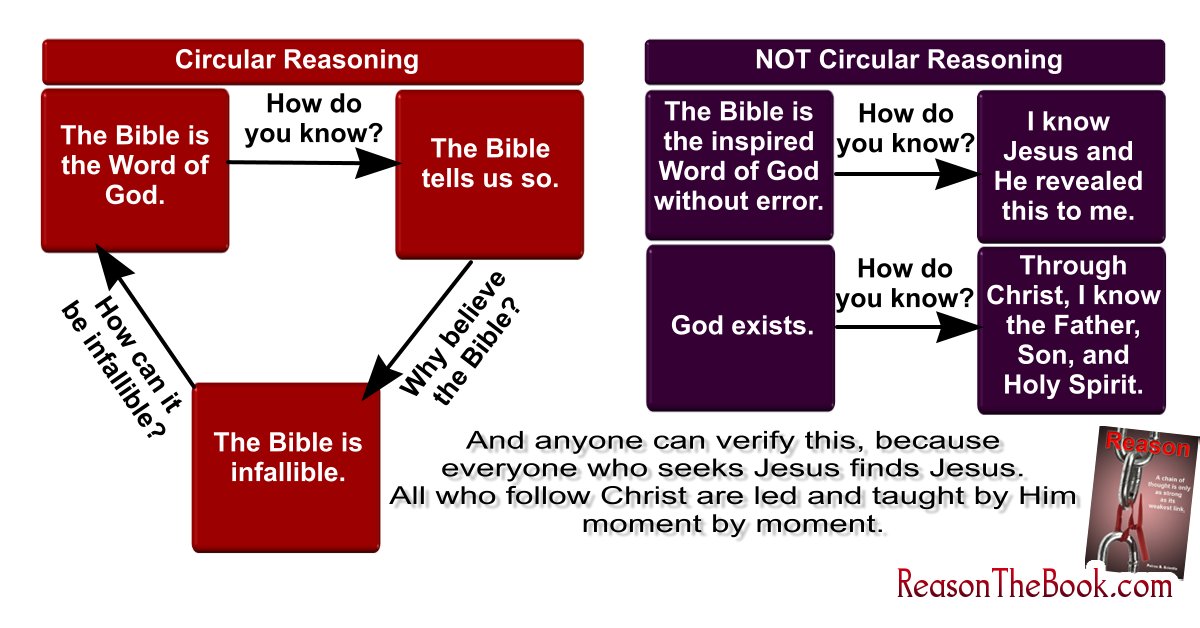
The circular reasoning straw man is a favorite fallacy for Secularists. Is it possible that some Christians actually do use this kind of poor logic? I hope not. A follower of Christ never needs to be irrational. A Secularist can never be rational, since a Secularist must base every thought on made-up stuff. For every interpretation of any observation, any experience, or Scripture, a Secularist must use made-up stuff. The fallacy is known as “axiomatic thinking.” It includes all the various methods of using made-up stuff to reason. Most logical fallacies are simply smokescreens to cover up axiomatic thinking fallacies. There are only two types of fallacies in the most basic analysis: axiomatic thinking and smokescreen. Circular reasoning is a smokescreen to hide axiomatic thinking. In the image on the left, there are two Divine revelations that are being presented as if they were axiomatic thinking fallacies that are being hidden by circular reasoning.

Christians never need to use fallacies. However, there is no way that any Secularist can prove any premise true without using axiomatic thinking fallacies. They only way to avoid axiomatic thinking fallacies is to listen to God and avoid adding to what He says. Divine revelation is the only way to avoid committing fallacies.

When Secularists use the straw man, they’re the ones using circular reasoning. They pull the unsupported assertion, “There is no God,” from their worldview. Then they reason from that axiomatic thinking fallacy. Beginning with the axiom, “There is no God,” they conclude,”God can’t possibly reveal that the Bible is His Word, since He doesn’t exist.” Also, based on the same circular reasoning, God would not be able to speak through Scripture. That’s why you can clearly state, to the Secularist, your experience with Christ. The Secularist, blinded by his or her own worldview, translates that as the Secularist straw man fallacy you see in red to the left.

Some people teach:

“The highest authority is always circular in reasoning. For example, the Bible is the word of God. How do we know? Because the Bible reveals this about itself.”

God is the Highest Authority. He isn’t circular in His reasoning, though. He does appeal to His own authority, since there is no other authority. That’s not the same as circular reasoning. It’s also not a faulty appeal to authority fallacy, since this is the only possible valid appeal to authority. If a book has authority, as the Bible does, it only has authority because God wrote it, preserved it to us, and currently speaks to us through it.

Some Christians don’t believe that God is active and working in their lives. They believe that they just have to use their own fallen minds to figure things out. They believe in the Bible, but they don’t interact with the God of the Bible. They never experience His Presence, leading, or teaching. They’re born again, but they lean on their own understanding. I pray that they do reach out and touch the Lord. That they begin to experience Him with all their spiritual senses so that they can know the difference between their own minds and the mind of Christ.


Facebooktwitterredditpinterestlinkedintumblrmail