
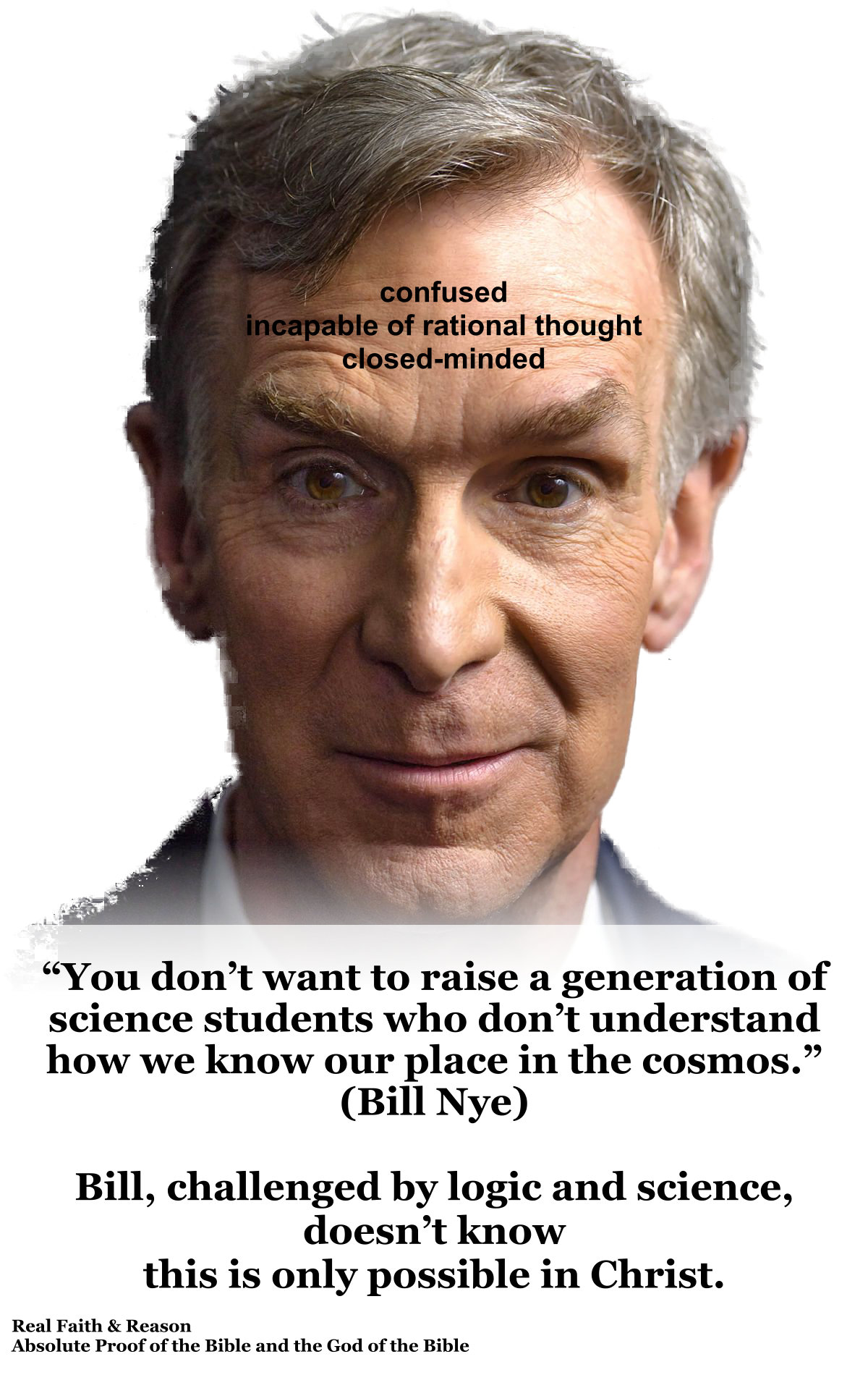
<quote from Real Faith & Reason>
“You don’t want to raise a generation of science students who don’t understand how we know our place in the cosmos.” (Bill Nye)
Ken Ham agreed with Bill’s point, yet Ken didn’t agree with Bill’s method of knowing our place in the cosmos because he didn’t think we could know our place through assumptions. Instead, Ken said the way to know our place in the cosmos is to allow God to reveal the interpretations of observations. Bill Nye, in direct opposition, said the way to know our place in the cosmos is to use a certain set of assumptions to interpret observations.
And Bill had a clever rationalization for using assumptions as his basis for thought. He claimed that assumptions are based on past experiences. While Bill’s rationalization might feel true to a person who hasn’t thought it through, our assumptions are only loosely linked to our filtered, distorted, and interpreted experiences and observations. We’ll examine the true source of assumptions in the next trip, and we’ll see that they come out of worldviews in a process involving circular reasoning and confirmation bias. For now, it’s enough to say we don’t really base assumptions on past experiences.
When Bill claims that assumptions are based on past experiences, he isn’t consistent. The claim blurs the line between make-believe and reality. Experience is real. If we listen to God, He reveals reality through experience, but human assumption-based interpretation of experience isn’t real. Assumptions are made-up. They’re make-believe. And if we interpret revelation or observation based on assumption, we run into the same problem. Reality is one thing. Assumption-based interpretation of reality is another thing. Blurring the difference between these two is insane.
And this problem with assumptions is almost universal since human interpretation often goes beyond reality. While we base part of our speculative interpretations on reality, we pretend that some made-up stuff is true. If we reason to conclusions based on what we made-up while we were interpreting, we make matters worse. To obscure reality even further, the irrational reasoning may use many complex steps to hide what’s happening. In this way, complexity helps hide two things: (1) the basis when the basis is made-up stuff and (2) the missing foundation for thought. As a result, human interpretation that allows even a single hidden assumption is just making believe. It’s just pretending.
To understand the contrast, we can consider how children make believe. We see that they base their make-believe partly on past experiences of reality, but their make-believe isn’t reality. Instead, their make-believe is always distinct from reality, and we call our ability to see this difference “sanity.” Conversely, if we lose our ability to tell the difference between reality and make-believe, we call this loss “insanity.” Children usually know the difference, while we adults often lose the distinction. Entire groupings of intelligent adults engage in mass insanity in a permanent state of pretending. That hardens their thinking against God, and they’re no longer able to come to Him in childlike surrender.
“Truly I say to you, if you are not converted and become as the little children, you shall never enter into the kingdom of the heavens.” (Matthew 18:3 Berean Literal Bible)
</end quote>
#RealFaith&Reason
Have you read this FREE book yet? “Real Faith & Reason” gives the absolutely certain proof of the Bible and the God of the Bible and shows how you can have real faith. This is faith that changes situations and transfigures you from glory to glory.
You can BUY it on Amazon, but you can get your FREE copy of Real Faith & Reason, which shows the intersection of faith, reason, truth, and sanity.
http://RealReality.org/Real_Faith_and_Reason_Vol_1_-_Scientia.pdf


