
<quote from Real Faith & Reason, vol 2>
Theories as a Way of Knowing
It’s popular to believe that theories bring us to understand reality as it is, and we’ve heard about theoretical science as opposed to empirical science. The word “empirical,” as in “empirical science,” means “by experience.” Empirical science isn’t theoretical science, and theoretical science isn’t empirical science. Instead, empirical science experiments and repeatedly observes, whereas theories make up stuff to go beyond observation and experience.
So empirical science is repeatable and verifiable experience and observation. In empirical science, we experiment to observe and experience a process and result. Then other people repeat this experiment and experience and observe the same thing.
As stated, theoretical science goes beyond experience when scientists try to guess why they might be observing what they’re observing. Of course, guesses can be correct or incorrect, and most guesses aren’t just a single guess but many guesses. So when we combine many guesses, some can be correct and some incorrect. As a result, the complex overall guess can be partly true, and something only partly true can be deceptive. In fact, many of the most deceptive and destructive lies are almost completely true with a little untruth mixed in. We need to remember that made-up stories, conceptual frameworks, theories, propositions, ideas, or other forms of made-up stuff aren’t the same as truth. We need to be aware of how easily we can accept these lies and insert them into our worldviews.
“Analysis of historical experience and the study of relevant sources again and again show the opposite of that which the positivists are yearning to cull from the chronicles of science. Scientific theories did not arise from experiments but IN EVERY SINGLE CASE designed by contemporary philosophical systems and the basic principles of religion and worldview.” ~ W Bohm
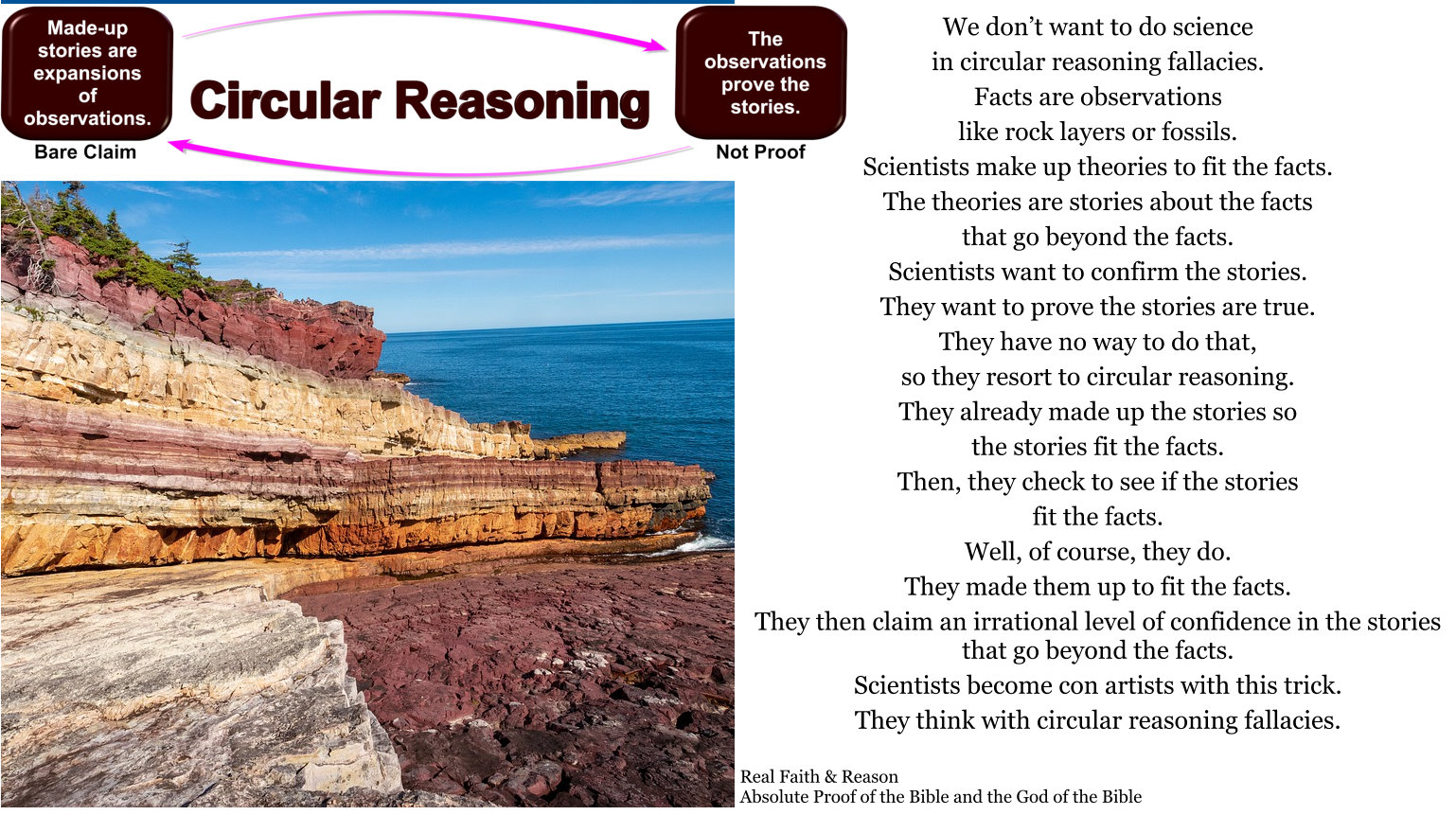
Theories explain by speculating about what we can’t observe or experience. We can get information from our five natural senses, but theories try to go beyond that. Theories are stories that we make up when we’re trying to explain what we can’t know through observation. And these stories expand observations and take observations out of their contexts. So, if we claim that the observations also prove that the stories are true, we commit the circular reasoning fallacy.
We don’t want to do science in circular reasoning fallacies. Facts are observations like rock layers or fossils. Scientists make up theories to fit the facts. The theories are stories about the facts that go beyond the facts. Scientists want to confirm the stories. They want to prove the stories are true. They have no way to do that, so they resort to circular reasoning. They already made up the stories so the stories fit the facts. Then, they check to see if the stories fit the facts. Well, of course, they do. They made them up to fit the facts. They then claim an irrational level of confidence in the stories that go beyond the facts. Scientists become con artists with this trick. They think with circular reasoning fallacies.
We don’t want to do science in circular reasoning fallacies. Facts are observations like rock layers or fossils. Scientists make up theories to fit the facts. The theories are stories about the facts that go beyond the facts. Scientists want to confirm the stories. They want to prove the stories are true. They have no way to do that, so they resort to circular reasoning. They already made up the stories so the stories fit the facts. Then, they check to see if the stories fit the facts. Well, of course, they do. They made them up to fit the facts. They then claim an irrational level of confidence in the stories that go beyond the facts. They think with circular reasoning fallacies.
We’re separating truth from fiction. Observations are one thing, but creative stories are another thing distinct from the observations. The stories are about the observations, but they aren’t the observations. Scientists don’t write stories that obviously conflict with what they observe. However, the stories are still stories, so if the stories avoid any obvious conflict with the observations, the lack of conflict doesn’t prove that the stories are true. Obviously, we can’t check the parts of the stories that go beyond experience and observation. And yet scientists and teachers often present theories as fact. They sometimes use coercion or bullying to create the illusion of truth by discouraging anyone from questioning or challenging the theories. As we consider this fallacy, it seems too obvious, and we might think that such obvious circular reasoning could fool no one. However, this exact method of circular reasoning has fooled millions of unsuspecting students worldwide, and it continues to do so.
<end quote>
#RealFaith&Reason
Have you read this FREE book yet? “Real Faith & Reason” gives the absolutely certain proof of the Bible and the God of the Bible and shows how you can have real faith. This is faith that changes situations and transfigures you from glory to glory.
You can get your FREE copy of Real Faith & Reason, which shows the intersection of faith, reason, truth, and sanity.
http://RealReality.org/Real_Faith_and_Reason_Vol_2_-_Scientia.pdf
Follow on
https://mewe.com/i/petrosscientia
https://gab.com/RealReality
https://parler.com/profile/Petros542287384712/posts


