
<quote from Real Faith & Reason, vol 2>
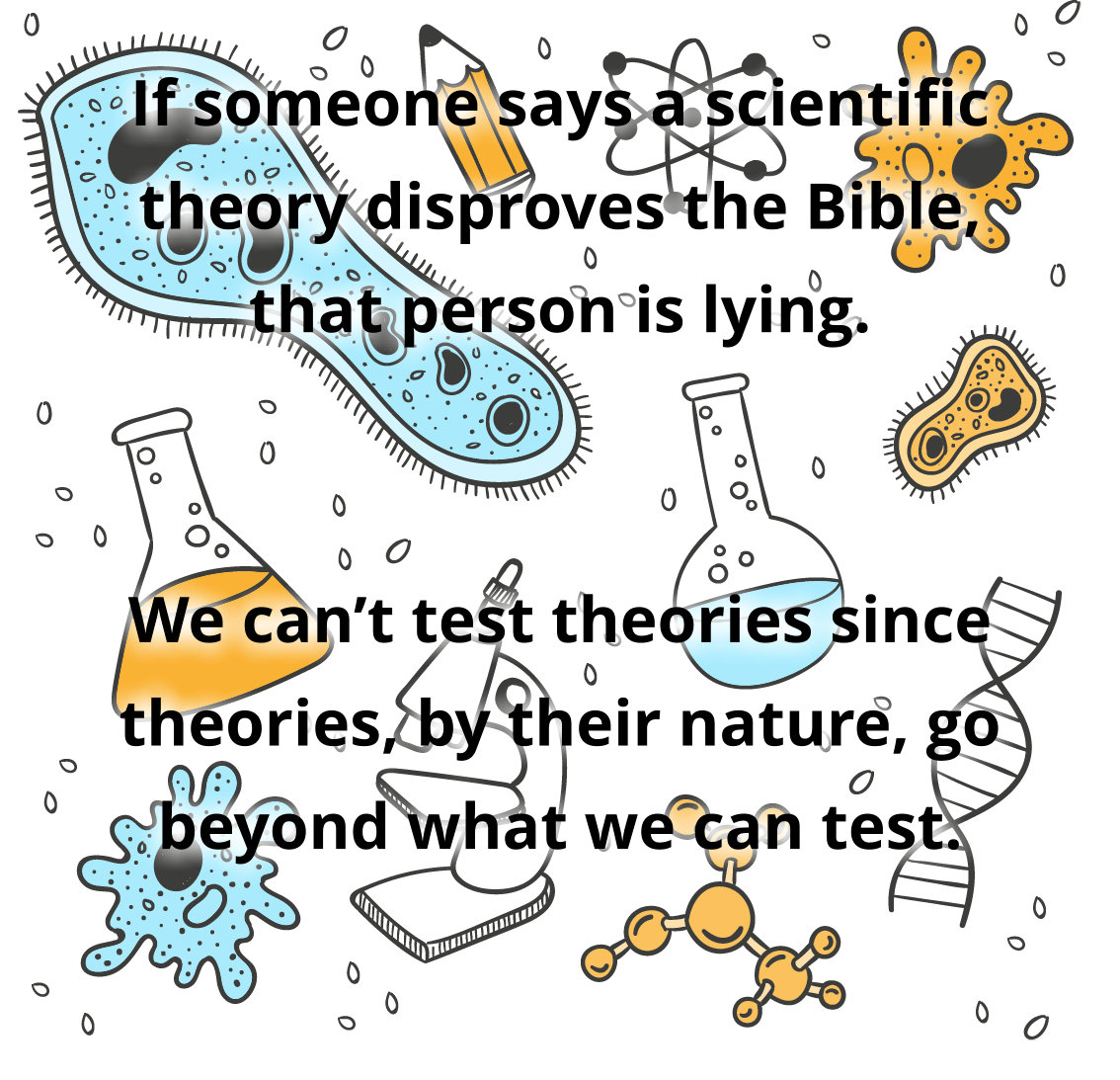
Another problem develops in calling a theory a “scientific fact.” A theory speculates to explain a set of scientific facts. Scientists determined the scientific facts by repeatedly observing and testing, so they have tested the facts. Scientists made up the theory to extend beyond what scientists observed and experienced, so they can’t test the theory. Therefore, even though we can repeatedly test and confirm observations and experiences, we can’t repeatedly test and confirm explanations other than to test to see if they conform to the current observations and experiences. We can’t test theories since theories, by their nature, go beyond what we can test. Scientists propose predictability as a way to test theories, but we’ll discuss the problems of the predictability way of knowing in the next section.
A theory isn’t an observation but rather a speculative explanation of an observation that goes beyond the observation. We can repeatedly observe to verify the observation. We can check to see whether any part of the explanation conflicts with any part of the observation. However, speculative explanations of observations consist of made-up stuff. We can’t observe or test speculative explanations because they go beyond what we can observe or test.
Here’s where the irrational error comes in. First, a theorist makes up a speculative explanation for a set of observations. Then the theorist uses those observations to prove the explanation has changed to the status of a theory. However, that’s merely a check to make sure the explanation doesn’t conflict with the observations. It doesn’t prove the theory is part of reality. The theorist confirms the explanation isn’t in conflict anywhere with what scientists observe. Sometimes, a theory conflicts with observation, which means the scientist created a weak theory. A desperate theorist may make up a just-so story to explain away parts of the conflict and rescue the speculative explanation. This just-so story is known as a “rescuing hypothesis.” In that case, the theorist can’t legitimately call the speculative explanation “a scientific theory.” However, most scientists accept some stories they must prop up with rescuing hypotheses. They illegitimately call these stories “theories.”
<end quote>
#RealFaith&Reason
Have you read this FREE book yet? “Real Faith & Reason” gives the absolutely certain proof of the Bible and the God of the Bible and shows how you can have real faith. This is faith that changes situations and transfigures you from glory to glory.
You can get your FREE copy of Real Faith & Reason, which shows the intersection of faith, reason, truth, and sanity.
http://RealReality.org/Real_Faith_and_Reason_Vol_2_-_Scientia.pdf
Follow on
https://mewe.com/i/petrosscientia
https://parler.com/profile/Petros542287384712/posts


