
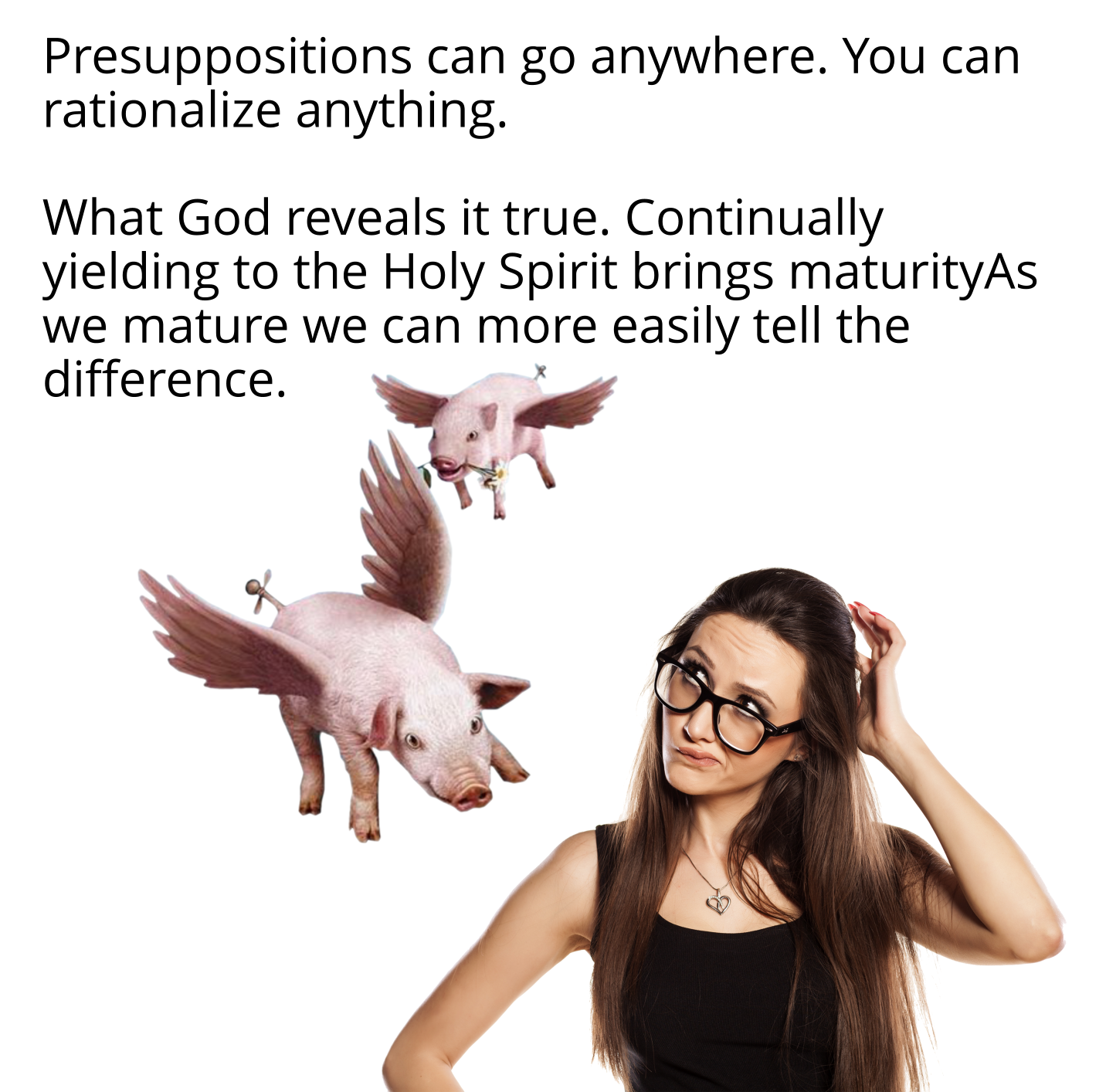
(quote from RealReality.org/Real_Faith_and_Reason_Vol_2_-_Scientia.pdf)
Here’s the definition of “presuppose” from the Merriam-Webster Dictionary:
1 : to suppose beforehand
2 : to require as an antecedent in logic or fact
Did someone design this second definition to be confusing? It’s not hard, but this definition of “presupposition” hides what’s really happening. It’s like a magic trick that’s performed by using language most of us never use. Here’s what “requiring as an antecedent” means: if claim one is true, then claim two is true, and we’re going to assume that claim one is true before we start reasoning.
If that’s too theoretical, don’t worry. In a moment, we’ll look at an example of flying pigs to make it easy to understand.
“If X, then Y.”
Therefore, requiring the antecedent is claiming that the antecedent is true without proof. We’ll need to break this definition down. The statement above is what’s known as a hypothetical proposition. Hypothetical propositions claim that one thing is true if another thing is true. And hypothetical propositions usually begin with the word “if.”
Here, X is the antecedent. “Y is true if X is true.”
“If pigs have wings, then pigs can fly.”
The definition says, “to require as an antecedent in logic or fact.” That means they’re going to assume that the if-part is true without proof, and it goes like the following:
“If pigs have wings (and we suppose beforehand that they do), then pigs can fly.”
This statement plainly admits that we suppose beforehand, but presuppositions don’t work to deceive us if we state them plainly. The power of presuppositions is in making presuppositions seem real. That goes back to the word “tacitly” from the Google definition, which means we’re going to pretend the presupposition is true and not just made-up stuff. So, persuaders don’t usually state presuppositions plainly. Instead, when they presuppose, they state the presupposition something like the following:
“Since we obviously already know that pigs have wings, pigs can fly.”
So this statement is what requiring the antecedent looks like, and in this statement, we find four nested presuppositions.
The first presupposition: I don’t want you to question whether pigs have wings, so I presuppose that pigs have wings by using the word “since” instead of the word “if.”
The second presupposition: I don’t want you to question the word “since,” so I ask you to evaluate whether you and I know that pigs have wings, and so I say, “We know.”
The third presupposition: I don’t want you to evaluate whether we know pigs have wings, so I presuppose that we know, and I presuppose this by using the word “already” for my third presupposition.
The fourth presupposition: While you’re trying to sort out whether we already know, I’ve presupposed that we already know. And I presuppose that “we already know” using the word “obviously.” But if you’re quick, you might ask me, “To whom is it obvious?” However, I’m hoping you can’t wade through all four presuppositions to challenge the claim that I want to insert into your worldview. I want you to think that pigs have wings. (I don’t really, but I’m just giving you an illustration.)
(end quote)


