This conversation begins with the skepticâs reaction to a post from a Christ-follower that we call âRocky Rockbuilder.â Rocky has just posted a few obvious facts as follows:
- Sound reasoning must be based on truth.
- If reasoning begins with untruth, it canât be rational.
- We canât make up stuff and base our reasoning on made-up stuff without being irrational.
- Skepticism is a claim that nothing can be known absolutely. Itâs self-refuting since it claims to know an absolute truth: that nothing can be known absolutely.
- The human mind has no path to truth without divine revelation. Therefore, the human mind is always irrational without the leading of the Holy Spirit. The only alternative to divine revelation is making up stuff, or lying.
- God is able to reveal reality to humans. What would stop Him? Those of us who follow Christ know that He does this since He does this constantly in our lives.
- Only divine revelation supplies true premises, a starting point of truth for rational thought.
These are obvious and testable facts since every one who seeks Christ finds Christ. Any skeptic can set aside his or her dogmatically-held belief in skepticism and come to Jesus Christ, listen to His voice, and be transformed. Anyone can make a real commitment to following Christ in this way and allowing Christ to do His works of righteousness through him or her.
When confronted with these facts, Skeptic are likely to argue against the truth. Of course, every argument they bring is based on made-up stuff. No argument they bring is rational since they have no path to truth as long as they resist Jesus Christ. So, they will argue for a while, but itâs very common for them to finally admit that they know nothing and then switch over to some form of argument where they claim that we, who know Jesus Christ, are in the same boat as skeptics who donât know Jesus Christ. Thatâs where we enter the following conversation.
<quote from Real Faith & Reason>
Letâs sit in on another conversation:
Sandy Sandbuilder: âAs to divine revelation, that premise itself would also lack proof, no?â
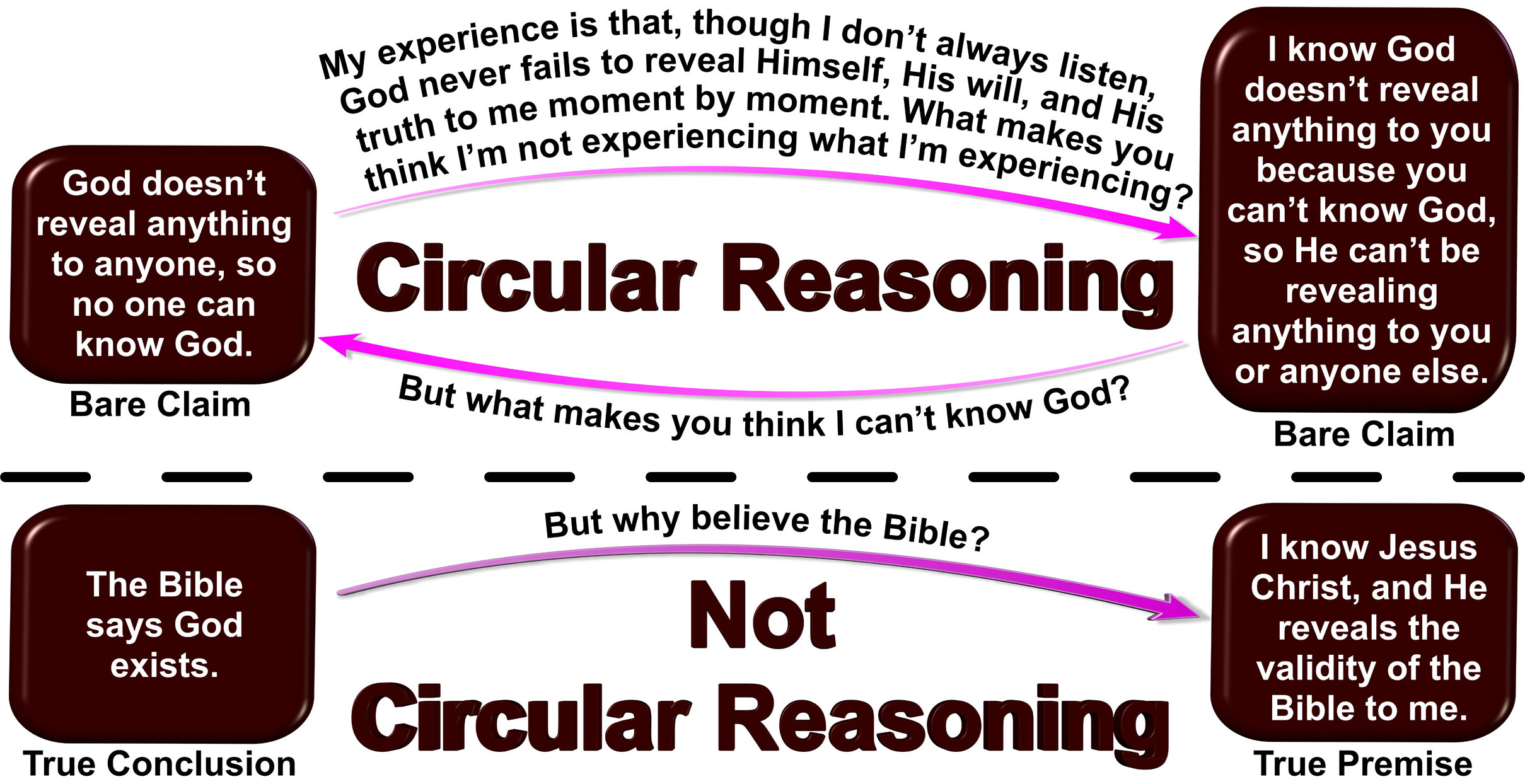
Rocky Rockbuilder: âYouâre saying that I have the same problem you have, that divine revelation as a premise also lacks proof. Thatâs a tu quoque fallacy. For several reasons, your tu quoque doesnât work. Do you want to know why?â
Sandy: âOf course, please explain.â
Rocky: âYou have no way to reason to your tu quoque other than by making up stuff. You make up a story. In your story, you say that the Almighty God isnât able to prove His divine revelation and make Himself and His revelation obvious. What possible mechanism would prevent God from revealing and giving us discernment? You canât prove your story. You canât even prove it to yourself. And yet, God does reveal Himself to me and to anyone who seeks Him. He reveals Himself explicitly, so we donât have to guess. You can test my claim by seeking Him. I can also test your claim and find it false.â
Sandy: âI would like to know whether one personâs divine revelation should be accepted by another as true if they have not themselves received it. If so, how do we distinguish between competing claims of divine revelation?â
Sandy Sandbuilder didnât answer the question. Ungodly thinkers can use various techniques to dodge questions about their bare claims or they can answer the questions irrationally. They donât have other options. The question was, âWhat possible mechanism would prevent God from revealing and giving us discernment?â Sandy didnât answer because he had no answer. Heâs just blowing smoke. Instead, he changed the subject.
Rocky: âYou ask if you should accept another personâs claim of divine revelation if you havenât received the revelation. I suppose you may be thinking this person would be asking you to trust them. However, if it is divine revelation, they arenât asking you to trust them. If itâs truly revelation, youâve received it. If itâs divine revelation, Jesus Christ is asking you to trust Him as He speaks through them. Christ teaches us that those who follow Him ought always to speak or write by the Holy Spirit. He says we should speak as His oracle. He says whoever rejects those who speak by His Spirit rejects Him directly. Whoever rejects Him rejects the Father directly. But what if the person isnât speaking by the authority of the Holy Spirit? If you seek God, Heâll give you discernment to recognize and reject the false teacher or false prophet.â
Sandy: âBut I donât believe in God, so why would I seek His mind?â
Rocky: âGod has also revealed one thing most disbelievers find disturbing. He says He revealed Himself, and a lot about Himself, to every person. Some people refuse to respond to Him. They then suppress this truth in their unrighteousness [deceitful trickery]. They reject Him because they love darkness rather than light since their deeds are evil. Otherwise, they would come to Him. They know that Jesus Christ would lead them out of their sins, and they donât want that. They love their sin and independence from God. As God says, they have no excuse. Most disbelievers find this fact disturbing and hard to accept, but it means you already know. You know God exists and you know a lot about Him.â
âBeyond that, anyone can test the reality of Jesus Christ without any equipment or expense. No one has to take someone elseâs word for it. All who seek Christ find Christ. Of course, they canât deceive God. They must come with sincerity, persistence, respect, and submission to Christ. They must want Christ to set them free from sin.â
Through the mouths of those who wonât come to Christ with an open mind, God confirms the revelation He gave us through Scripture that those who reject Him are willingly ignorant. They know. They wonât come to Him with sincerity, persistence, respect, and submission even though they donât need to buy anything or even inconvenience themselves. They know about the spiritual cost intuitively. They know that they would have to give up their sinful thoughts, words, and deeds. Theyâre comfortable as slaves of Satan.
At this point, Sandy Sandbuilder said axiomatic reasoning is reasonable and useful in all sorts of circumstances. Hereâs where heâs confusing two methods of thinking. He has a brute-beast mind that can react to his five senses. He can make pancakes and learn about burning them. He can avoid the problem next time he cooks pancakes. He can work within what he learns from his five senses. However, when he tries to extrapolate beyond his five senses, heâll be irrational.
Animals react to their five senses and learn, too. And Sandy would say, so what? Heâs just an evolved animal. He can project from his sense data. He can see whatâs happening ahead of him on the road as heâs driving and hit his brake or step on the gas as needed. Heâs calculating the results of speed and how long it takes to slow down or speed up. He sees a car veering all over the road and gets away from it, extrapolating that information as a warning sign. Besides sense data, God gave him instincts. He can follow those. And though he wonât thank God for it, God also guides him. God helps all of us. He warns us of danger. He tells us of opportunity. His rain falls on the wicked and the righteous. Christ is the Light that lights every person who comes into the world.
Though Sandy has great ability within his brute-beast mind, he canât think beyond his five senses and still be rational. He canât tell the difference between what God reveals and what his own mind makes up. Sandy canât discern the difference between what his own mind makes up and what a demon tells him. He certainly canât reason to the conclusions he wrote about online in the conversation we just followed. He reasons to these conclusions based on axioms. Axioms consist of made-up stuff. Made-up stuff isnât reliable information.
When he says axiomatic reasoning is reasonable and useful in all sorts of circumstances, he says heâs rational to make up stuff and call the made-up stuff true. He thinks that he can base all his reasoning on made-up stuff and he says it makes sense for him to reason this way. Of course, he says axioms arenât made-up stuff. He says axioms are so obvious that he can take them as proved though theyâre not proven. But how can they be obvious if we canât prove them?
He also thinks itâs okay if we each have our own made-up stuff, and your made-up stuff can conflict with his made-up stuff. He says neither one is ultimately true, but you can use your made-up stuff, and he can use his made-up stuff for sound reasoning. Then two people can come to conflicting conclusions when both are using sound reasoning. He really says that.
Sandy: âTaking divine revelation to be an axiom, as you said, isnât binding on those who havenât received it. I further challenge whether those who HAVE received it and hold it axiomatic, are correct.â
Rocky: âI never said âTaking divine revelation to be an axiom.â We donât hold divine revelation axiomatic, as you claimed. Youâre trying to put your words in my mouth. We donât offer axiomatic reasoning as a way out. Axioms are made-up stuff. Rather than axioms, we experience divine revelation in an ongoing flow from the Holy Spirit Who never leaves us or forsakes us.â
âYou say Christ didnât reveal Himself to you, but He has. Heâs revealed Himself to you through me. Heâs also spoken to you in many other ways. God has revealed Himself to you through the things He created, but youâve suppressed His truth in your deceitful trickery.â
âChrist leads, teaches, and corrects every person who follows Him moment by moment, and Christ is how we know. When He speaks to us, faith comes. Faith is reality as opposed to concept, and faith is the only proof possible to prove anything. Jesus Christ authors it, and only the Almighty, All-knowing, Creator God Who cannot lie can establish any truth. If we hold divine revelation as an axiom, we forsake Christ and begin following the fallen human mind. God wants a relationship. He doesnât want theoretical believers.â
âGod doesnât give anyone responsibility to convince you or persuade you. He holds you responsible since He provides the revelation you need. Heâs very clear on this fact. Those on the side of truth listen to Christ. Many other voices exist, but God equips you to discern truth if you desire righteousness and truth.â
Sandy: âAxioms arenât made-up stuff. Theyâre things that seem so self-evident we accept them without challenge. An example would be the âexcluded middle,â which is the impossibility for something to be both true and false at the same time.â
âGod has certainly not revealed himself to me in the things he has created, not even when I prayed for such a revelation.â
Rocky: âAxioms are unproven claims, yet we accept them as if we had proved them. However, we have to be careful not to confuse divine revelation with made-up stuff. If we wonât acknowledge Christ, weâll see everything the same. We make no difference between made-up stuff and reality. However, we do see conflicts between whatâs in our worldviews and whatâs in other peopleâs worldviews. We also see conflicts between whatâs in our worldviews and what God reveals. Whatever we firmly establish in our worldviews seems âso self-evident we accept it without challenge.â For instance, God reveals that something canât be true and false at the same time. A person without Christ would take this truth as an axiom. A person with Christ hears this truth from Christ at the moment God says it to that person. A Hindu says that things can be both true and false at the same time and in the same way and that you donât understand Eastern philosophy. To the Hindu, what you call âself-evidentâ is nonsense.â
âGod has indeed revealed Himself to you. As I said, God says He reveals Himself to every person, and most disbelievers find this fact disturbing. He reveals Himself to you today in the words that Iâm saying to you. You canât hear Scripture quoted or read a verse without hearing His voice. You canât look at any part of creation without Him revealing Himself to you. However, you can reject Him. You can refuse to acknowledge Him. One of the things I noticed about the way you express yourself, you look for reasons not to believe. You approach God with animosity and skepticism, with a closed mind. You look for ways to screen Him out. You must come as a child, full of wonder and acceptance of Him. He wonât force Himself on you if you donât want Him. When you come with every intention to prove that He isnât there, He knows your heart better than you do. He turns you over to your own corrupted mind. The fall corrupted every human mind. Our minds arenât capable of rational thought without divine revelation.â
Sandy Sandbuilder is a skeptic who believes that he canât know anything for certain. He claims that he was once a Christian who knew Christ. Then, he decided that he didnât know anything and questioned everything he once believed. He became dogmatic enough about his disbelief that he now looks for every opportunity to argue against Christ. The trouble is that he bases every argument he makes on made-up stuff, so every argument he makes is irrational.
Hereâs another point from the conversation:
Rocky: âGod teaches those who follow Him to communicate guided and empowered by the Holy Spirit. He says, âSpeak as His oracle.â He says whoever rejects His words as He speaks through His followers rejects Him directly. Whoever rejects Him rejects the Father directly.â
This point means that God spoke to Sandy Sandbuilder during this conversation, but Sandy rejected God. Sandy refused to acknowledge God. He has closed his mind to God.
During this conversation, Sandy tried to prove three things. He wanted to prove that he was open to God, but that it was Godâs fault that he couldnât find God. He wanted to prove that he could be rational without a true premise. And he looked for ways to question knowing anything by divine revelation. Weâll go over a few of Sandyâs comments to see how he argued.
Sandy Sandbuilder has done his part. He tried. He implies that God failed him.
Sandy: âI have been completely open to being convinced of Godâs existence by revelation or reason on several occasions in my life.â
We notice that Sandy isnât open now. Heâs become dogmatic. Heâs entrenched in His philosophy and unwilling to challenge His own dogma. Sandy insists that he can think rationally by depending on axioms as long as he sincerely feels that those axioms are obvious. Weâll go into some detail on this journey to find out why our axioms, even the false ones, seem so obvious to us.
Sandy: âI must have received divine revelation since I appear capable of at least some rational thought. Since I am not conscious of having received revelation, the word ârevelationâ does not seem appropriate to whatever I may have received from God.â
Sandy receives revelation. He refuses to acknowledge God, so he canât tell the difference between what he makes up and what God reveals to Him. Most of what God shows him, he rejects. The revelation Sandy accepts seems like something obvious that he got from some unknown source. He puts his made-up stuff into the same category. He makes no difference between the two. And because he continually and consistently refused to acknowledge God, thank Him, and give Him the glory, God turned him over to his own corrupted mind. As he continues to disrespect and ignore God, even trying to convince Christians to stop following Christ, he hardens his mind against God. He develops disbelieving answers for every approach the Holy Spirit may make toward him. His senseless mind is darkened. The following quotes show how he claimed to be rational without a true premise:
âThe thought was rational, even though its premise and conclusion later turned out to be false.â
âItâs entirely possible to have rational thought of correct form without ultimate certainty in its premises.â
Though Sandy canât be sure of anything, heâs sure that he can reason rationally without a true premise. But he can only state bare assertions. He exposed his useless definition of ârational thought.â He thinks that valid form is rational thought, but sound logic must also have true premises. Rational thought is sound reasoning, not merely valid form.
When Sandy says âof correct formâ heâs pointing out a failure of the education system. Schools teach that correct form is all we need for sound logic. Sandy feels that heâs reasoning rationally even though he uses premises that may be false. He thinks rational thought only requires valid form. Consider the sociopath who thinks itâs OK to murder people on Tuesdays. This claim seems obvious, so the sociopath takes it as an axiom. Sandy is saying that the sociopath is rational if he uses this axiom about murdering people on Tuesdays as a premise. Hereâs this valid form with a false premise:
Sociopath: âItâs OK to murder people on Tuesdays. Itâs Tuesday. Therefore, I can murder people today.â
The form of the sociopathâs logic is valid. Sandy is saying that a sociopath can make this statement rationally as long as the sociopath feels that itâs obviously okay to murder people on Tuesdays.
Sandy also insisted that he couldnât know anything for certain. And yet, he doesnât claim his uncertainty in uncertain terms. Heâs certain of his uncertainty. How can he be so certain that he canât be certain about anything? Here are a few of Sandyâs claims about not being able to know:
âI have no way of knowing anything.â
âI have not denied that divine revelation may be possible.â
âYou are certain about some things, unlike me; Iâm uncertain about everything.â
âI do not believe such a proof (for or against God) is conceivable, or necessary.â
Disbelief is a form of belief. Itâs belief in not believing. Sandy doesnât just express a lack of belief. He willfully disbelieves. When he says âis conceivable,â we can see his desire to push the possibility of knowing God as far from himself as he can. When he says âor necessary,â heâs rationalizing a complete theology and concept of the spiritual and natural world. Since he canât be certain of anything, how is he so certain about his belief? Why would he willfully disbelieve God? Hereâs what he said as he looked back at when he was a Christian:
âI found I could not at all distinguish between the things I was convinced were revelations and the things that turned out to be wishful thinking.â
Sandy Sandbuilder brings up something every Christ-follower must overcome. We do find out that weâre wrong sometimes. We find out that we misinterpret God as He speaks to us through Scripture, intuition, the created world, or any other way He communicates. We find that teachers tell us things we believe, and we later, sometimes decades later, realize that those teachers were wrong. The only reason weâre ever deceived is that weâre immature in Christ. We havenât grown to His fullness. We have a fleshly nature thatâs deceitful and desperately wicked, so we all make many mistakes. However, as we focus on Christ and His will, He continues to correct us where weâre wrong. As we forsake our own will and our own strongly held opinions, He reveals truth. We need patience. We have Christ rather than dogmatism.
We canât look into Sandyâs past when he was a Christian and see the experience heâs describing, so we donât know if it was real. If God did reveal reality to him, he looked back at those revelations at a certain point and convinced himself that Godâs revelation was wishful thinking. Then he knew HE COULDNâT BE CERTAIN of anything, YET HE WAS CERTAIN he couldnât tell the difference between Godâs revelation and wishful thinking.
If God didnât reveal, but Sandy Sandbuilder just believed the things he wanted to be true, thatâs a different story. Sandy may have wished for a million-dollar check and imagined that God told him it would come on April 30th of 2012. We donât know what Sandy means by ârevelations,â but weâre just giving an example of what these revelations might have been. Perhaps a pastor told him to name it and claim it, but, for obvious reasons, God didnât honor Sandyâs claim. If Sandy had cared about Godâs will and submitting to Godâs will, he would have been seeking Godâs mind continually. If he was wrong, the Holy Spirit would have corrected him at some point and told him that he was prophesying a vision out of his own heart. The Holy Spirit would then have revealed the truth He wanted Sandy to know, and Sandy may have received this truth from the Holy Spirit, or he may have rejected this truth since he didnât want to hear it. He may have decided to get rid of God if God wouldnât be his vending machine to give him his own will. Then, he may have directed his mind to believe that he couldnât be certain about anything.
Heâs inside his bunker, protecting himself from God by willful ignorance. He said he couldnât know the difference between what his mind makes up, what demons tell him, and what God reveals, but only in the ultimate sense. He didnât say what the âultimate senseâ is. Heâs not uncertain about his uncertainty. Heâs certain that heâs uncertain about everything. And Heâs certain that God hasnât spoken to Him. He said, âGod has certainly not revealed himself to me.â And yet, he canât see that heâs conflicted with himself in describing his certainty and his universal uncertainty at the same time and in the same way.
He thinks he has moral flaws, yet he doesnât admit to a lawgiver. He doesnât know of a source of morality. Heâs eliminated every means by which God could give him an understanding of right and wrong with certainty. In all likelihood, he tries to follow Godâs Laws, since God reveals these Laws to every person. However, he refuses to acknowledge God or give Him the glory.
We can see why Jesus said, âI tell all of you with certainty, unless you change and become like little children, you will never get into the kingdom from heaven.â
Sandy Sandbuilderâs thinking is similar to the thinking of many who reject Christ. A person who is open to Jesus Christ wonât defend thinking based on made-up stuff while trying to find a way to prove that those who follow Christ arenât experiencing what theyâre experiencing. (video: Scooby-Doo and the Skeptometer https://youtu.be/YrGVeB_SPJg)
</end quote>
#RealFaith&Reason
Have you read this book yet?
You can BUYÂ it on Amazon, but you can your FREE copy of Real Faith & Reason, which shows the intersection of faith, reason, truth, and sanity.
http://RealReality.org/Real_Faith_and_Reason_Vol_1_-_Scientia.pdf