Deeper in the Safety of Christ

In a world that’s full of terror and fear, we can have full confidence in our Lord Jesus Christ. He’s our protector and defender. And yet, we do sometimes fear, don’t we? What’s the answer? How can we always be confident and fearless?

The question is like the question of a child who asks, “How can I be big.” We want to be mature and complete, but maturity takes time. The Bible says that we go from glory to glory and from faith to faith. It’s a progressive experience and an ever new and exciting way. As we go through many testings, the Holy Spirit imparts a greater measure of faith. We have less of the fearful nature and more of the confident, fearless nature of Christ. We just need to keep on keeping on.

Facebooktwitterredditpinterestlinkedintumblrmail

Naturalism Means No God

Naturalism is Another Way to Say “No God.”

Naturalism is an assumption that ungodly thinkers accept as an axiom. The term “axiom” means that they are just going to believe it and never question it. Naturalism makes many claims. One of those claims is that God does nothing, that He has no impact on His creation. It’s not the same as the philosophy of materialism or the philosophy of atheism, but it’s closely related since all of these are aspects of ungodliness.

What’s the opposite of Naturalism? Godliness is exactly the opposite of naturalism, atheism, and materialism. But what is godliness? What do ungodly people say about it? Google thinks that godliness is the quality of being devoutly religious.

Ungodly people can’t bear to think about Jesus Christ as a real person, so they try to put in into various boxes. They put Him into a box called religious. They have another box called theology and another one called doctrine, but none of those is the Creator God. None of those is Jesus Christ.

God speaks to us through the Bible, and He says that He’s working toward the day when He’ll conform us to the image of Christ.

And we know that God works all things together for the good of those who love Him, who are called according to His purpose. For those God foreknew, He also predestined to be conformed to the image of His Son, so that He would be the firstborn among many brothers. ~ Romans 8:28-29

We may not be very well conformed to the image of Christ right now, but God has a plan. In His plan, we will be conformed to Christ’s image. We’ll be in submission to Him to the point that we never rebel against Him in anything. That starts with being born again, which mainly affects our spirits but seems to affect our minds/souls also. The present battle is for the mind, and it has to do with reason. God says, “Come, let us reason together.”

As it works out, rational thought is impossible without Jesus Christ, and rational thought is impossible without faith. You may not have ever heard anyone tell you this, but every pastor everywhere ought to be telling people about this. It has to do with the way God designed logic. Logic is all about what we can know. By the way, the word “logic” comes from a Greek word “logos.” You may have heard about “logos” since it’s a Greek word in the Bible that refers to Christ. “Logos” means “utterance.”

Another Greek word also means “utterance,” and that Greek word is “rhema.” Both of these words that mean “utterance” are usually translated as “word.” “In the beginning was the logos.” “In the beginning was the word.” “Faith comes by hearing and hearing by the rhema of God.” Faith comes by hearing and hearing by the word of God.”

Faith comes by hearing the utterance of God. God speaks through Scripture and every means that He mentions in Scripture. When He speaks, faith comes. Speaking through the Bible, God says that faith is substance. Here, the word “substance” means reality as opposed to concept. And yet, ungodly thinkers try to confuse that issue. They try to make it seem as though faith is conceptual rather than substantial. God also says that faith is evidence, and, in this case, “evidence” means absolutely certain proof. And yet, ungodly thinkers try to insinuate that faith is the act of believing without any evidence. The reason that faith is substance and evidence is that it comes when God speaks. Whatever God says is a fact. Whether He speaks to us through the Bible, a pastor, our consciences, our intuitions, His creation, or any other means, what He says is a fact. As we mature in Christ, we’re better able to discern between His voice and all the other voices out there. But we must focus on Him. Whoever seeks Him finds Him, and we continually find Him more completely as He transfigures us into the image of Christ.

When ungodly thinkers say that faith isn’t substance and faith isn’t evidence, they’re projecting the problems of their ungodly thinking onto those who follow Christ. The only way to be rational is to follow Christ, and the reason is very simple. Rational thought must have a starting point, and that starting point must be true. The starting point can’t be made-up stuff.

However, ungodly thinkers have no way to have a starting point that’s true. Each time they come up with something that they think is true, they have to come up with a reason that they think it’s true. So they look for something that’s true to prove whatever they claimed was true. They end up in an infinite regression of unproved proofs. They can’t escape this, so they use axioms. Axioms are claims that they make up and believe to be true without proof. They do this very cleverly, so it seems to make sense unless we really press them. When we press them, we find that they’re very hard to pin down. Once we pin them down, they’ll finally admit that they’re making the whole thing up, but then they’ll accuse us of having their same problem.

We don’t have their same problem. We have Christ. We’re learning to hear His voice and to respond in submission. This process of submitting to the point of letting Him do His works through us by grace—this process is what makes us mature. With maturity comes increasing discernment. On this Road (Christ), we may make honest mistakes, but God sees our hearts and that we’re seeking Him, so He picks us back up if we fall. If we leave the Road for a moment, He’ll put us back on track. As long as we’re humble before Him, He’ll see it through. If it depended on us, we would be lost, but we have a great and loving God Who takes care of us.

Facebooktwitterredditpinterestlinkedintumblrmail

No Foundation

I continually have conversations with atheists, evolutionists, and other such ungodly thinkers where the conversation follows what has now become a familiar course. The reasoning goes like this: I know that God doesn’t exist (or God doesn’t reveal anything to anyone or God doesn’t speak through Scripture, or God doesn’t reveal Himself to me, or the stories of evolutionism happened, or the earth is billions of years old, or something else). It starts with a bare claim, usually with some form of smokescreen fallacy.

From there, I tell them that God speaks to me and to everyone who follows Christ. He speaks through Scripture and every means that God mentions in Scripture. He tells me that Scripture is accurate and that I can continue to know Christ better as I listen to Him and respond in willing submission. I’ll also note that a true premise is needed to prove any conclusion, and a true premise is impossible without divine revelation. What God says is a fact. What I say will vary depending on what God gives me to say, but it will say something like that.

The ungodly thinker will then argue that his or her reasoning is based on a true premise—that the ungodly thinker can self-generate true premises from nothing. This argument can take many forms, but it’s always a defense of the ungodly thinker’s made-up stuff. At the same time, while basing all thinking on made-up stuff, the ungodly thinker will claim to know that no follower of Christ can really hear Christ’s voice. This argument usually goes to the point of claiming that, because of human weakness, God can’t possibly communicate with human beings in a meaningful way. Of course, the ungodly thinker is basing this entire argument on made-up stuff.

Have I seen any of these ungodly thinkers turn to Christ as a result of these conversations? No. Even when they admit that they’re making up their entire argument, they refuse to turn to Christ. When I invite them to know Christ and verify His existence that way, they refuse to seek Him. Often, they will flippantly say, “OK. I tried seeking Him, and nothing happened.” Mostly, they ignore the invitation, which is apparently very scary for them.

In many cases, the evolutionist, atheist, or other ungodly thinker will create a convoluted argument that follows a kind of butterfly logic. It becomes difficult to pin them down to find out the basis of their thoughts. When I’m able to pin them down, they have some kind of justification for basing all their thoughts on made-up stuff. Based on this made-up stuff, they rationalize that they can know that no one can know God.

What can we learn from this?

Facebooktwitterredditpinterestlinkedintumblrmail

The Atheist God Complex

I’m posting this conversation because it’s an excellent example of the convoluted and deceptive reasoning that comes from the fallen human mind. Those who are familiar with my blog are aware that the human mind has no way to self-generate truth. It can’t conjure up truth without a source for truth. It can react to its environment in the same way that an earthworm can react to its environment or a raccoon can react to its environment. It can’t find a way to reason to a conclusion beyond that environment. For instance, it can do science, which is always pragmatic and practical. It can’t reason rationally about right, wrong, the nature of knowledge, spiritual matters, or the nature of reality. It can’t even prove the existence of a real world. God, on the other hand, reveals right, wrong, the nature of knowledge, spiritual matters, the nature of reality, and the fact that the world around us is real.

The most irrational arguments are the hardest to refute. The refutation tends to become long and hard to follow because of the irrationality of the original argument. Here’s the conversation, but we’ll stop once in a while for critical thinking:

Rockbuilder: Ungodly thinking can’t possibly produce a rational thought that leads to a true conclusion. The problem of infinite regression prevents ungodly thinking from having a true premise. Without a true premise, rational thought is impossible. Only divine revelation can provide a true premise.

Sandbuilder: You don’t need God to have rational thought. Even if a supreme being were necessary, Brahman could easily be the ground for it instead of God. So your last statement is a bare assertion unless you’re using “divine” loosely to allow for any supreme being.

CRITICAL THINKING ****************

Sandbuilder said, “Brahman could easily be the ground for it instead of God.” Sandbuilder just claimed that a demon is just as credible as God. This statement is patently false. Demons lie, but God can’t lie. The most important thing to know is the source of Sandbuilder’s claim. He made it up. It’s an axiomatic thinking fallacy. As we’ll see, Sandbuilder thinks it makes sense to use axiomatic thinking fallacies as the basis of reasoning. The reason that axiomatic thinking is a fallacy is that axiomatic thinking in making up stuff and then calling the made-up stuff “true.” That’s the definition of insanity.

*********************************

Sandbuilder: Divine revelation is a red herring. Even if we grant that a divine revelation could provide a true premise, which already is a shaky precept, it is impossible for a fallible human to know that any given experience of divine revelation is not a case of self-deception. If you cannot tell a genuine divine revelation from a fake, you have no argument.

CRITICAL THINKING ****************

Sandbuilder said that it’s a shaky precept to say that divine revelation could provide a true premise. This is another axiomatic thinking fallacy that claims god-like omniscience. Sandbuilder is claiming that God can’t reveal knowledge. What would prevent God from doing so?

Sandbuilder said, “It is impossible for a fallible human to know that any given experience of divine revelation is not a case of self-deception.” Here is Sandbuilder, who has no way to self-generate a true premise to prove any conclusion, but now he claims to know that God can’t reveal in a way that those who follow Him know that God is God and know the difference between God’s voice and their own human minds. Satan says that you can’t know. Satan says, “Hath God said?” He said that to Eve in the Garden of Eden.

*********************************

Rockbuilder: Making unsupported assertions like you just did is irrational.

Sandbuilder: Can someone receive divine revelation, but in reality be deceived?

If your answer is yes, then my point is valid.

If your answer is no, then that means all claims of revelation are true, even those from different and mutually exclusive gods.

If your answer is “For everyone except me and my god” you need to demonstrate this before you can use it as a foundation.

So you’re in the same boat as the atheists, you’re just lying to yourself about it.

CRITICAL THINKING ****************

We’ll start with Sandbuilder’s conclusion since it’s the crux of his problem. “So you’re in the same boat as the atheists.” Sandbuilder is committing a classic tu quoque fallacy stated very plainly. Tu quoque means “You too.” The reason that a tu quoque fallacy is a fallacy is that it doesn’t solve the original problem, but it’s an admission that the original problem is real. The original problem is that there is no way rationally to come to any conclusion without divine revelation. Sandbuilder just admitted that, but he said, “You too have the same problem since no one anywhere can rationally come to any conclusion.”

Why is that a problem? Sandbuilder didn’t solve his first problem, which is that he can’t come to a rational conclusion about anything because he can’t have a true premise. He believes that an axiom is enough, but axioms consist of made-up stuff. But it’s irrational to say, “I made us X, and that proves Y.” Made-up stuff can’t prove anything.  Sandbuilder still has this problem. He admits it. He says, “You too have the same problem because I conclude that the Almighty God is incapable of communication in a meaningful way.”

Therefore, Sandbuilder is admitting that any conclusion is irrational, but yet he thinks that his conclusion about the limitation of Jesus Christ is rational. His conclusion that says, “Almighty God is incapable of communicating in a meaningful way,” is a claim of amazing knowledge of the spiritual realm and the nature of God. For an atheist, that’s an irrational claim. And yet, claiming to have this amazing knowledge, Sandbuilder can’t muster up a true premise for even the most simple conclusion. Of course, looking at the rest of what Sandbuilder wrote bears out his problem with reasoning.

Now, let’s examine Sandbuilder’s conclusion that takes the form of a three-pronged trilemma. We’ll look at each one and show the irrationality of all of them.

Prong #1: Can someone receive divine revelation, but in reality be deceived? If your answer is yes, then my point is valid.

No one can receive divine revelation but in reality, be deceived. He’s presupposing no God. Presupposing is a form of the axiomatic thinking fallacy. Someone can think that he or she is receiving divine revelation and be deceived, but this only happens when the person is deceived by his or her fleshly desires. And we all deceive ourselves at times. However, if we truly desire to do God’s will, He’ll correct us, we’ll receive or correction, and He’ll set us back on the right path. Every person who follows Christ has this experience of divine correction. So, the answer is No, but Sandbuilder is misstating the problem. He’s misstating the problem because he’s imagining the problem using his fallen mind that’s incapable of rational thought. In any case, Sandbuilder’s point isn’t valid.

Prong #2: Can someone receive divine revelation, but in reality be deceived? If your answer is no, then that means all claims of revelation are true, even those from different and mutually exclusive gods. That way absurdity lies.

We’ve touched on this already, but the answer is No. No one can receive divine revelation and be deceived by divine revelation. God deceives no one.

Sandbuilder’s conclusion is totally irrational, although his grammar makes his thought unclear. It is clear that he’s equating everything that humans call “a god” with the Almighty God Who created all things. That’s the type of nonsense that happens when a human being based reason on made-up stuff. Now, idols made of stone, wood, or gold cannot speak. They’re incapable of articulate speech. However, demons are created beings who have also fallen away from God just as mankind has fallen away from God. Demons speak, but they lie. God speaks, but He can’t lie.

Prong #3: Can someone receive divine revelation, but in reality be deceived? If your answer is “For everyone except me and my god” you need to demonstrate this before you can use it as a foundation.

Sandbuilder, like all people, know that Jesus Christ exists, and he knows a lot about Him. Sandbuilder knows this so well that God says that Sandbuilder is without excuse. He knows. He refuses to acknowledge Jesus Christ, the Creator God because Sandbuilder’s deeds are evil. God reveals these facts, and God doesn’t require that we “demonstrate this” to Sandbuilder since Sandbuilder already knows.

That being said, God demonstrates the fact that He can communicate and impart discernment to Rockbuilder, Sandbuilder, and every other person. That’s why Sandbuilder is without excuse. Therefore, Sandbuilder’s proposal is in error, which would be expected since he’s making the whole thing up. He was bound to get it wrong.

Notice that all three of these prongs are misstatements. They are straw man arguments that seek to frame the entire discussion inside of a lie. Someone who knows Christ can be deceived, but not by Christ. Christ is in charge of both divine revelation and discernment, so these aren’t dependent on human ability. If Satan deceives a person who knows Christ, God knows all about that and will lead that person back to Himself providing the Christ-follower sincerely wants to follow Christ. God is not equal to the lesser creatures that He created, and He’s not equal to the imagination of the human mind, but Sandbuilder presupposed that.

Rockbuilder didn’t cast these pearls before Sandbuilder, knowing that Sandbuilder wouldn’t be able to receive them. Instead, Rockbuilder just pointed out that Sandbuilder couldn’t reason to his tu quoque fallacy without first having a true premise.

*********************************

Rockbuilder: You’re trying to reason beyond your immediate senses. You have no true premise for any claim, and it’s your own fault since Christ reveals Himself to every person and gives discernment between Himself and all creatures that He created. You can only know what God reveals. If you’re deceived, it’s your own fault since you want to be deceived to satisfy your flesh. But all who sincerely desire Christ receive Christ. All who ask for the Holy Spirit receive the Holy Spirit. Once they’re born again, they can be tempted, but God doesn’t tempt them. Their own flesh tempts them.

Sandbuilder: From your response, you fall on the third prong of my question, and so you need to demonstrate all of your claims before they can be seriously considered. I understand you don’t intend to, as this is what attracts people to presuppositional apologetics, thinking they can avoid this responsibility.

CRITICAL THINKING ****************

Sandbuilder just told a lie. Rockbuilder doesn’t need to demonstrate anything to Sandbuilder. God has already demonstrated this to Sandbuilder and to Rockbuilder. Not only that, but every person who seeks Christ finds Christ. Sandbuilder wouldn’t look at the evidence because he wouldn’t be able to continue in the sin that he loves. However, if Sandbuilder were to turn his life over to Jesus Christ and live in submission to Christ, Jesus Christ would demonstrate this and much more to Sandbuilder.

*********************************

Rockbuilder: Nonsense. You’re way over your head. Your tu quoque doesn’t work since it’s based on made-up stuff and your desperation is trying shoehorning your faulty logic onto something that can confuse unintelligent people. Tell me something that’s not dependent on made-up stuff.

Sandbuilder: Already did, I don’t need to repeat myself. Engage with what I’m saying, rather than using your flimsy excuses not to. They are transparent.

CRITICAL THINKING ****************

Here Sandbuilder now claims to have presented a true premise. Notice the reversal since he admitted that atheists have no way to have a true premise. This is inconsistency and is irrational. He has so deceived his own mind that he thinks his bare claims are real. He’s committing the projection fallacy since he’s the one making flimsy excuses and refusing to engage with Jesus Christ, the Source of all truth.

*********************************

Rockbuilder: Sorry. I don’t accept made-up stuff as the basis for reason, so I don’t accept your irrational tu quoque fallacy. In addition, God didn’t give me the responsibility to prove anything to you since you already know as I previously explained. You know. God holds you responsible.

Sandbuilder: “Sorry. I don’t accept made-up stuff as the basis for reason”

You know that’s a lie Bob, or else you wouldn’t have embraced such an evasive tactic as your primary apologetic. You cannot defend your claim, but you think you can avoid having to if you repeat it long enough.

CRITICAL THINKING ****************

Again, Sandbuilder resorts to pure made-up stuff, projection, and false bravado.

*********************************

Rockbuilder: Show me a true premise, or don’t bother bringing yet another axiomatic thinking fallacy.

Sandbuilder: Already did. And btw, using axioms isn’t a fallacy.

CRITICAL THINKING ****************

Again, Sandbuilder lied about having a true premise. Then, he drops the bombshell. The reason he claims to have shown a true premise is that he thinks that making up stuff and calling the made-up stuff “true” is rational. That’s the insanity that’s common to ungodly thinking.

*********************************

Rockbuilder: You have no way to prove any premise true, not even to yourself. That’s the ungodly thinking problem. It applies to every thought that’s not originated from God—including my own thoughts when I fail to yield to the Holy Spirit. So, you’re stuck without a true premise, and your smokescreen fallacies can’t help you.

Sandbuilder: You have the same problem as atheists. You cannot know that when you claim you “submit to the Holy Spirit,” you are not deceiving yourself. Indeed, if you think that you are, you ARE deceiving yourself, and you cannot avoid this. Even if your presuppositional argument had merit, you couldn’t lay claim to knowledge as you can always be fooled.

CRITICAL THINKING ****************

Now that we understand Sandbuilder’s reasoning, we see how he could say anything as foolish as what he just said. He just claimed to know about all of Rockbuilder’s inner spiritual experiences with Christ. In addition, he claimed to know that Christ is limited and unable to provide discernment and make His messages clear. Sandbuilder is suffering from a god complex. And Sandbuilder believes that whatever he makes up is truth.

*********************************

Summary of the faulty atheist mindset:

  • believes that whatever he makes up is truth.
  • begins thinking with a presupposition of no Almighty Creator God or, at least, no way to know God.
  • presupposes that God has no power to communicate and impart discernment.
  • tries to project the atheistic problem onto those who follow Christ.
  • asserts that he knows all about the inner spiritual experiences of every person who follows Christ.
  • knows that he can’t self-generate a true premise but believes that he can self-generate a true premise.
  • doesn’t admit that God has already revealed Himself to him.

The ungodly thinker returned. You won’t believe how “The Athiest God Complex Part 2” went. https://realreality.org/atheist-god-complex-2/

Facebooktwitterredditpinterestlinkedintumblrmail

Intimidation

What follows is an excerpt from “The Creation-Evolution Debate,” which is the second book of a boxed set about reason from a Christian perspective. The first book in the set is titled “Reason” with the subtitle of “A Christ-Follower’s Exploration of Rational Thought.” The third book is titled “The Dictionary of Logical Terms and Fallacies.” The fourth book is titled “A Guide to Syllogisms.” Since this is an excerpt it ends rather abruptly, and, for that, I apologize. The point of the book is that we, as followers of Christ, don’t need to commit fallacies even though we often do. Please pray for me that I can complete this project and that I only write the words that come from the Holy Spirit.

Bill Nye also used the tactic of intimidation. He’s an actor and an illusionist. Throughout the debate, he portrayed a congruent character, acting out the role of the stern adult as if Ken Ham were the misbehaving child. Bill Nye’s demeanor never changed when Ken Ham was speaking, and it was always an amazing scowl of disapproval. That’s how he used contempt as a weapon.

He designed this extreme body language and facial expression to intimidate. Proof by intimidation is a logical fallacy. Anyone who raised teenagers knows about this tactic. The teenagers begin to act as if they’re the ones with the experience and authority, and they scold their parents and accuse them. It works. The parents often give in to what the teens demand, and the teens suffer as a result. On the positive side, Ken ignored Bill’s irrational antics effectively.

We’ve seen the same tactic work in politics. We see ungodly people in every part of life exercise intimidation, and as the ungodly gain more control, they escalate the intimidation. They often progress until they’re a physical threat. They may start by using peer pressure, one of the most effective ways to intimidate. Peer pressure morphs into open rioting, violence, and terrorism, pushing for political changes to allow even more intimidation.


Facebooktwitterredditpinterestlinkedintumblrmail

Dogmatism

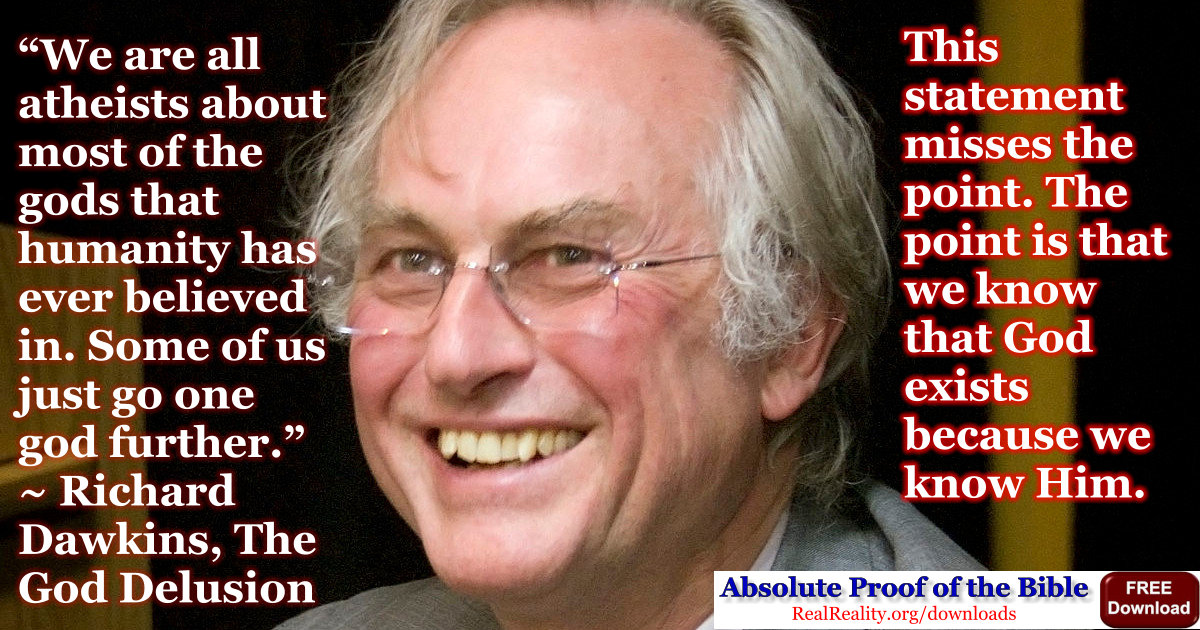
It’s funny how easy it is to become dogmatic. Sometimes, we become dogmatic without even realizing that we’re dogmatic. We just think our opinion is reality and fail to even question it. Consider Vergil who says that he wants to consider the nature of reality without limiting the perspective to any one religion, philosophy or worldview. That sounds very open-minded, doesn’t it? Unfortunately, Vergil’s philosophy of fake open-mindedness quickly degrades into dogmatism. One of the dogmatic ideas that Vergil holds is that the nature of reality is beyond all descriptions. That would be a claim that God can’t describe reality. That would be a dogmatic claim that God can’t reveal anything to anyone.

Virgil is convinced that there is no truth that can be known at any level. Yet, he believes that he can find truth through looking at the various religions and philosophies and choosing what he wants to believe. Virgil is extremely dogmatic about this belief, and he gets upset if anyone should be so bold as to disagree.

Those of us who follow Christ don’t follow dogma. We follow Christ. Christ is real. He’s a real person. He tells us the following:

The one who thinks he knows something does not yet know as he ought to know. ~ 1 Corinthians 8:2

And yet, He tells us that we know the truth if we know Him. He is the truth. He tells us that everyone who’s on the side of truth listens to Him. It would be different if He had gone off somewhere and wasn’t living in the heart (innermost mind) of every follower of Christ. But He is here.

https://www.pinelakemusic.com/resource/gg5531_lyrics.pdf

You ask me how I know He lives. He lives in my heart. He walks with me and talks with me.

Facebooktwitterredditpinterestlinkedintumblrmail

Interpretation

Zooxantelas

How could those animals have lived their entire life and formed these layers in just 4,000 years? There isn’t enough time since Mr. Ham’s Flood for this limestone that we’re standing on to have come into existence. ~ Bill Nye

This was circular reasoning. Circular is rarely obvious as you listen to skilled thinkers use the fallacy.

Hidden by the circular reasoning smokescreen is a presupposition. Bill’s presupposition is that the Flood didn’t happen. Presupposition is a way ofmaking stuff up and making it seem true. The presupposition is also hidden by a framing fallacy and by a loaded question. If the limestone was laid down during the Flood, it was laid down quickly. The assumption that the Genesis Flood didn’t happen is the beginning axiom. Based on this axiom, no limestone could have been laid down during the Flood. That’s circular reasoning.

Bill held up a rock with fossils in it. He then told a story about the fossils. The story was his evidence. Neither the rock nor the fossils in the rock were Bill’s evidence. Using a story as evidence is a weak premise fallacy.

Bill assumed the Flood had not occurred. If the Flood didn’t occur, the deposits couldn’t have occurred during the Flood. That’s circular. Bill limits us to only two options for depositing the fossils. They might have been deposited over the last 4,000 years. They might have been deposited over billions of years. This is a false choice fallacy or exclusivity fallacy. It limits the choices to two when at least one more choice is available. Bill left out the time during the Flood. He didn’t consider the fossils being deposited during the Flood. Then he concludes that they must have been deposited over billions of years. Yet the only explanation that fits the evidence is the choice that was left out. It looks like the deposits were made during the Flood.

Bill’s circular logic goes like this:

  1. The Flood didn’t occur, and billions of years did occur.
  2. Therefore, the Flood couldn’t have laid down the fossils.
  3. Therefore, the fossils were either laid down over billions of years or in the last 4,000 years.
  4. They couldn’t have been laid down in the last 4,000 years.
  5. Therefore, they were laid down over billions of years and the Flood didn’t occur.

Note that none of that was stated. It was implied. When a skilled communicator uses circular reasoning, it’s often difficult to detect.
You’ll recognize additional fallacies. Bill used ad hominem fallacy, genetic fallacy, and appeal to coincidence fallacy. These fallacies make it harder to spot the circular reasoning. The circular reasoning is a smokescreen to hide the axiomatic thinking fallacy. The two axioms are that the Flood didn’t occur and billions of years did occur.

Facebooktwitterredditpinterestlinkedintumblrmail

Confused Words

Confused2

When the same word is used to mean very different things, it causes confusion. The word, “science,” is used for knowledge gained by repeated experimentation and observation by many people, but it’s also used for the unsupported assertions of a group of politically elite scientists.

The word, “evidence,” is used for absolute and certain proof, but it’s also used for interpretations based on unsupported assertions, on made-up stuff.

The word, “faith,” is used for the absolute proof and certainty that comes when God speaks, but it’s also used for a belief based on unsupported assertions. The word, “hope,” is used for the vision God gives concerning what He has promised He will do, but it’s also used for a human-generated wish based on vapor.

The phrase, “I’m a Christian,” is used to mean, “Jesus Christ leads me and teaches me moment by moment and does His Works through me,” but it’s also used to mean, “I know that Jesus Christ exists.”

These are just a few examples, but the list could go on and on. The result is that statements need clarification. Words must be defined.

Facebooktwitterredditpinterestlinkedintumblrmail

Christ: The Only Foundation

FoundationForThinking

When we interpret Scripture, observation, experience, or anything, we must add something to it. Often, we add something from our own worldviews. Since our worldviews seem, to each of us, as if they were reality, we add without knowing we’re adding. God speaks to us through all these things, but we add to His Words. Adding results in distortion. Interpretation involves adding information, but what is the source of that information. Worldviews come out of previous interpretations and aren’t to be trusted. Worldviews are powerful filters that can keep us from seeing all these things as they really are. (2 Co. 3) Don’t hold your theology so tightly that the Holy Spirit is unable to teach you. The Holy Spirit is the only Teacher. Only He can interpret Scripture, observation, experience, or anything else. Christ is the only Foundation. Pray that God leads you as you study Scripture and as you live your life.

Facebooktwitterredditpinterestlinkedintumblrmail

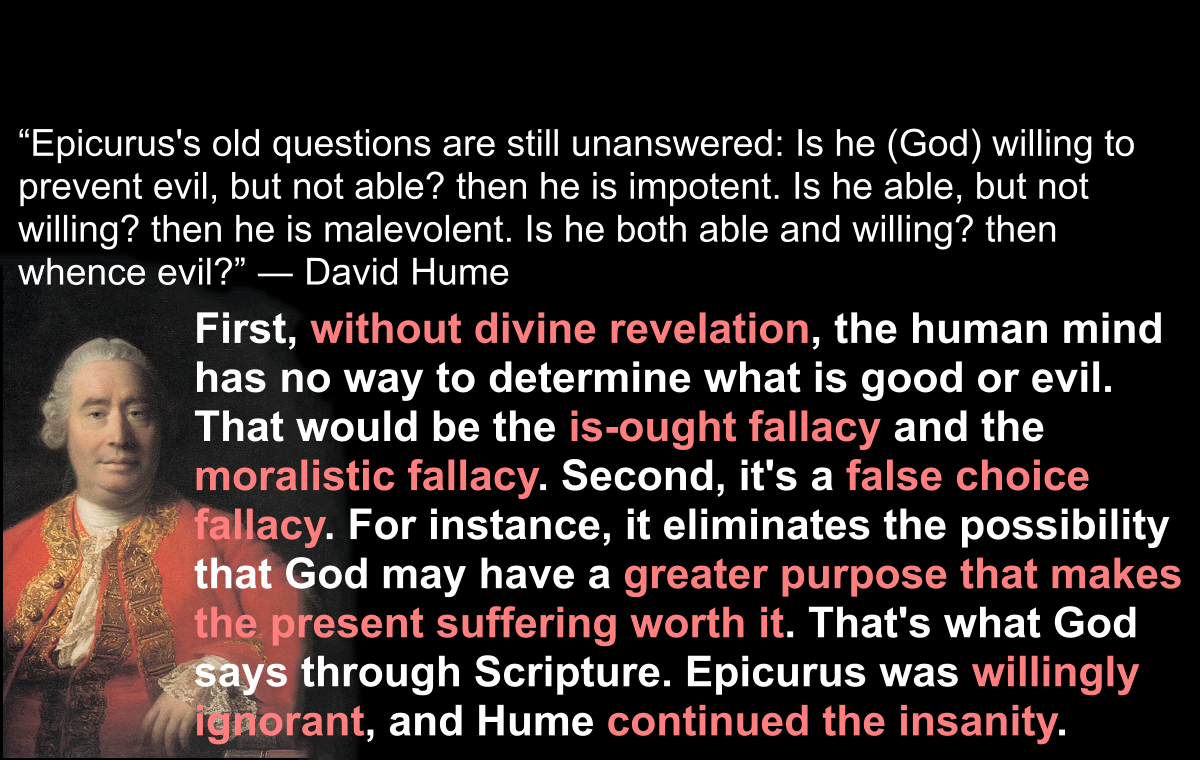
Without Divine Revelation

WithoutRevelation


That’s the simplicity that’s in Christ Jesus. We know Him. He leads us. He teaches us. We don’t need to use loopy logic. We can know what He reveals through Scripture, through Creation, through what we observe. We don’t have to interpret Scripture using assumptions and other kinds of made-up stuff. We can ask the Holy Spirit about it. Whatever the Holy Spirit doesn’t reveal to us, we leave with God.

All other ways of thinking are based on made-up stuff. No Secularist can explain another way to think. No Secularists can explain how he or she can prove any premise true. Without a true premise, sound logic is impossible. Without the ability to have certainty, it’s impossible to be rational

At first, Secularists may deny this. If pressed, they will claim that their made-up stuff is correct and known–even though it’s made up stuff. More likely, they will just deny the harsh reality of the futility of their own thinking. The human mind can’t pull knowledge out of the air. We can observer imperfectly, but additional knowledge is required to interpret observation. This is true of scientific observation, too. Even Scripture, if interpreted by the carnal mind, is useless. We need the Holy Spirit, our Teacher and Friend.

At a certain point, the Secularist will claim that every follower of Christ was only assuming that he or she was following Christ. When asked for the method by which they think they can know this, they will change the subject, engage in name-calling, or do whatever it takes to keep themselves from facing the harsh reality of the futility of their own thinking. You may even be amazed at how irrational they become and how mean. Eventually, they will manifest their slave-master, Satan.

The goal of the dogmatic skeptics or the ardent Secularists is to keep you from dwelling in the Presence of Christ. Often, these can be brothers and sisters in Christ who have somehow become disconnected from the Head, Christ. They don’t believe what God is saying. They refuse to acknowledge Him as He speaks through you. If they can’t convince you with irrational logic, they will try to make you angry. The principalities and powers against which we fight are well aware that fear or anger will take us out of the Presence of Christ. Alternately, they will try to force you to lean on your own understanding and to speculate about all types of things. They’ll ask you question after question to try to get you to speculate, because they know that speculation takes you out of the Presence of Christ and that it gives glory to your own intellect.

There are wonderful promises to the overcomers. God isn’t asking us to overcome the skeptics or Secularists. He’s asking us to overcome our fleshly natures and to have a totally transformed mind. He’s asking us to press into His Glory and to dwell there. The testing of our faith is the very mechanism that brings us into the fullness of the experience. As steel is heated to give it strength, so you and I must go through the heat and be found faithful as part of the process of growing up into the fullness of Christ.


Facebooktwitterredditpinterestlinkedintumblrmail