
2 Peter 2:12a and Jude 1:10 & 19 speak of those who are like brute beast, unable to process rational thought and only able to respond to their five senses because they don’t listen to the Holy Spirit.
<quote>
Without divine revelation, the human mind can’t reason beyond the senses. It can find out what works. It can remember what worked in the past. Based on past experiences, it can even visualize things like physical kinetics or immaterial relationships. It can make guesses about what might work in the future and test to see if a new idea does work. It can develop techniques like Six Sigma, business analysis, risk management, and project management. And it can mentally test various options in the human imagination but with limited accuracy. These are all functions of the brute-beast mind, but what about unexpected events? For instance, what about death? In this godless way, no absolutes exist. God can stop any process, project, or effort.
We find out how accurate our concepts are whenever we can physically test them. Concepts are testable if the concept can be made into a product such as a chair or a method such as a surgical procedure. These are concepts about a material product or method, and we can test the product or try the method. The brute-beast mind has extreme restrictions. When the brute-beast mind wants to “prove” something that it can’t test, it must set up a fake test. By setting up fake tests, it can have strong opinions on subjects about which it has no capacity to know anything.
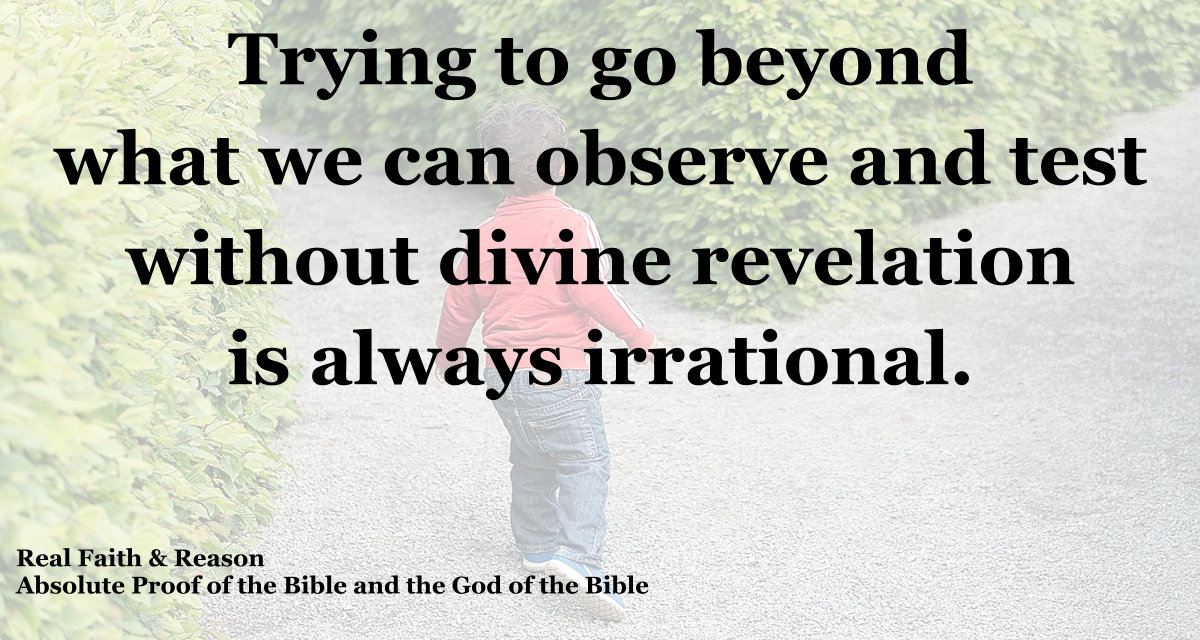
We can find out what works. We don’t know that it’s the best way or the best design possible. We’re talking about pragmatic survival mechanisms rather than truth. Pragmatism is about what works. That’s it. Trying to go beyond what we can observe and test without divine revelation is always irrational.
</end quote>
#RealFaith #RealReason
Have you read this book yet?
Get your free copy of Real Faith & Reason, which shows the intersection of faith, reason, truth, and sanity.
http://RealReality.org/Real_Faith_and_Reason_Vol_1_-_Scientia.pdf


