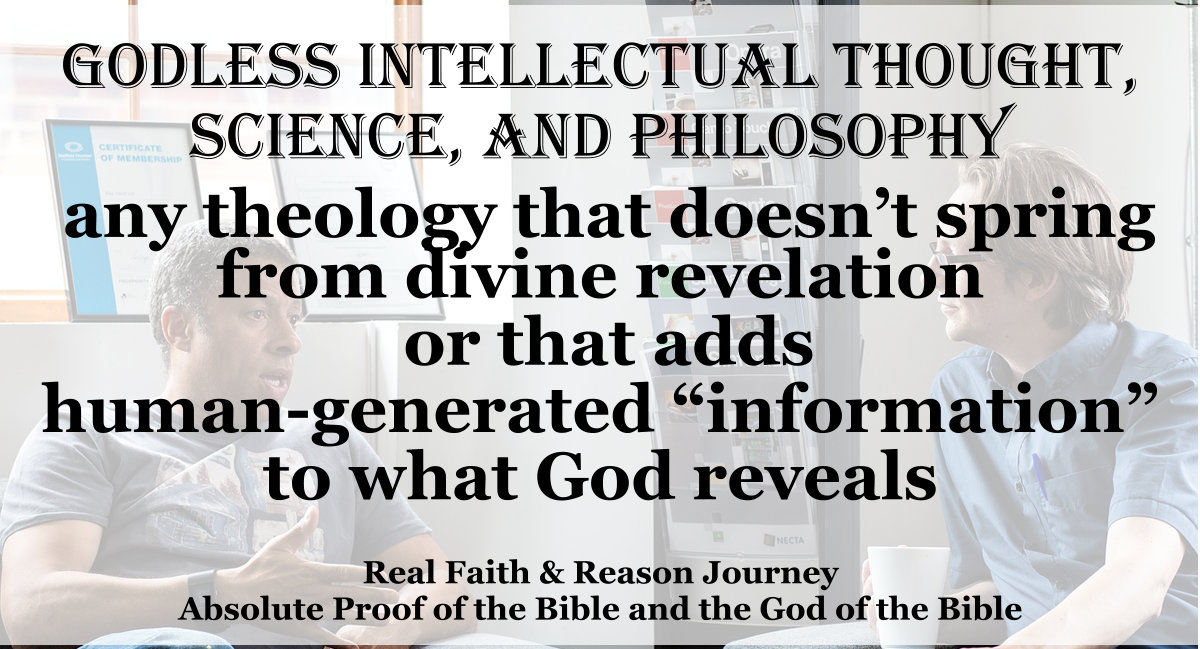
We Don’t Need Presuppositions

<quote>

Consider the following falsehoods that students learn and add to their worldviews:

“All logic begins with presuppositions.”

“The axioms of science are obvious.”

“A theory isn’t a concept but a proved fact.”

All these statements are bare claims. In other words, they have no proof. Still, many educated people believe these statements and can’t believe that anyone would question them. To make matters worse, some people mix revelation with made-up stuff as the following example illustrates:

“All logic begins with presuppositions. For instance, we may presuppose that God can reveal reality to us.”

To sort through this confusion, we must realize that God can reveal reality to us. In fact, He reveals that His revelation isn’t the same as our made-up stuff, so we don’t need presupposition. We don’t need to presuppose that God reveals since God shows us that He’s revealing. God makes it plain to us when He’s revealing a matter to us. In contrast, presupposition, or other made-up stuff, is only necessary if we choose to add to or diminish what God is saying. Contrast the following statement with the previous statement that implied that all logic begins with presuppositions:

“Sound logic never begins with presuppositions since presuppositions consist of made-up stuff. Instead, sound logic begins with a true premise. However, we can’t get a true premise from made-up stuff, so we can’t get a true premise from presuppositions. Since God can reveal reality to us, we don’t need any presuppositions.”

</end quote>

Get your free copy of Real Faith & Reason, which shows the intersection of faith, reason, truth, and sanity.

http://RealReality.org/Real_Faith_and_Reason_Vol_1_-_Scientia.pdf

Facebooktwitterredditpinterestlinkedintumblrmail

Made-up Stuff is Made-up Stuff Whatever We Call It

<quote>

Euphemisms for Made-up Stuff

Here are some words that mean “made-up stuff.”

  • assumption
  • presupposition
  • supposition
  • axiom
  • hypothesis
  • theory

Now, don’t those euphemistic words sound much better than saying “made-up stuff?” They sound better, but all of them mean the same thing as made-up stuff. Making matters worse, many teachers say “presuppositions,” “axioms,” and “theories” are necessary. They say students can use any of these as a rational basis for thinking.

</end quote>

Get your free copy of Real Faith & Reason, which shows the intersection of faith, reason, truth, and sanity.

http://RealReality.org/Real_Faith_and_Reason_Vol_1_-_Scientia.pdf

Facebooktwitterredditpinterestlinkedintumblrmail

Rationalizing

<quote>

Ungodly thinkers rarely consider themselves as basing all thinking on made-up stuff, but instead, they make insane thinking seem sane in a practice known as rationalizing. So ungodly thinkers use different synonyms for “made-up stuff,” and these synonyms sound rational. They sound better than “made-up stuff,” but they aren’t any better.

</end quote>


Get your free copy of Real Faith & Reason, which shows the intersection of faith, reason, truth, and sanity.

http://RealReality.org/Real_Faith_and_Reason_Vol_1_-_Scientia.pdf

Facebooktwitterredditpinterestlinkedintumblrmail

We Have a Choice

<quote>

Here’s the amazing thing. Some people believe that we must base all thinking on axioms. Worse, most schools teach this belief. Our journey will question this belief and provide other choices beyond axiomatic thinking fallacies as the basis for thought. However, ungodly thinkers base their thoughts on axioms, and our journey will fully expose that fact. And even though Christ-followers have another choice beyond ungodly thinking, those who are devoid of the Spirit have no other choice than to make up stuff and call the made-up stuff true. Made-up stuff is how they think. It’s a standard part of their lives. They don’t want to question it.

By the way, we include ourselves among the ungodly thinkers when our thinking lacks the active moving of God’s Spirit. We have a better option, but we drift.

</end quote>

Get your free copy of Real Faith & Reason, which shows the intersection of faith, reason, truth, and sanity.

http://RealReality.org/Real_Faith_and_Reason_Vol_1_-_Scientia.pdf

Facebooktwitterredditpinterestlinkedintumblrmail

Axioms = Made-up Stuff

<quote>

Sandy Sandbuilder: I don’t base my thoughts on made-up stuff. I base my thoughts on axioms. Axioms are obvious facts that don’t require proof. They aren’t made-up stuff.

But axioms are made-up stuff.

On Christ the solid rock I stand. All other ground is sinking sand. ~ Edward Mote

</end quote>

Get your free copy of Real Faith & Reason, which shows the intersection of faith, reason, truth, and sanity.

http://RealReality.org/Real_Faith_and_Reason_Vol_1_-_Scientia.pdf

Facebooktwitterredditpinterestlinkedintumblrmail

Axiomatic Thinking Fallacy

<quote>

An axiom is an assumption. An assumption is a supposition. A supposition is an unproven claim. An unproven claim is made-up stuff. All of these are different forms of what’s known as the axiomatic thinking fallacy. Making up stuff and calling the made-up stuff “truth” is the axiomatic thinking fallacy, yet the word “axiom” almost sounds real. It deceives us since it sounds real, but axioms aren’t real. Rather, axioms are concepts that people make up and call true when they don’t know that the axioms are true or real.

</end quote>

Get your free copy of Real Faith & Reason, which shows the intersection of faith, reason, truth, and sanity.

http://RealReality.org/Real_Faith_and_Reason_Vol_1_-_Scientia.pdf

Facebooktwitterredditpinterestlinkedintumblrmail

Results of Losing the Distinction

<quote>

As people lose the distinction between good and evil and between truth and error, we begin to see bizarre behavior. Marriages break up or become distorted since they no longer follow the pattern of Scripture. Churches aren’t following the Scriptural pattern either and are unable to bring back order and sanity. Society is in disarray, and that confusion causes pain and fear.

And yet, some do follow Christ, and the light of Christ shines out from them. Then those who hate the light turn against those who are walking in the way of the cross. We see disruptions such as mass murder, riots, wide-spread hatred, or terrorism. The politicians start pointing fingers, but the solutions they propose make things worse since the politicians have lost the distinction between good and evil. They don’t have the Truth and don’t want the Truth.

</end quote>

Get your free copy of Real Faith & Reason, which shows the intersection of faith, reason, truth, and sanity.

http://RealReality.org/Real_Faith_and_Reason_Vol_1_-_Scientia.pdf

Facebooktwitterredditpinterestlinkedintumblrmail

Sanity Test

<quote>

We’ve already looked into the problem of judging between reality and made-up stuff, but we haven’t defined the fundamental difference. Reality is what exists. It’s what’s real. A concept is a story about what exists, and this story also contains made-up stuff or at least parts that we can’t prove to be real. And so we return to the question of sanity.

Here’s a one-question sanity test:

Is it sane to make up stuff and insist that the made-up stuff is true?

</end quote>

Get your free copy of Real Faith & Reason, which shows the intersection of faith, reason, truth, and sanity.

http://RealReality.org/Real_Faith_and_Reason_Vol_1_-_Scientia.pdf

Facebooktwitterredditpinterestlinkedintumblrmail

Flesh Hates Truth

<quote>
The fleshly part of our beings resists certain elements of the truth because truth destroys the strongholds in our minds. God further defines this resistance to truth as “loving a lie,” “loving darkness,” and “hating light.” On the other hand, Christ in us desires truth, which is why we seek God’s face and seek the Holy Spirit’s leading, teaching, and correcting. However, even as we seek Him, we have strongholds in our minds that we protect from the light of the Holy Spirit. And sometimes, rather than seeking truth to demolish those strongholds, we avoid exposing ourselves to the truth. Instead, we seek to assure ourselves that our current beliefs are true.
</end quote>
Get your free copy of Real Faith & Reason, which shows the intersection of faith, reason, truth, and sanity.
http://RealReality.org/Real_Faith_and_Reason_Vol_1_-_Scientia.pdf
 
Notice the human will in the middle of the graphic with the Light on the right but the darkness on the left. We each have a will. We can will to do God’s will. We can desire truth and righteousness. Or we can drift. If we drift, we drift into the darkness because of the pull of the fleshly nature.
Facebooktwitterredditpinterestlinkedintumblrmail

Sane or Insane?

<quote>

We’re taking this excursion to guide us toward sane thinking, so, as we focus on that goal, we’re not trying to ridicule insane thinking. However, we’ll use the words “sane” and “insane” so that we don’t forget that this problem is serious. Though some people use these words as personal attacks or ad hominem fallacies, we don’t use these words as attacks. Rather, we use these words for clarity to describe several common human conditions. As we use these words, the word “insanity” refers to failing to tell the difference between reality and make-believe, which is a real and universal human problem. We’ll use the word “sanity” to refer to perceiving the difference between reality and make-believe.

In our journey, we could have used euphemisms that make poor thinking seem more acceptable. For instance, we could have chosen words like “logical” versus “illogical” or “sound reasoning” versus “unsound reasoning.” And while those words mean the same thing and make us feel better than “sane” or “insane,” we don’t want to lull ourselves to sleep by pretending that unsound reasoning is sane. We surely don’t want to make insanity feel better than it is since living in insanity is living in an illusion, and we receive no benefit from living in an illusion. And yet, we do live in an illusion in some areas of our lives. God exposes this illusion when we find out we’ve been wrong about some strongly-held belief. Even people who spend their entire lives living mostly in illusion are aware of this problem, though they don’t always apply this knowledge to themselves. It’s easier to see the insanity in others than in ourselves.

“People don’t want to hear the truth because they don’t want their illusions destroyed.” (Friedrich Nietzsche)

Interestingly, Friedrich Nietzsche so resisted the truth that he refused to acknowledge God and famously declared “God is dead.” However, Nietzsche didn’t include himself among the people who don’t want to hear the truth even though he had no rational method to say that anything was true. He had no basis for declaring, “God is dead” or anything else for that matter. He wasn’t only claiming that God is dead, but he was claiming that truth is dead, reality is dead, logic is dead, knowledge is dead, and sanity is dead. While that may seem like an overstatement, we’re just starting to explore reason, and we’ll explore whether we’ve overstated this problem.

The human nature in each of us tends to correct others without ever correcting ourselves. And so we each must diligently seek the mind of the Holy Spirit for constant, incremental leading, teaching, correcting, and purifying in every area of life. We allow Him to examine our strongholds, theologies, and worldviews. Allowing Him to correct us is the only way that we’ll develop discernment of the difference between reality and made-up stuff.

</end quote>

Get your free copy of Real Faith & Reason, which shows the intersection of faith, reason, truth, and sanity.

http://RealReality.org/Real_Faith_and_Reason_Vol_1_-_Scientia.pdf

Facebooktwitterredditpinterestlinkedintumblrmail